Super Clone Watches vs. Originals: Can You Spot the Difference?
Verified Reddit Watch Specialist (RepTime / RepGuild)
When you compare super clone watches vs originals, you may spot differences in a good inspection, but the answer depends on what you can examine. From wrist distance, a carefully made replica can reproduce the broad shape, color, dial layout, and bracelet style of a genuine watch. Under magnification, during function testing, and especially after opening the case, more differences often become available.
That still does not mean one visual cue can authenticate a watch. Genuine watches can be worn, polished, repaired, or fitted with replacement parts. Replica quality also varies from sample to sample. The safest method is a layered inspection that starts with the reference, moves through the exact watch in front of you, and ends with brand or qualified independent verification when real money or authenticity is at stake.
You are not trying to win a guessing game from one photo. You are building enough connected evidence to know what the watch is, how it behaves, and which claims remain unproven.
The short answer
At a glance, you may not be able to tell. In a side-by-side inspection, you can compare proportion, printing, finishing, bracelet construction, function behavior, and movement architecture. Those checks can reveal inconsistencies, but none is a universal shortcut.
For an original, the strongest evidence comes from the brand, an authorized retailer or service center, reliable ownership records, and inspection of the complete watch. Rolex states in its authentication guidance that official jewelers have the training, equipment, and access needed to guarantee authenticity. Its Certified Pre-Owned process returns watches to Rolex workshops for configuration checks, service, testing, and official certification. That is a different standard from comparing a logo or serial engraving online.
For a replica, judge only what the exact sample evidence supports. A seller's catalog photo, factory label, or phrase such as 1:1 does not identify the unit you will receive or establish its movement, metal, pressure resistance, or durability.
Start with the exact reference, not the brand name
The comparison fails when details from different generations are mixed. A Submariner, Nautilus, or Santos has changed over time. Dial text, bracelet taper, clasp, hand length, case geometry, movement, and serial placement can vary by reference and production period.
Record the model, reference, approximate year, case and bracelet configuration, dial, bezel, functions, and claimed movement. Use an official product page, manual, archive, or service document where available. The Rolex Submariner Date page, for example, is useful for the visible layout of that genuine reference. It does not prove that a watch offered elsewhere shares the same dimensions, material, caliber, or test results.
Patek Philippe explains that its Certificate of Origin records movement and case numbers and is valid under defined retailer conditions. Its service process checks watches against historical archives and examines movement and external parts. That shows why a full authentication question is larger than matching the face of a watch.
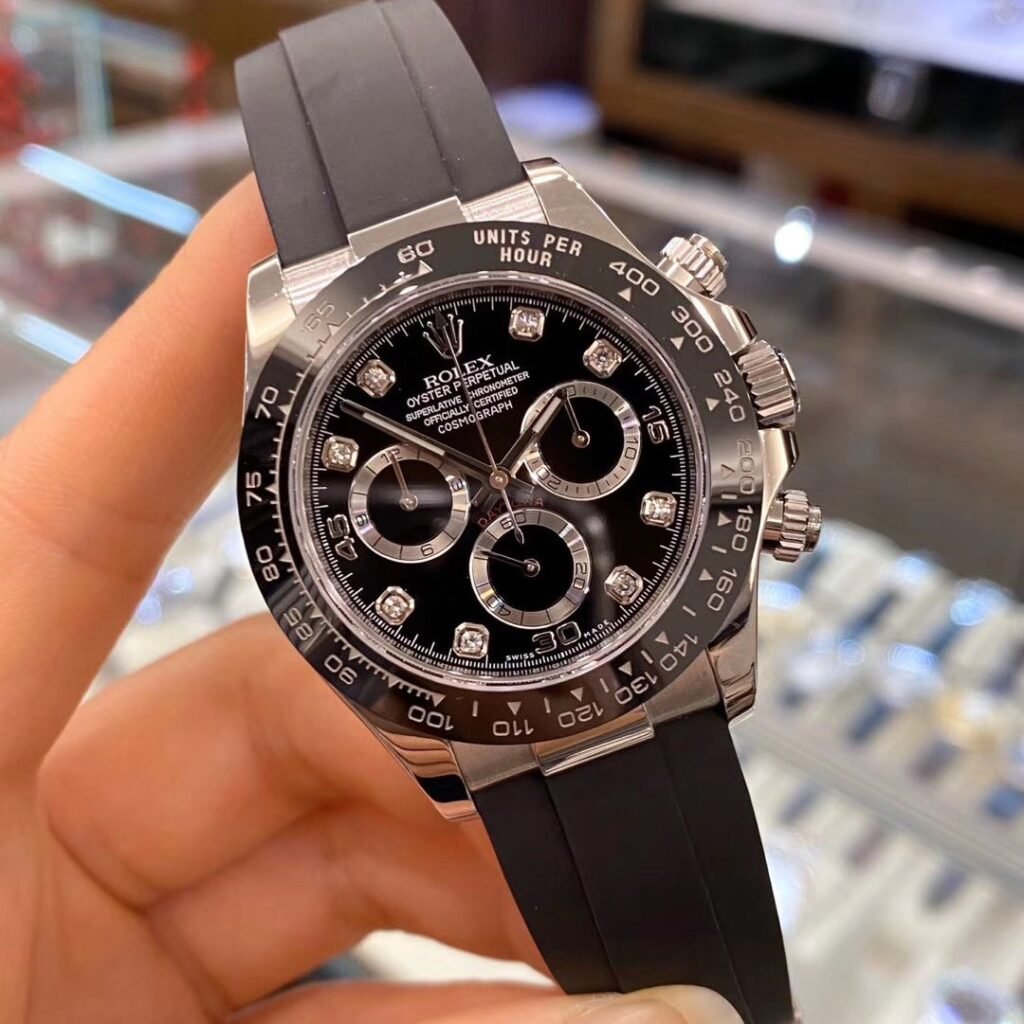
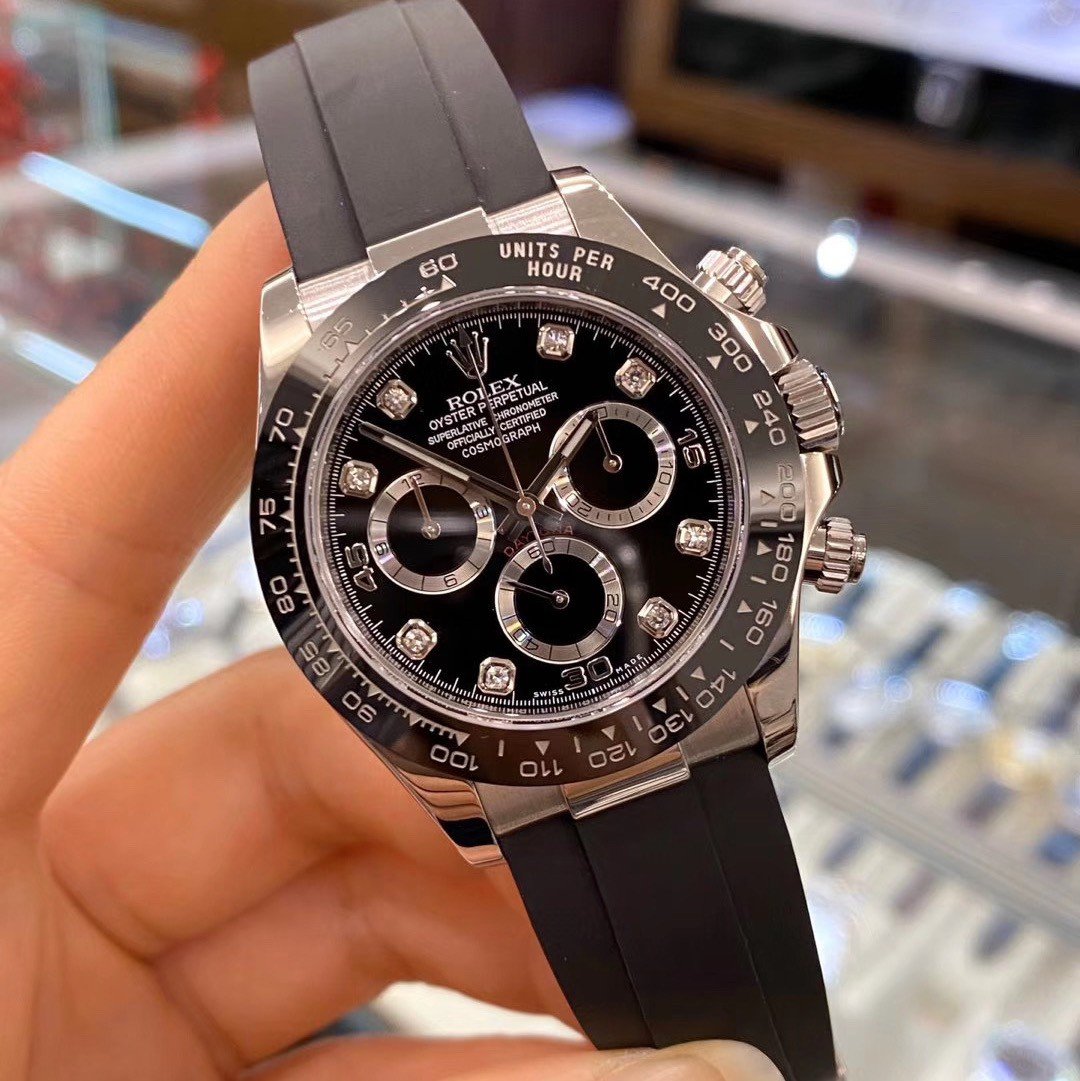
The supplied close-up image above is useful for discussing visible dial, bezel, pusher, case, and strap details. It is not an authentication result, and it does not prove original materials, movement identity, certification, pressure resistance, or ownership history.
Use a seven-zone visual inspection
| Inspection zone | What you can compare | Differences that may deserve a closer look | What you still need |
|---|---|---|---|
| Overall geometry | Diameter, thickness, lug shape, bezel, crown and pusher position | Case looks too thick, lugs curve differently, controls sit too high or low | Measured sample dimensions and correct reference data |
| Dial and printing | Logo, minute track, text spacing, marker position, date window | Uneven type, fuzzy edges, inconsistent spacing, crooked marker or date | Neutral-light macro photos and multiple date positions |
| Hands and alignment | Hand length, shape, center stack, zero positions | Hands miss tracks, overlap incorrectly, or fail to reset | Continuous setting and complication video |
| Bezel and crystal | Numeral style, insert color, magnifier, rehaut, reflections | Poor centering, rough action, distorted date, unexpected profile | Side views, full bezel rotation, material evidence if claimed |
| Case finishing | Brushed and polished transitions, edges, engraving | Soft edges, wavy polishing, shallow or uneven engraving | Macro video under moving light and independent inspection |
| Bracelet and clasp | Link shape, taper, screws, end links, clasp layout | Gaps, sharp edges, loose fit, wrong articulation or hardware | Wrist video, measured first-link spread, clasp demonstration |
| Caseback and movement | Architecture, bridge layout, rotor, regulator, decoration | Architecture conflicts with the claimed caliber or function | Safe case opening by a willing qualified watchmaker |
1. Check proportion before tiny details
Broad geometry controls how convincing a watch looks on the wrist. Compare the case outline, lug curvature, bezel width, dial opening, crown guards, pushers, and first bracelet links. A replica can have sharp dial printing but still wear differently because the case is taller or the first links spread farther.
Ask for actual measurements. Diameter alone is not enough. Include thickness, lug-to-lug span, fixed first-link spread, bracelet range, clasp length, and weight. Compare them with the correct reference and with a watch that already fits you. Do not accept measurements copied from the original-brand page as measurements of the sample.
2. Inspect the dial as a system
Look at relationships rather than hunting one magic flaw. Check the distance from logo to hands, marker-to-minute-track alignment, subdial position, date-frame centering, text baselines, and the space around every printed element. Then tilt the watch so you can see marker height, applied logos, surface texture, and contamination under the crystal.
Phone processing can sharpen text and hide dust. Request uncompressed close-ups under neutral light and a slow video with reflections moving across the dial. Protective film should be removed from the areas you are expected to approve. A low-resolution seller image can support version selection, but it cannot clear the exact watch.
3. Make the functions do the talking
A still image says little about how the watch works. Wind it, set the time in both directions where appropriate, cycle the date, and operate every promised complication. For a GMT, observe which hand adjusts and how the date responds. For a chronograph, run it long enough to advance the minute counter, then stop and reset it. For a diving bezel, check direction, alignment, grip, and a full rotation.
The movement does not have to copy the original mechanism to display a similar dial. Setting behavior, hand stack, register use, date-change timing, and reset action can expose a different architecture. Treat that as a documented difference, not an automatic judgment about whether the watch will suit your use.
4. Compare finishing under moving light
Brushing and polishing are easiest to judge when light moves across the surface. Look for straight grain, consistent direction, clean borders, crisp bevels, even screw recesses, and a case-to-bracelet transition that makes sense. Over-polished genuine watches can also lose edge definition, so soft lines alone do not prove a replica.
Bracelets deserve separate attention. Check end-link gaps, link articulation, screw or pin finishing, side surfaces, clasp engraving, closure pressure, and sharp edges. A close-looking case can be let down by a bracelet that rattles, binds, or wears too wide.
5. Treat engravings and numbers as clues, not certificates
A serial number can be copied, repeated, misplaced, or attached to a configuration that never existed. A convincing font does not show who made the movement or whether the watch appears in brand records. Compare engraving position, depth, alignment, and surrounding finish, but avoid posting a complete serial number publicly.
Paperwork also needs context. Names, stamps, cards, boxes, and QR codes can be imitated or separated from the watch they once accompanied. Match every document to the watch and seller history. Patek Philippe's service-center network and commitment to service illustrate the value of trained, authorized examination rather than visual paperwork checks alone.
6. Open the case only with the right help
Movement inspection can reveal architecture, automatic works, balance layout, regulator, bridge shape, rotor, decoration, and identifiers that exterior photographs cannot show. It can also damage gaskets, scratch the case, contaminate the movement, or compromise a future pressure result.
Ask a qualified watchmaker who is willing to inspect the watch. Tell them what the seller claims without presenting that claim as fact. A decorated movement can resemble a branded caliber while using a different base architecture. A genuine movement can also contain service parts. The conclusion should cover the complete watch instead of resting on one familiar-looking component.
Brand service systems show why component-level review matters. The Patek Philippe Seal applies across the complete genuine watch, and Patek says only trained and certified watchmakers perform service to its standards. Cartier describes a complete watch service that uses authentic components. Audemars Piguet's published service terms distinguish work carried out by authorized service centers. A replica cannot inherit those systems by copying visible decoration.
Timing and pressure results answer narrow questions
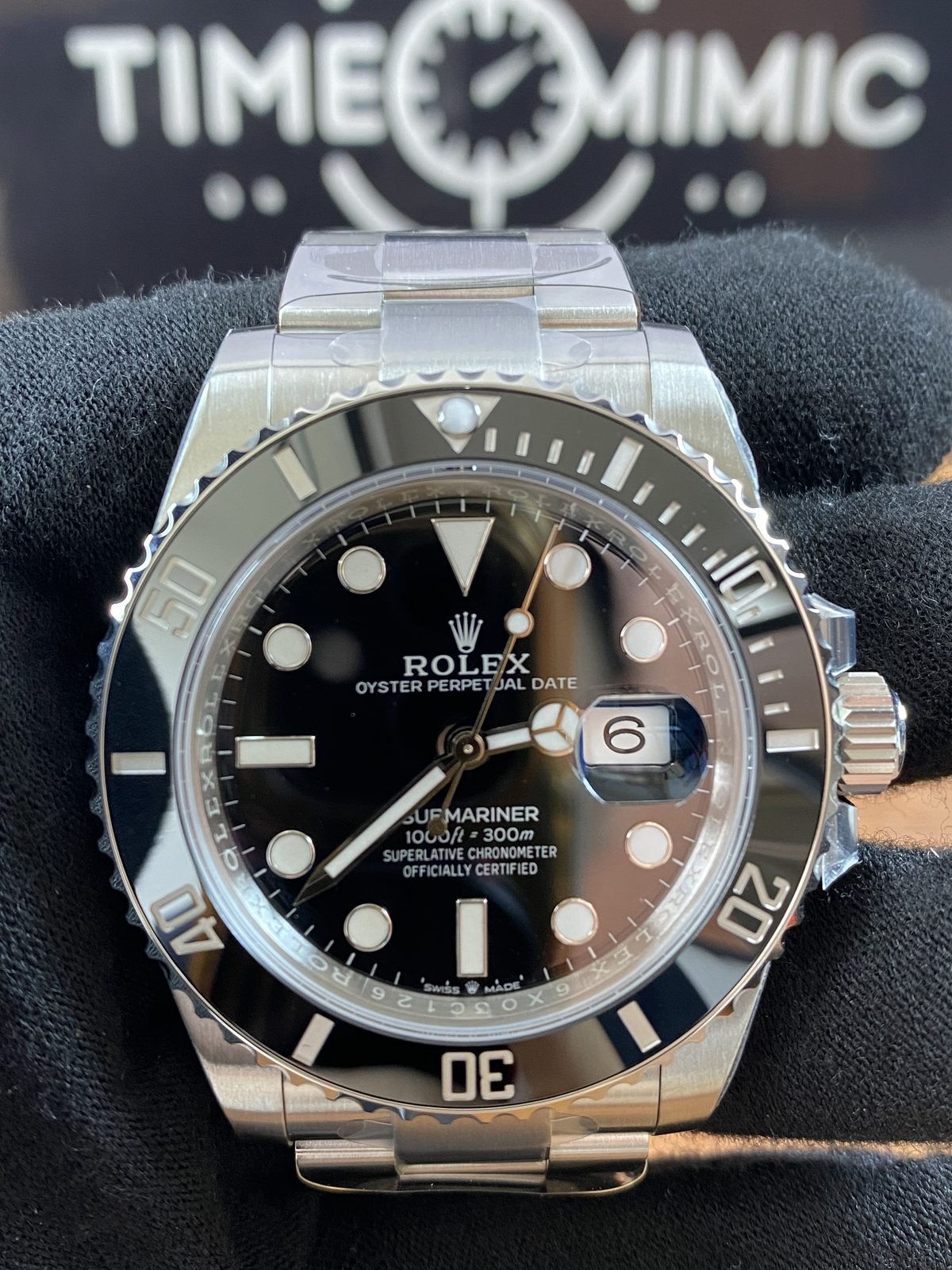
The QC image below is one photographed front view. You can inspect visible marker, bezel, hand, date, and surface relationships. You cannot use it to prove the movement, alloy, pressure resistance, authenticity, or future reliability.
A timegrapher reading can show rate, amplitude, and beat error for one position, state of wind, lift angle, and measurement period. It cannot authenticate the movement or predict all-position wrist performance. Ask for one continuous video that includes the watch and test screen.
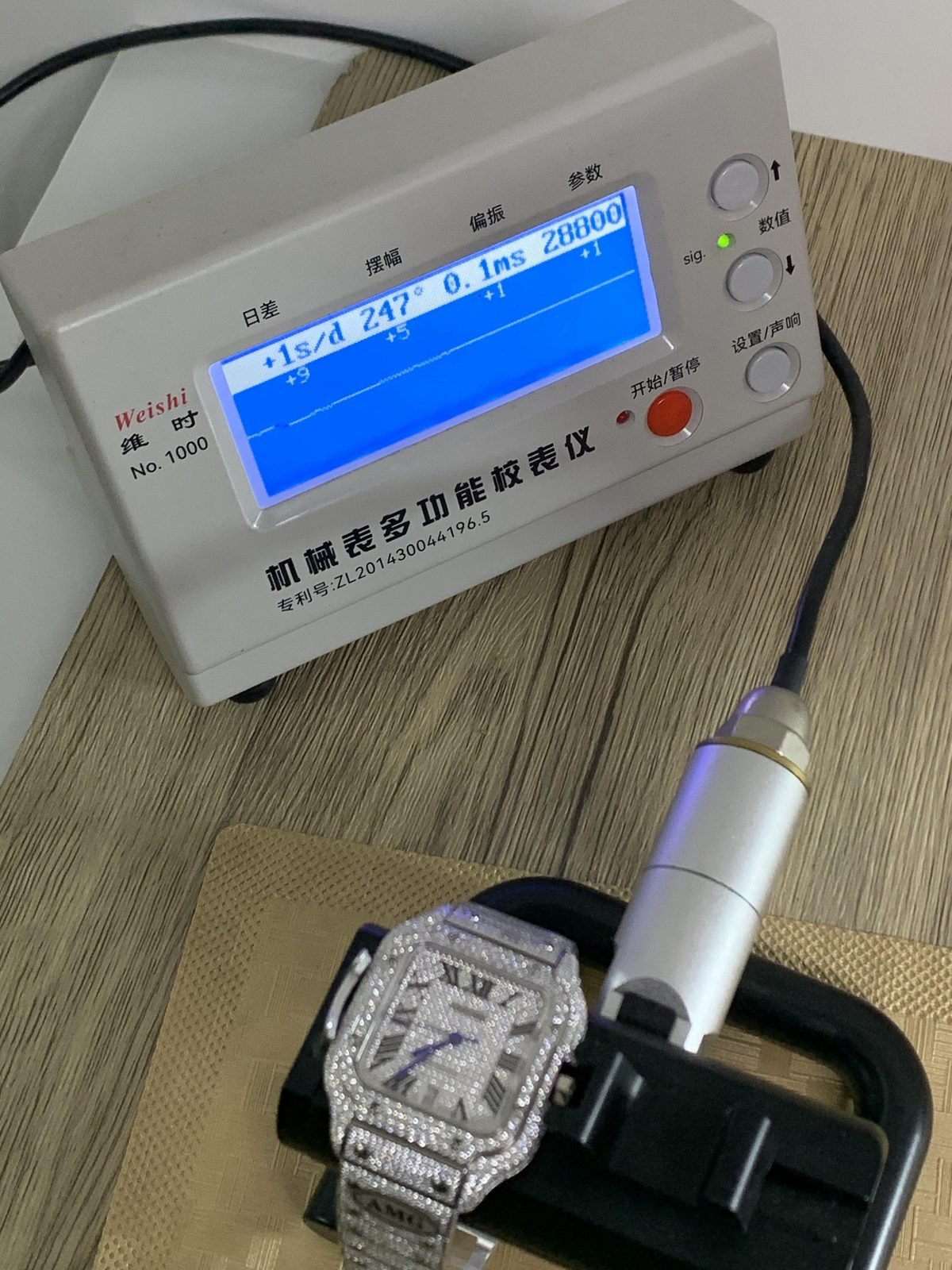
The timegrapher image below is one visible example from one photographed sample. It records one setup, not a certificate.
Water resistance needs its own documented test. ISO 22810 defines requirements and test methods for water-resistant watches, while the broader ISO watch standards catalog shows that timing, cases, crystals, coatings, and water resistance are not one combined claim. METAS Master Chronometer certification covers defined areas through an independent process described in METAS N001. A similar dial does not transfer certification to another watch.
Build an evidence chain
| Evidence level | What it adds | Important limit |
|---|---|---|
| Reference page or manual | Correct genuine configuration and operating context | Does not describe the offered replica or altered pre-owned watch |
| Current sample photos | Visible version, alignment, finish, and condition | Only the shown angles and image quality |
| Continuous function video | Connection between the sample and demonstrated behavior | Does not prove hidden components or long-term reliability |
| Measurements and test records | Fit data and narrow timing or pressure results | Valid only for the stated sample, method, and time |
| Independent physical inspection | Exterior, movement, condition, and consistency review | Quality depends on examiner access and expertise |
| Brand or authorized certification | Brand-level authentication and defined service or guarantee | Available only through the relevant official program and conditions |
For a high-value original, use a seller and process that define authentication, return rights, and responsibility if the watch fails review. Chrono24 Certified is one marketplace program with stated inspection terms; it is not the same as brand certification. Read the scope, exclusions, and remedy instead of relying on the word certified.
The FTC's marketplace guidance recommends checking the seller, actual-item photos, return terms, and safer payment options. Keep the listing, messages, invoice, payment record, inspection report, and serial documentation. If a seller blocks independent inspection or rushes payment outside the platform, stop.
Do not confuse spotting with legal permission
Whether you can see a difference does not determine whether a transaction or import is lawful. WIPO explains that trademark counterfeiting involves unauthorized use of a sign identical or essentially indistinguishable from a registered mark, and its IP enforcement overview describes border, civil, administrative, and criminal measures. Its guidance on enforcement and disputes also notes that customs authorities can stop infringing goods at borders.
Rules depend on country, route, quantity, and conduct. U.S. Customs and Border Protection publishes a narrow traveler personal-use exemption with specific conditions. Do not generalize it to postal shipments, resale, or another country. The OECD 2025 report documents the large role of small parcels in counterfeit watch seizures. Check current official rules for your location before buying or traveling, and never present a replica as genuine.
A 15-minute comparison routine
- Confirm the exact reference and configuration before looking for flaws.
- Compare overall case, bezel, dial opening, controls, and bracelet geometry.
- Check dial printing, markers, hands, date, subdials, and alignment under neutral light.
- Tilt the watch to inspect brushing, polishing, edges, crystal profile, and contamination.
- Operate winding, setting, date, bezel, GMT, chronograph, and clasp functions as applicable.
- Measure thickness, lug-to-lug span, first-link spread, bracelet range, and weight.
- Review engraving and paperwork without treating either as final proof.
- Request sample-linked timing and pressure evidence only for the claims you need.
- Arrange independent movement and condition inspection when value justifies it.
- Use brand or authorized authentication when you need a decision that protects an original purchase.
Final answer
Can you spot the difference between super clone watches and originals? Sometimes you can, especially with the correct reference, side-by-side measurements, moving light, full function testing, and movement inspection. From one polished photograph or ordinary wrist distance, the answer may be no.
Your goal should be stronger than a visual guess. Connect the reference, exact-sample photos, function video, measurements, narrow test results, seller records, independent inspection, and official authentication where appropriate. That process gives you a defensible answer and keeps appearance separate from identity, certification, condition, and long-term ownership.
Looking for a Top-Tier Clone or Custom Build?
Direct access to VS, ZF, 3KF, Clean & BTF factory stock. We provide detailed multi-angle QC photo & video approval prior to final payment.