Super Clone Watches: A Deep Dive Into the World of Replica Excellence
Verified Reddit Watch Specialist (RepTime / RepGuild)
You can judge a watch by how it looks in one photo, but that tells you very little about how well it was made. A convincing dial may sit inside a poorly fitted case. A movement may produce one acceptable timing result while the crown feels rough, the date changes late, or the bracelet develops play. If you want to understand super clone watches, examine the whole watch as a connected system.
Replica excellence is not a claim that a watch equals the original. It is the degree to which one specific sample brings design, assembly, function, testing, and seller evidence together in a consistent and verifiable way.
This distinction protects you from two common mistakes. The first is paying for a label such as "1:1," "Swiss," or "best factory" without evidence. The second is rejecting every useful detail because no replica can carry the original maker's provenance. You can still assess finish, function, fit, and QC. You simply need to keep each conclusion inside the limits of the proof you have.
Why genuine watchmaking sets a demanding benchmark
Major watchmakers describe quality as a system rather than a single attractive component. Rolex discusses precision, waterproofness, self-winding, autonomy, resistance to magnetism, and reliability as connected areas of performance. Its service process also includes component inspection, refinishing, reassembly, regulation, and waterproofness testing. Patek Philippe says its Seal applies to the complete watch and to service over the product's lifetime. METAS certification evaluates a finished watch for performance, magnetic resistance, power reserve, and water resistance.
That background matters when you evaluate replica watches. A polished case or clear logo cannot prove the performance of the finished watch. Real quality control asks whether the parts work together, whether results are repeatable, and whether a repair path exists after the sale.
The word "excellence" should therefore describe evidence, not reputation. For a luxury replica watch, the useful question is: what can you verify about this individual piece before money changes hands?
The eight layers of replica excellence
The table below separates visible quality from assumptions. Use it as a map when you compare listings, request QC, or inspect a delivered watch.
| Excellence layer | What it controls | Evidence for one sample | Claim it cannot support |
|---|---|---|---|
| Reference definition | Case shape, dial layout, hand set, bezel, bracelet, color, and function set | A named reference, straight-on images, dimensions, and side views | That every small detail is identical to an authentic watch |
| Materials and surfaces | Brushing, polishing, coating appearance, edges, transitions, crystal, and external wear points | Macro photos under neutral light and clear material disclosure | Exact alloy, coating thickness, hardness, or long-term wear without testing |
| Dial and hand assembly | Printing, marker position, date centering, hand clearance, and visible cleanliness | High-resolution dial images at several hand positions | Hidden cleanliness, lume chemistry, or future stability |
| Functional architecture | Crown actions, winding, setting, date, chronograph, GMT, power reserve, and other complications | An uncut function video showing each control | Movement origin, service history, or long-term reliability |
| Finished-watch testing | Rate snapshot, power reserve check, pressure test, and function test after casing | Dated results tied to the same sample | Permanent accuracy or a universal waterproof guarantee |
| Repeatability | Whether multiple units are assembled and checked to a similar level | Sample-specific QC, stable process records, and consistent seller responses | That one good unit proves the quality of a full production run |
| Service pathway | Repairability, parts access, return rules, and responsibility for defects | Written warranty and return terms plus a realistic repair contact | That the original brand will service a replica |
| Evidence honesty | How clearly the seller separates what is seen, tested, stated, and unknown | Original files, timestamps, test conditions, and limits stated in writing | Authenticity, authorized status, factory identity, or provenance |
These layers are connected. A high quality replica watch may look clean yet fail the functional layer. An automatic replica watch may run well but have rough case finishing. A seller may provide attractive QC photos while avoiding returns or repairs. The strongest evaluation covers all eight layers instead of letting one impressive feature carry the whole decision.
Layer 1: Start with the exact reference
You cannot compare details until you know which design is being reproduced. Ask for the model family, reference number, color, bracelet or strap, case diameter, thickness, lug width, and intended functions. Then compare those points with the maker's official product pages or manuals.
Design accuracy is more than logo placement. Cartier describes proportion and recognizable design codes as part of its watchmaking identity. Audemars Piguet explains how polished and satin-brushed surfaces are combined. Panerai's manufacture material covers design, prototyping, materials, movements, decoration, and testing. These sources show why a reference must be viewed as a complete arrangement of shapes, surfaces, and functions.
For you, this means that a listing titled only "Rolex-style" or "luxury automatic" is too vague for a serious comparison. A close visual match to the wrong generation, dial, or bracelet is still the wrong reference.
Layer 2: Read the surface transitions
The best visual clues often sit at the boundary between finishes. Look where a brushed lug meets a polished case flank, where the bezel meets the mid-case, and where bracelet links change direction. A clean transition should look intentional from several angles. Soft edges, wavy reflections, excess polishing, or inconsistent brushing can change the character of the watch even when the overall silhouette is close.
Do not turn appearance into a material claim. A photo can show color and reflection. It cannot confirm that a case uses a particular steel grade, that a crystal is sapphire, or that a coating has a stated thickness. ISO 18684 covers hard external parts and resistance to shock, corrosion, scratching, sunlight, and wear, which illustrates how much laboratory work sits behind material-performance statements.
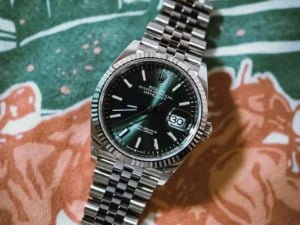
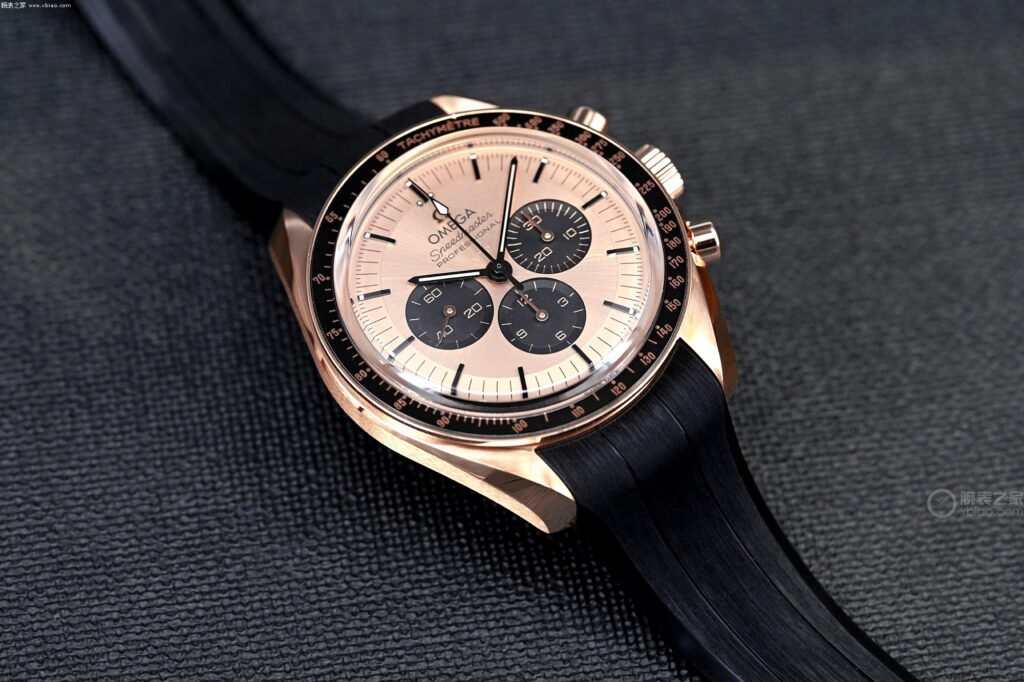
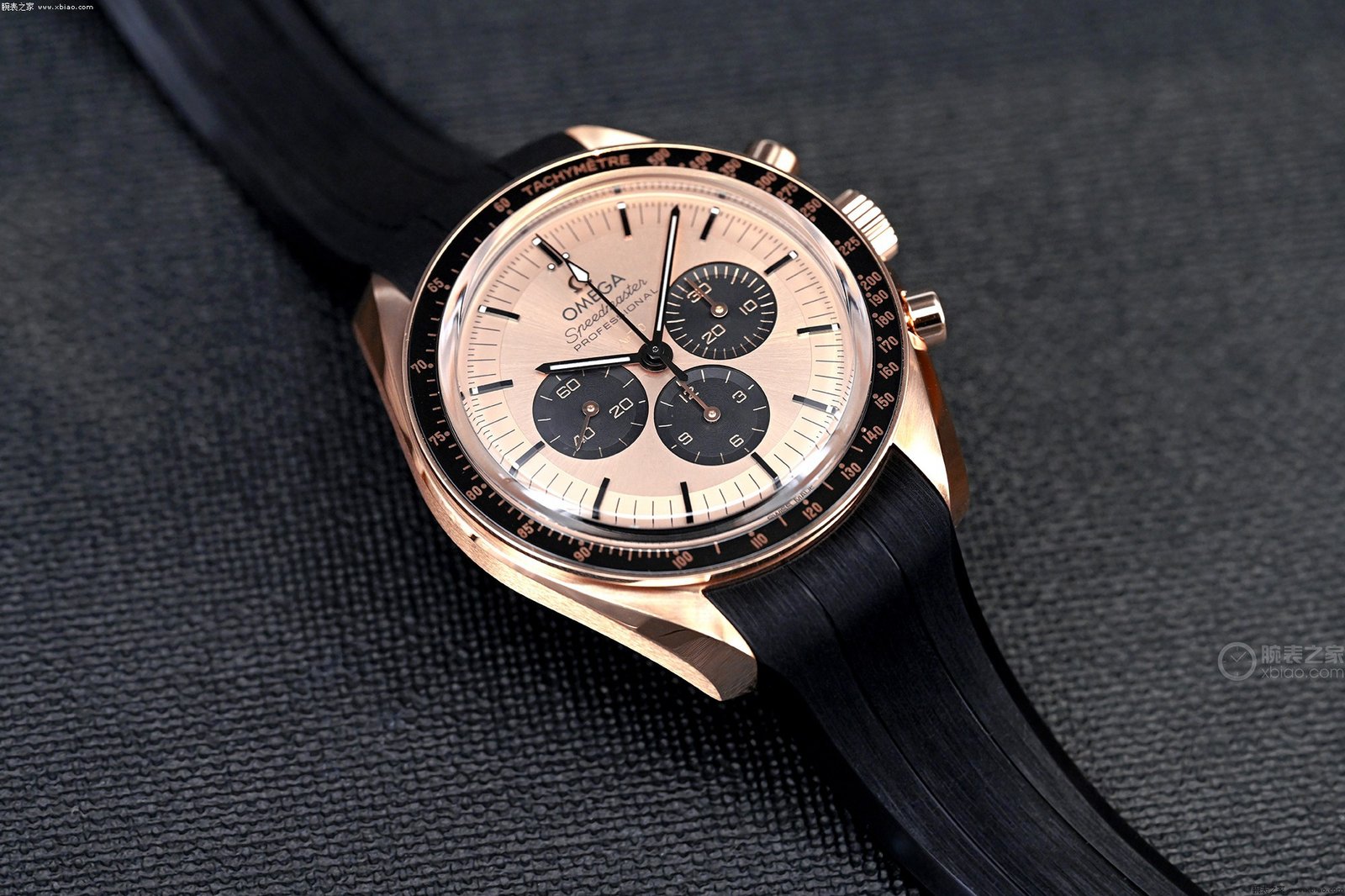
The supplied hero image is useful as a design reference for this inspection method. It lets you study bezel scale, subdial spacing, hand length, case curvature, and the way polished and brushed areas meet. It is not QC for a current order and does not verify authenticity, materials, movement, water resistance, durability, or factory source.
Layer 3: Inspect the dial as an assembly
A dial should be assessed as a set of relationships. Check whether the logo sits level, minute markers meet the chapter ring consistently, applied markers point toward the center, and the date sits within its window. Look for dust, fibers, scratches, or adhesive around markers. Compare the hour and minute hands at 12:00, then check whether the hands pass without touching each other or the crystal.
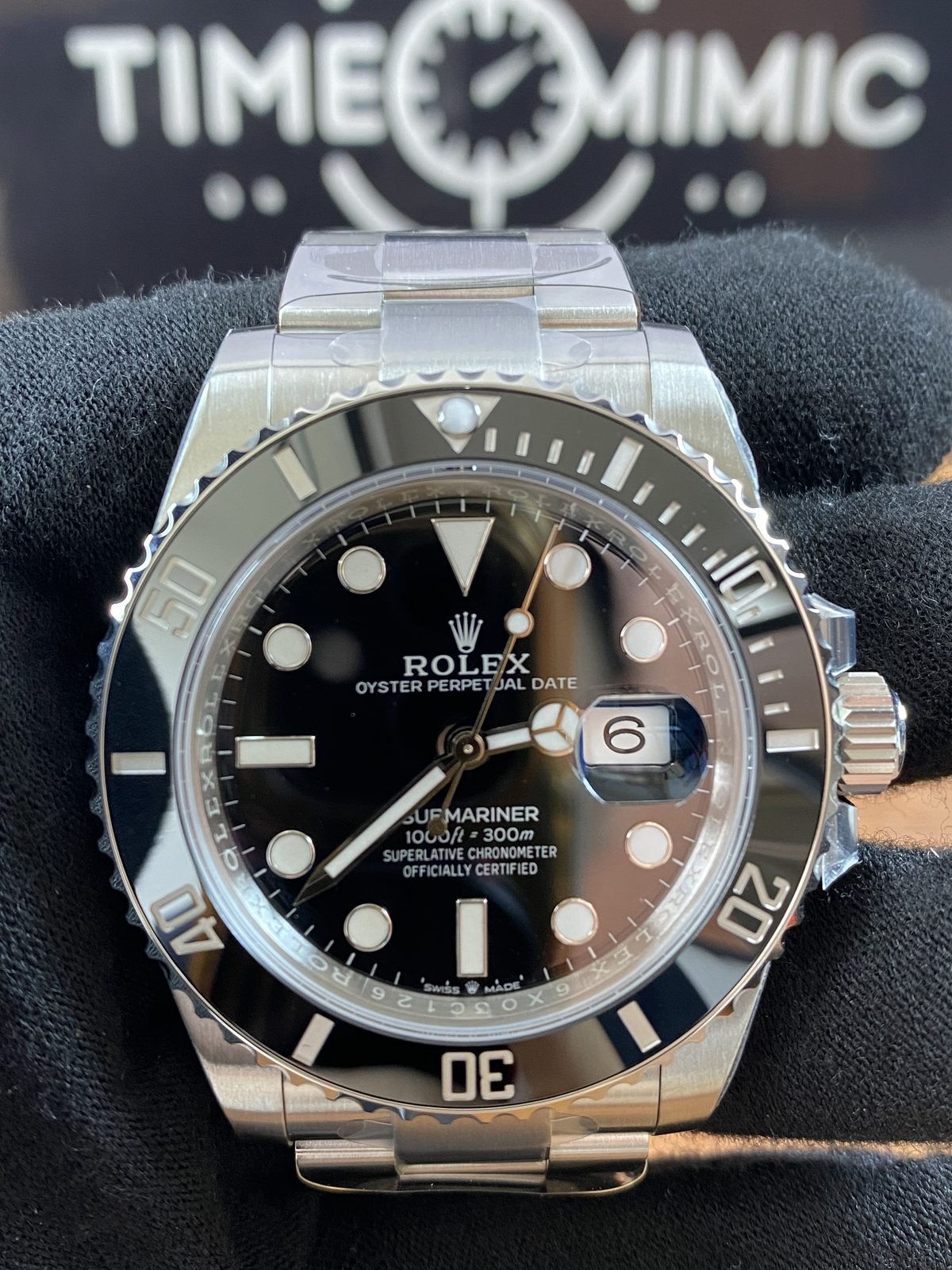
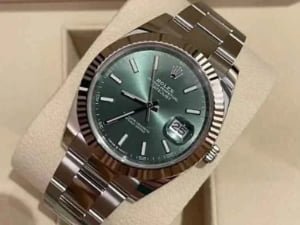
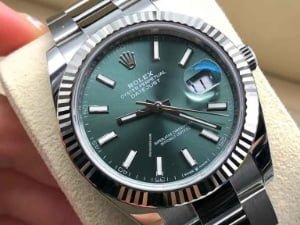
A front-view QC image below shows the type of sample-specific evidence you can use. Judge what is visible: alignment, exterior condition, print position, hand placement, and date centering. Avoid conclusions about parts hidden by the case.
QC should include more than one dial angle. Reflections can hide dust and misalignment, while a tilted camera can create false perspective. Ask for a straight view, both sides, case back, clasp, and close-ups of any area that concerns you.
Layer 4: Make every function prove itself
Movement labels often create more confidence than they deserve. "Clone movement" might describe appearance, layout, dimensions, or a marketing category. The same caution applies to phrases such as "Swiss super clone watches" when no traceable origin is supplied. The safest approach is to judge functions first and identity only when independent evidence supports it.
Request one continuous video that begins with the watch running. The seller should demonstrate winding, time setting, date change, quick-set actions, crown positions, screw-down engagement if present, and every advertised complication. For a chronograph, ask to see start, stop, reset, minute progression, and hand return. For a GMT model, confirm which hand adjusts and how the date responds across midnight.
This functional check also exposes mismatches. A decorative subdial, a 24-hour display sold as a chronograph counter, or a date mechanism that works differently from the named reference may be acceptable to some buyers, but it should not be hidden.
Layer 5: Test the finished watch, not an abstract movement
A movement can change after it is installed in a case. Casing pressure, hand clearance, magnetism, shock during shipping, and crown-stem fit can affect the result. That is why established test systems focus on the complete watch. The finished piece should be the object connected to the QC photos and results.
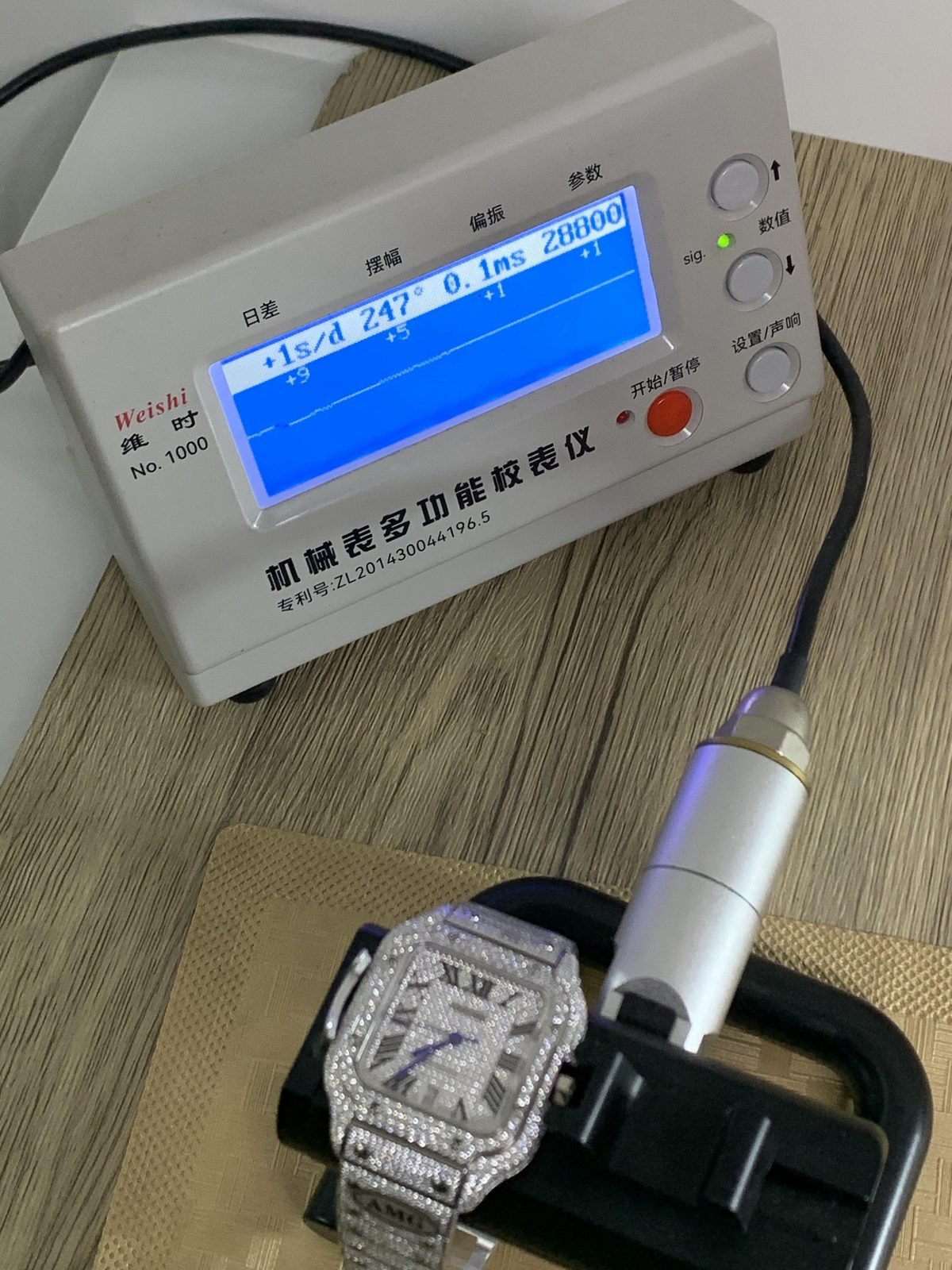
The timing QC image below is an example of one measurement for one photographed sample. Read the displayed rate, amplitude, beat error, lift angle, test position, and elapsed test time if they are visible. Ask whether the watch was fully wound and whether it was checked in more than one position. A single graph is a snapshot, not a promise about daily wear.
Water resistance deserves the same discipline. ISO 22810 defines requirements and test methods for water-resistant watches, while manufacturer service procedures commonly include renewed seals and a pressure check. A listing that says "waterproof replica watch" is not enough. If water exposure matters to you, request a recent test tied to the exact watch and repeat the test locally after delivery. Avoid treating a depth marking on the dial as proof.
Layer 6: Look for process, not a lucky sample
Exact replica watches are often marketed through one perfect image. That image cannot tell you whether the next unit has the same alignment, cleanliness, bracelet fit, or timing result. Repeatability comes from a stable inspection process and sample-level records.
You may not receive a factory audit, but you can test the seller's process. Does the seller send original QC files? Are multiple views clearly the same watch? Is a date or order reference visible? Can the seller explain a rejected unit without changing the subject? Do replacement images follow the same structure?
Consistent answers matter more than a dramatic claim about factory rank. Factory names can be copied, reused, or changed. A clear record tied to your piece is easier to evaluate than an unverifiable story.
Layer 7: Price the service path before purchase
The real ownership cost includes shipping, payment fees, possible import charges, regulation, pressure testing, bracelet sizing, and future repair. A cheap purchase can become expensive when a specialized movement has no parts or no watchmaker willing to accept it.
Ask who handles a watch that arrives damaged, runs poorly, or loses a function. Get the return period, shipping responsibility, repair terms, and exclusions in writing. Confirm whether a return address is available before payment. Keep screenshots and files connected to the order.
If dependable service, provenance, and resale support matter more to you than visual similarity, an authorized pre-owned watch, a microbrand, or an homage design may fit your needs better. This is not a moral judgment. It is a practical comparison of risk, support, and ownership goals.
Layer 8: Reward honest limits
Trustworthy evidence uses narrow language. "The date appears centered in these photos" is supportable. "The date is perfect on every unit" is not. "This sample completed a pressure test under the stated conditions" is different from "safe for swimming forever."
Replica excellence includes the ability to say what remains unknown. No photo proves long-term durability. No timegrapher screen proves movement origin. No packaging proves authorized status. No factory nickname supplies brand provenance. A seller who explains these boundaries gives you more useful information than one who repeats absolute claims.
A 30-minute deep-dive inspection
Use this sequence when you receive a complete QC set. It keeps you focused on decisions rather than marketing language.
- Spend five minutes confirming the reference, dimensions, color, bracelet, and function list. Stop if the product being shown is not the product you requested.
- Spend five minutes on the case, bezel, crystal, crown, pushers, and bracelet. Check symmetry, gaps, surface transitions, damage, and clasp action.
- Spend five minutes on the dial. Review alignment, printing, date position, hand clearance, dust, lume placement, and reflections from several angles.
- Spend five minutes on the continuous function video. Follow each crown position and complication from start to finish.
- Spend five minutes on testing. Match the watch in the timing or pressure-test evidence to the watch in the photos. Record the conditions and limits.
- Spend five minutes on commercial risk. Read the return, repair, shipping, payment, and defect terms before you approve anything.
If an issue is visible, describe its location and impact. "The 6 o'clock marker appears rotated clockwise in the straight-on image" is easier to resolve than "the dial looks wrong." Ask for one targeted retake before rejecting or accepting the sample.
Match your conclusion to the proof
| Proof level | What you can conclude | What stays unknown |
|---|---|---|
| Listing text | The seller is making a claim | Whether the claim applies to your watch or is accurate |
| Seller photos | Visible appearance of the photographed item | Whether the images show your reserved sample, plus hidden parts and performance |
| Sample-linked QC | Visible condition and demonstrated functions of one identified piece | Future reliability, full material specification, and provenance |
| Dated instrument result | Performance during one stated test | Performance in other positions, temperatures, wear conditions, or later dates |
| Independent local inspection | Findings from a named examiner and stated methods | Authorized status unless supported by valid brand records |
| Original maker documentation | Specifications and service standards for the authentic reference | Whether a replica meets those standards |
This proof ladder is the heart of a careful deep dive. It lets you value good workmanship without turning a limited observation into a broad promise.
Questions worth sending to a seller
- Are these original photos of the exact watch reserved for my order?
- What reference, case size, thickness, bracelet, and functions are being supplied?
- Can you provide an uncut video of winding, setting, date change, and every complication?
- What does the movement name mean in terms of architecture, parts access, and repair options?
- Was this finished watch tested for rate, power reserve, and pressure? Under what conditions?
- What happens if the delivered watch differs from the approved QC or arrives damaged?
- Who pays return shipping, and where is the return handled?
- Which statements are based on a test, which are supplier descriptions, and which remain unverified?
A reliable seller should answer in a way you can save and compare with the delivered item. Pressure to pay before basic questions are answered is useful information in itself.
Final perspective
The strongest super clone watches are not defined by one dramatic photo or one confident label. They are better understood through a chain of evidence: a clearly defined reference, controlled surfaces, clean dial assembly, coherent functions, finished-watch testing, repeatable QC, a usable service path, and honest limits.
That approach gives you a fairer decision. You can recognize visible workmanship while avoiding claims that the evidence does not support. You can also decide whether a replica, an authorized pre-owned watch, a microbrand, or an homage is the right answer for your budget and ownership priorities.
If you remember one rule, make it this: approve the specific watch you can inspect, not the story surrounding it.
Looking for a Top-Tier Clone or Custom Build?
Direct access to VS, ZF, 3KF, Clean & BTF factory stock. We provide detailed multi-angle QC photo & video approval prior to final payment.