Super Clone Watches: Myths vs. Facts Unveiled
Verified Reddit Watch Specialist (RepTime / RepGuild)

Most confusion about super clone watches comes from claims that sound precise but do not name a test. Words such as "1:1," "Swiss grade," "waterproof," and "best factory" can feel informative while leaving the important questions unanswered: Which sample? Which component? Which measurement? Which independent record?
Quick answer: Treat every statement about a super clone watch as one of three things: a visible observation, a measured result, or an unverified claim. Photos can support appearance. A function video can show one operation. A timing or pressure test can record one condition. None of those results automatically proves authenticity, every material, movement origin, long-term durability, or legal status.
This guide does not repeat a simple list of five myths. It gives you an evidence ladder you can use on any seller page, review, QC set, or product message.
Use an evidence ladder before believing a label
Strong evidence is sample-specific, current, and narrow. Weak evidence is generic, recycled, or asked to prove several unrelated things at once. The FTC's online marketplace guidance recommends checking the seller, actual-item photos, return terms, payment method, and written records rather than relying on a listing alone.
| Common claim | What may be true | Evidence that would help | What still is not proved |
|---|---|---|---|
| "Top-grade 1:1" | The sample may look close in selected views | Current straight photos, dimensions, handling video, and comparison with the named reference | Standardized grade, identical tolerances, materials, or factory controls |
| "Swiss movement" | A movement may use a known architecture or seller-supplied component | Clear caliber identification, movement photo, full function map, and parts route | Manufacturer, originality, condition, or future serviceability without further verification |
| "Waterproof" | A finished sample may pass one pressure test | Dated sample-specific test method and result | Permanent resistance, suitability for every activity, or compliance with a named standard |
| "Perfect reviews" | Some buyers may have had good experiences | Recent independent reviews, buyer history, order details, and balanced complaints | Your sample, delivery, return, or refund outcome |
The useful habit is simple: approve only what the evidence can actually support.
Myth 1: Super clone is an official quality grade
Fact: The market uses super clone, AAA, 1:1, premium, and factory labels inconsistently. They are sales categories, not a shared ISO, brand, or government grading system. Two sellers can use the same term for watches with different movements, finishing, testing, and after-sales terms.
Ask the seller to replace the label with a specification. You need the exact design reference, measured case size and thickness, bracelet or strap configuration, movement designation, working functions, tests performed, and written remedy. A high quality replica watch should be evaluated through those details, not through the number of A's in its name.
Myth 2: A close-looking photo proves identical construction
Fact: A photograph can support visible observations. It can show dial layout, hand length, marker position, bezel alignment, date placement, surface finish, scratches, and obvious assembly problems. It cannot identify a steel alloy, crystal composition, gasket condition, lubrication, movement manufacturer, or hidden machining.
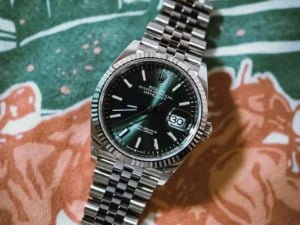
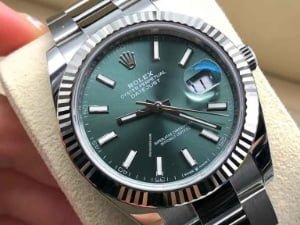
The supplied reference image below gives you a clear view of a green-dial fluted-bezel design, bracelet finish, date magnification, hands, and markers. It is not current QC for a reserved sample. Original-brand specifications also belong only to the genuine reference. Rolex explains that its new genuine watches are sold through official jewelers who warrant authenticity and provide a five-year guarantee in its watch care FAQ. A similar appearance does not transfer that system to a replica.
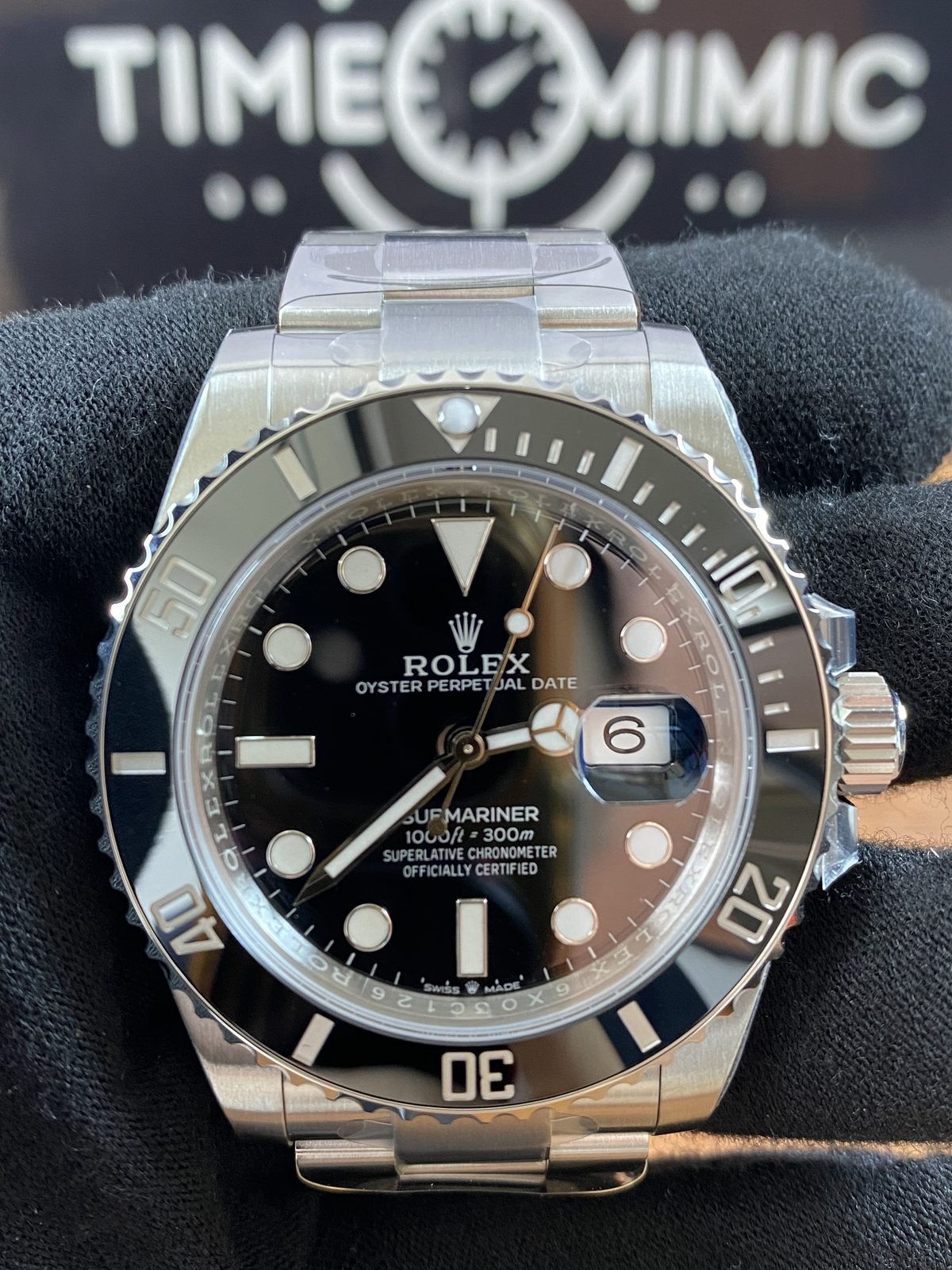
The QC image below is one photographed sample. You can inspect exterior alignment and condition. You cannot use it to prove authenticity, exact materials, movement identity, water resistance, or future reliability.
Request photos of your exact sample with an order code in frame. If the sample changes, the approval resets. This rule is more useful than arguing about whether one model is the best replica watch in a category.
Myth 3: A timegrapher screen certifies the movement
Fact: A timegrapher estimates rate, amplitude, and beat error under one setup. The result depends on position, winding level, lift-angle setting, temperature, regulation, and the movement's condition at that moment. It does not identify every component or predict years of use.
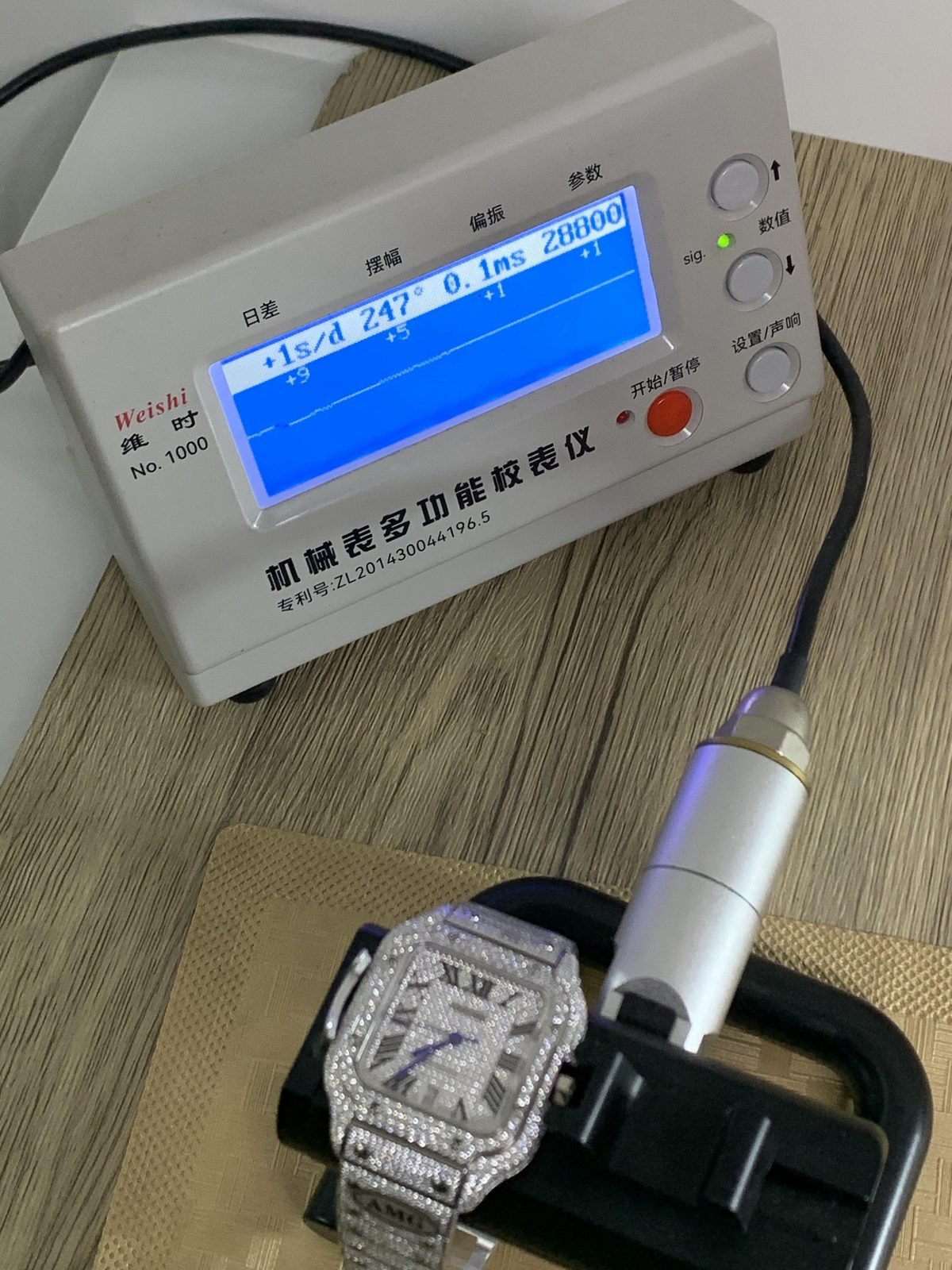
The timegrapher image below records one reading from one photographed sample. It can be part of a mechanical QC file, but it is not a certificate of movement origin, durability, or serviceability.
When a seller names a movement, compare the claim with official maker information. Citizen Miyota publishes a 9015 product page, a technical document, and parts information. Those documents define an official product family. You still need evidence that the movement in your automatic replica watch is what the seller says it is.
Formal certification is much broader. METAS explains that Master Chronometer certification covers complete watches and includes chronometric performance, water resistance, magnetic resistance, and power reserve under defined requirements. One seller photo is not equivalent to that process.
Myth 4: A water-resistance number means you can safely swim
Fact: Water resistance is a tested performance claim, not a conclusion you should infer from a screw-down crown or diver-style bezel. Gaskets can be missing, dry, damaged, or poorly seated. Case opening can change the result.
ISO 22810 specifies requirements and test methods for water-resistant watches. ISO 6425 addresses divers' watches. A seller's informal "30 m," "100 m," or "waterproof" message does not establish compliance with either standard.
Ask whether the finished sample was tested, which method and pressure were used, when the test occurred, and whether you will receive the result. Until a competent watchmaker tests your watch for the activity you intend, keep it away from water. Repeat testing after service or case opening.
Myth 5: A high star rating proves the seller is safe
Fact: Reviews are useful signals, but ratings can be fake, incentivized, selective, or attached to a different product. The FTC's guide on evaluating online reviews recommends considering the source, recency, reviewer history, unusual bursts, and material connections. Its review-platform guidance also explains why transparent collection and moderation matter.
Read recent positive and negative reviews across more than one source. Look for specific descriptions of QC, delivery, defects, returns, and refunds. Search the seller's name, domain, email, phone number, and payment account with terms such as complaint, scam, refund, and review.
Then verify the transaction itself. Save the listing, messages, final configuration, invoice, payment receipt, and return policy. A strong review history cannot replace a charge-dispute route or a written remedy for your order.
Myth 6: Replica watches are either legal everywhere or illegal everywhere
Fact: The answer depends on the country, conduct, and route. Personal possession, purchase, import, commercial sale, trademark use, deception, and resale are different legal questions. Customs rules and enforcement also vary.
WIPO describes intellectual-property enforcement through civil, administrative, border, and criminal measures. The OECD's 2025 analysis of counterfeit Swiss watches documents the scale of the trade and notes that e-commerce and small parcels create enforcement challenges. Its chapter on small-parcel shipments shows why a seller cannot guarantee customs clearance.
Check the law that applies to you before ordering, traveling with, or reselling a replica. Never present one as genuine. This article provides a risk framework, not jurisdiction-specific legal advice.
Myth 7: If it runs on arrival, maintenance is no longer a concern
Fact: Arrival is the beginning of ownership. Mechanical watches can need regulation, cleaning, lubrication, seals, parts, and repair. Replica service can be harder because the actual movement, modifications, and parts route may be unclear.
Ask before payment whether a local watchmaker will accept the watch, whether routine parts exist, and what the seller will do if the movement fails. Get the return address, time limit, shipping responsibility, and exclusions in writing. Include possible inspection, pressure testing, regulation, repair, and movement replacement in the budget.
Official brand service shows what a documented system looks like. Rolex describes authentication, testing, genuine parts, and a two-year guarantee in its Certified Pre-Owned process. Cartier's watch warranty information defines authorized warranty channels. A seller warranty should not be described as equivalent unless its actual coverage and service capacity support that claim.
Myth 8: One detail can prove a watch is identical or fake
Fact: A good evaluation is layered. Exterior details, operation, movement architecture, measured performance, paperwork, seller identity, and brand authentication answer different questions. A single engraving, serial pattern, smooth seconds hand, timing result, or box cannot settle all of them.
Use a claim-to-evidence map:
| Claim type | Evidence that fits the claim | Red flag |
|---|---|---|
| Appearance | Current straight photos, macro views, dimensions, and visible condition | Stock photos or different samples mixed together |
| Function | Continuous video of winding, setting, date change, and complications | Edited clips or functions described but never shown |
| Performance | Dated timing, pressure, or magnetic test with method and setup | One result used to prove unrelated qualities |
| Transaction | Identifiable seller, protected payment route, written return and delivery terms | Urgent payment, off-platform transfer, or vague remedy |
| Authenticity | Brand or authorized-channel examination and documented provenance | Logo, packaging, or seller wording treated as certification |
If the evidence does not fit the claim, mark the claim as unknown. You do not need to turn an unknown into either a fact or a defect.
Myth 9: A higher price or famous factory name guarantees a better watch
Fact: Price can reflect real differences, but it can also reflect scarcity language, reseller margin, packaging, shipping route, or demand. A factory nickname is not a public quality certificate, and the same nickname may be used by unrelated sellers. Production batches can also change.
Ask what the higher price changes on the exact sample. Useful answers include a named movement, a measured case dimension, a different clasp, a demonstrated complication, a current pressure test, a longer return period, or a service commitment. Weak answers repeat words such as latest, upgraded, best, or exclusive without showing the change.
This matters when comparing a Rolex super clone with a cheaper listing that uses the same front-view image. Do not assume the expensive item is better or the cheap item is identical. Request separate current QC, configuration, movement evidence, and terms from each seller. Compare the records line by line.
The lowest price can hide delivery and service risk, while the highest price can hide an unsupported premium. Judge value after adding payment fees, shipping, duties, inspection, regulation, likely repair, return cost, and low resale value. A watch is affordable only when the total risk fits your budget.
A 60-second claim audit before you approve QC
Use this short check whenever a listing or message makes a strong promise:
- Name the claim. Rewrite broad wording as a testable statement. "Perfect quality" might become "the date changes correctly and the visible dial is clean."
- Identify the sample. Confirm that the photos, video, and test result belong to the watch reserved for you. Look for a current order code in the frame.
- Match the evidence. Use photos for appearance, continuous video for operation, named tests for measured performance, and authorized records for authenticity.
- Record the limit. Write down what the evidence cannot show. A pressure result does not identify the movement. A movement photo does not prove water resistance.
- Set a stop condition. Do not approve when the sample changes, a key function is hidden, the seller refuses written terms, or payment removes the protections you expected.
This process is deliberately short. It keeps you focused on the claim that affects your decision instead of sending you through endless forum rankings or marketing comparisons.
Final answer
The most useful fact about super clone watches is that quality cannot be proved by a market label. You can verify visible condition, demonstrated functions, individual test results, transaction terms, and service arrangements. You should keep materials, movement origin, water resistance, durability, authenticity, legal status, and resale claims separate until each has fitting evidence.
This approach makes myths easier to handle. You do not need to believe or reject every sales statement immediately. Ask what the statement means, request evidence for the exact sample, record what remains unknown, and walk away when the seller asks trust to replace proof.
Looking for a Top-Tier Clone or Custom Build?
Direct access to VS, ZF, 3KF, Clean & BTF factory stock. We provide detailed multi-angle QC photo & video approval prior to final payment.