Super Clone Watches: How to Spot the Best Reproductions
Verified Reddit Watch Specialist (RepTime / RepGuild)

The fastest way to misjudge a reproduction is to ask whether it "looks real." That question is too broad. A well-lit photo can hide a rotated marker, a rough crown, a wrong subdial function, or a bracelet gap. A less dramatic photo may show a much better watch because it gives you straight angles, honest reflections, and a complete function test.
To spot the best reproductions, inspect one identified sample in a fixed order. Compare its geometry, assembly, controls, test evidence, and purchase terms. Approve what you can verify, and leave every unsupported claim unproven.
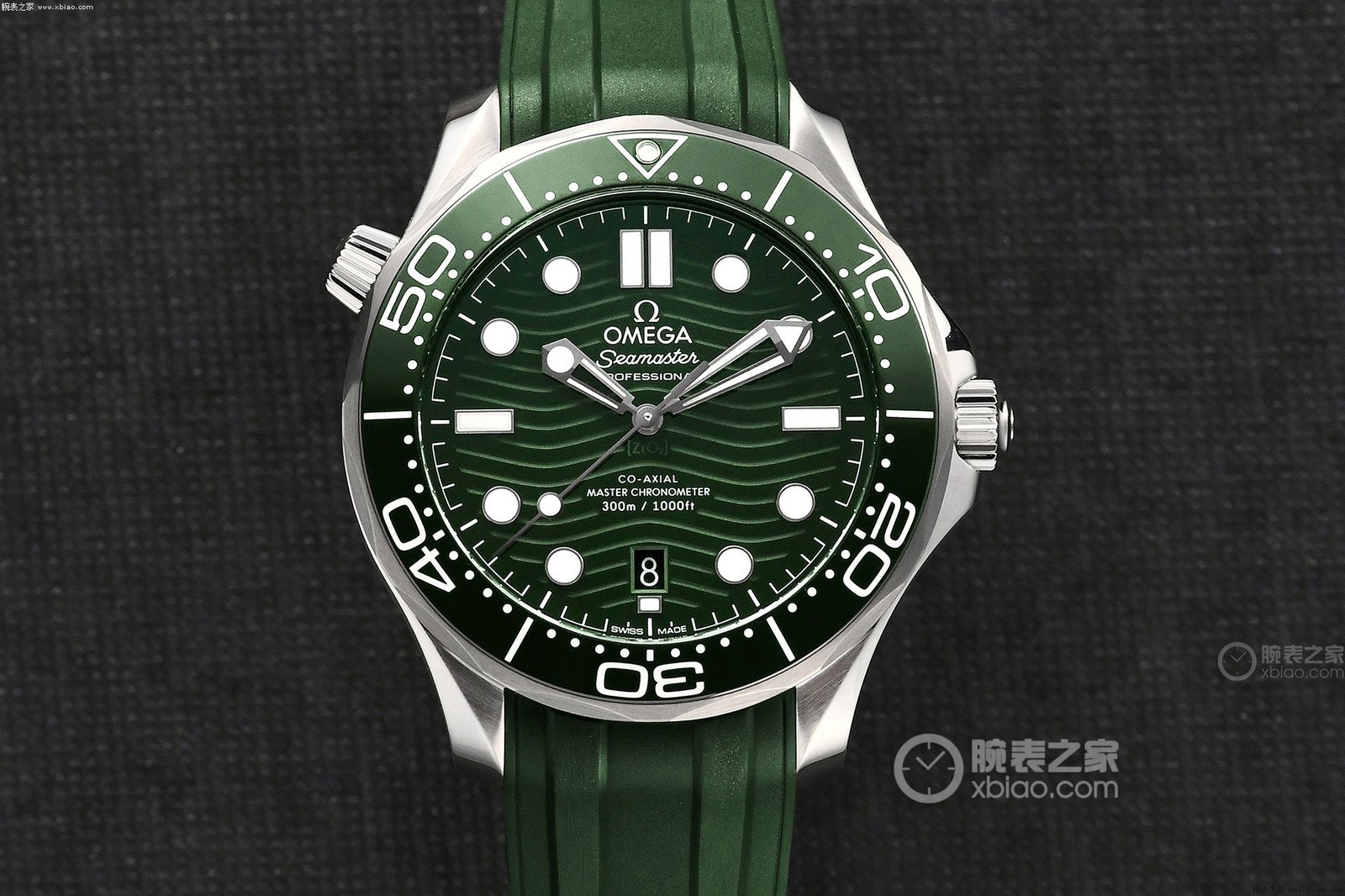
This guide gives you that order. It is designed for QC photos, seller videos, and a watch in your hand. It will not authenticate a watch or prove a factory name. Instead, it helps you separate a strong sample from a persuasive listing.
Define "best" before you compare watches
The best reproduction for you should satisfy three conditions. First, it should match the correct reference closely enough in the areas you care about. Second, the individual watch should be assembled and functioning well. Third, the seller should provide usable evidence and a remedy if the delivered item differs from the approved QC. If your goal is a luxury replica watch for regular wear, comfort, repair access, and a workable defect remedy deserve as much attention as visual detail.
Those conditions are more useful than labels such as "1:1," "AAA," or "top factory." The labels do not have a shared testing standard. Price also cannot prove quality. A high quality replica watch needs sample-specific evidence, while an expensive listing may still rely on stock photos and vague descriptions.
Original manufacturers show why the reference matters. Cartier describes line, shape, proportion, and details as core design principles. Audemars Piguet documents the contrast between satin-brushed and polished surfaces. Patek Philippe discusses cases, dials, hands, finishing, and complete-watch standards. These sources describe authentic watchmaking, not replicas, but they identify the relationships you should compare.
Use eight inspection passes
Work from large structures to small details. This prevents a tiny logo difference from distracting you from a wrong case shape or non-working function.
| Inspection pass | What to inspect | Evidence to request | Reject or clarify signal |
|---|---|---|---|
| 1. Identity lock | Exact reference, generation, color, size, bracelet, and function set | Written configuration plus a full front image | Listing title and photographed watch do not match |
| 2. Geometry | Case outline, thickness, lugs, bezel, crown, guards, end links, and bracelet taper | Straight front, both sides, rear, clasp, and wrist profile | Distorted proportions, uneven gaps, or images taken only at flattering angles |
| 3. Dial assembly | Printing, marker position, date centering, hand length, hand clearance, dust, and lume placement | High-resolution front view at 12:00 plus close-ups | Rotated markers, touching hands, debris, or inconsistent spacing |
| 4. Surface control | Brushing direction, polished areas, edges, coatings, crystal, and scratches | Neutral light, moving reflections, and macro photos | Wavy polishing, soft boundaries, chipped coating, or unexplained damage |
| 5. Controls and functions | Winding, setting, date, bezel, pushers, GMT, chronograph, and advertised complications | One uncut video of every control | Skipped function, rough operation, decorative display, or incorrect reset |
| 6. Movement evidence | Architecture, rotor, regulator, date mechanism, service access, and parts path | Clear movement images, stated movement family, and repair terms | Identity claimed from engraving alone or no repair answer |
| 7. Finished-watch tests | Rate snapshot, power reserve, pressure result, and post-casing function check | Dated readings tied to the same sample and stated conditions | Generic test screen, missing sample link, or permanent guarantees from one result |
| 8. Transaction proof | Original QC files, return window, defect remedy, shipping responsibility, and payment protection | Written terms saved before payment | Stock-only images, payment pressure, unclear return address, or no mismatch remedy |
You can complete the first four passes from a good photo set. The remaining passes need video, test information, and written terms. If a seller refuses one type of evidence, do not compensate by overvaluing another.
Pass 1: Lock the exact identity
Start with the reference number and generation. A model name may cover several case sizes, dials, bezels, bracelets, and movement layouts. Ask the seller to state the exact configuration in one message. Save it with the QC files. Search phrases such as exact replica watches encourage an all-or-nothing expectation, but the useful task is to measure where a specific sample is close and where evidence is missing.
Use the original maker's official page or manual as the reference source. Record case diameter, thickness if published, lug or bracelet arrangement, dial layout, date position, bezel markings, crown and pusher design, and advertised functions. A screenshot from an anonymous comparison page is weaker than the maker's own specification.
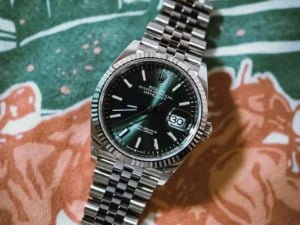
The supplied hero image is useful for learning this first pass. You can study the wave dial, bezel scale, crown and valve positions, marker proportions, hand lengths, and strap integration. It is a supplied design reference, not QC for a current order, and it does not prove authenticity, materials, movement identity, water resistance, durability, or factory source.
Pass 2: Check geometry before tiny details
Large proportions shape the entire watch. Look at the relationship between dial opening, bezel width, case length, lug angle, crown size, and bracelet width. A watch can have clean printing and still feel wrong because the case is too thick or the lugs sit at the wrong angle.
Use a straight-on image to compare symmetry, then use side views for thickness, crystal height, bezel profile, crown position, and case-back depth. A wrist profile helps you see whether the case sits flat or rises sharply. Check that the end links meet the case evenly and that the bracelet tapers in the correct direction.
Camera position matters. A wide-angle phone lens can enlarge the nearest part of the case. Ask for a retake from farther away with the camera centered over the dial if proportions look strange. Do not reject a sample on perspective distortion that a neutral image can resolve.
Pass 3: Read the dial as a coordinate system
Imagine a line running from every hour marker to the center pinion. The markers, minute track, hands, date window, subdials, and printed text should relate to that shared center. This method is faster than checking each item in isolation.
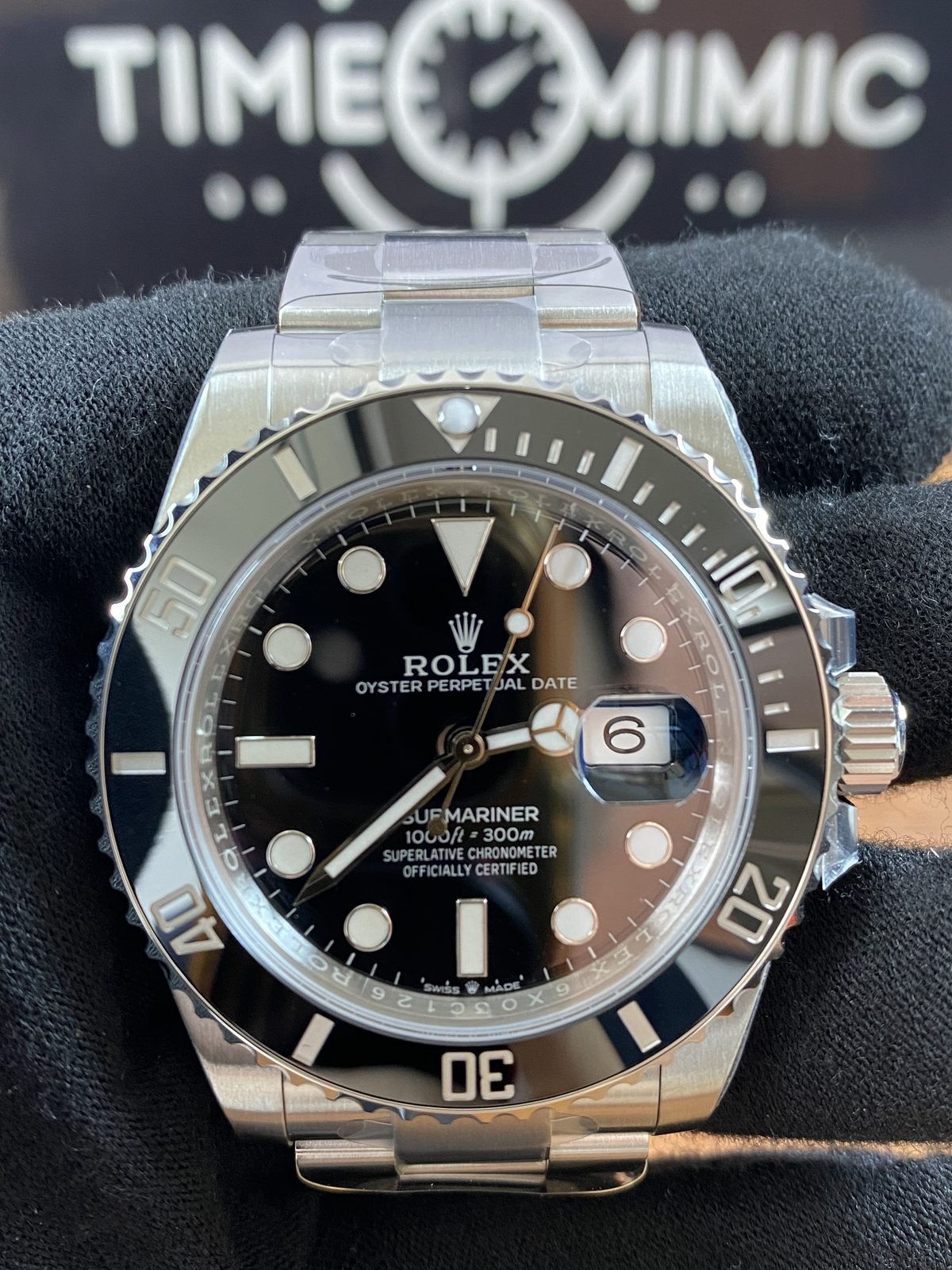
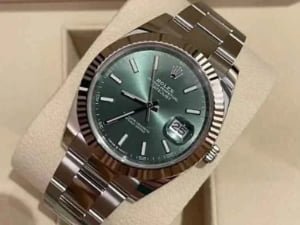
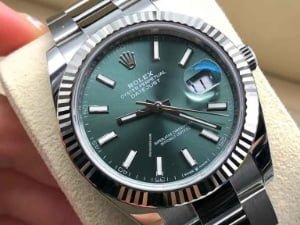
A front-view QC image below is an example of sample-level exterior evidence. Check whether the bezel marker, dial markers, date, and hands share the expected axes. Inspect the rehaut or chapter ring, visible dust, scratches, printing edges, and the space around applied markers. Judge only what the image shows.
Ask for the hands to be moved to 12:00 and another open position such as 10:10. At 12:00, you can check hand stacking and marker alignment. At 10:10, you can see the logo, date, and lower dial more clearly. A short video should confirm that the hands pass each other and the crystal without contact.
Lume photos can reveal missing or uneven application, but camera exposure changes brightness. Use lume images to find obvious imbalance, not to claim a precise compound or lasting duration.
Pass 4: Follow reflections across the case and bracelet
Finishing is easiest to see while the watch moves under neutral light. Brushed lines should follow a deliberate direction. Polished areas should reflect cleanly without ripples. The boundary between the two should remain controlled along lugs, bezel edges, case flanks, and bracelet links.
Audemars Piguet's documentation on case and bracelet finishing is a useful lesson in contrast and direction. Patek Philippe describes deburring and preparation before polishing. Those authentic processes are not evidence that a replica uses the same methods. They explain why you should inspect edges, transitions, and consistent reflection instead of treating shine as quality.
Look for damage separately from finish. A scratch, dent, chipped coating, sharp bracelet edge, loose screw, or clasp mark may justify a new sample even if the general finishing is good. Ask the seller to circle the same area in a fresh close-up so you know the reply addresses your concern.
Pass 5: Make the controls tell the truth
An uncut function video is one of the most valuable parts of QC. It connects the photographed case to the crown, movement, date, and complications. Ask the seller to begin with the watch running and keep the watch in frame.
The video should show winding, every crown position, time setting, date change, crown re-engagement, bezel action, and each advertised complication. A chronograph needs start, stop, reset, and visible minute progression. A GMT watch needs a clear demonstration of which hand moves independently and how the date behaves across midnight.
Listen as well as watch. Grinding, skipping, an unstable crown, a pusher that does not return, or a bezel with inconsistent engagement deserves clarification. Do not expect every movement to feel like the authentic reference, but the behavior should match the product description and remain internally consistent.
Terms such as automatic replica watch or Swiss super clone watches do not identify a movement by themselves. Engraving can imitate appearance. Movement identity needs architecture, dimensions, functions, and a traceable source. If those are unavailable, describe the movement as unverified and focus on demonstrated behavior and repair access.
Pass 6: Treat movement photos as evidence with limits
A clear movement photo can help you compare bridge layout, balance position, rotor shape, regulator style, and visible finishing. It can also reveal corrosion, debris, damaged screws, or careless handling. It cannot prove a supplier, jewel count, material, or service history by appearance alone.
Compare the movement's function set with the dial. A watch should not depend on decorative displays or hidden corrections that contradict the named reference without disclosure. Ask whether a local watchmaker can service the movement and whether replacement parts are realistically available.
The 2025 Miyota catalogue, for example, publishes layouts and specifications for named movements. METAS publishes a certification framework for complete watches. That is the level of traceable documentation behind meaningful technical claims. A seller nickname is not equivalent.
Pass 7: Read test evidence without overpromising
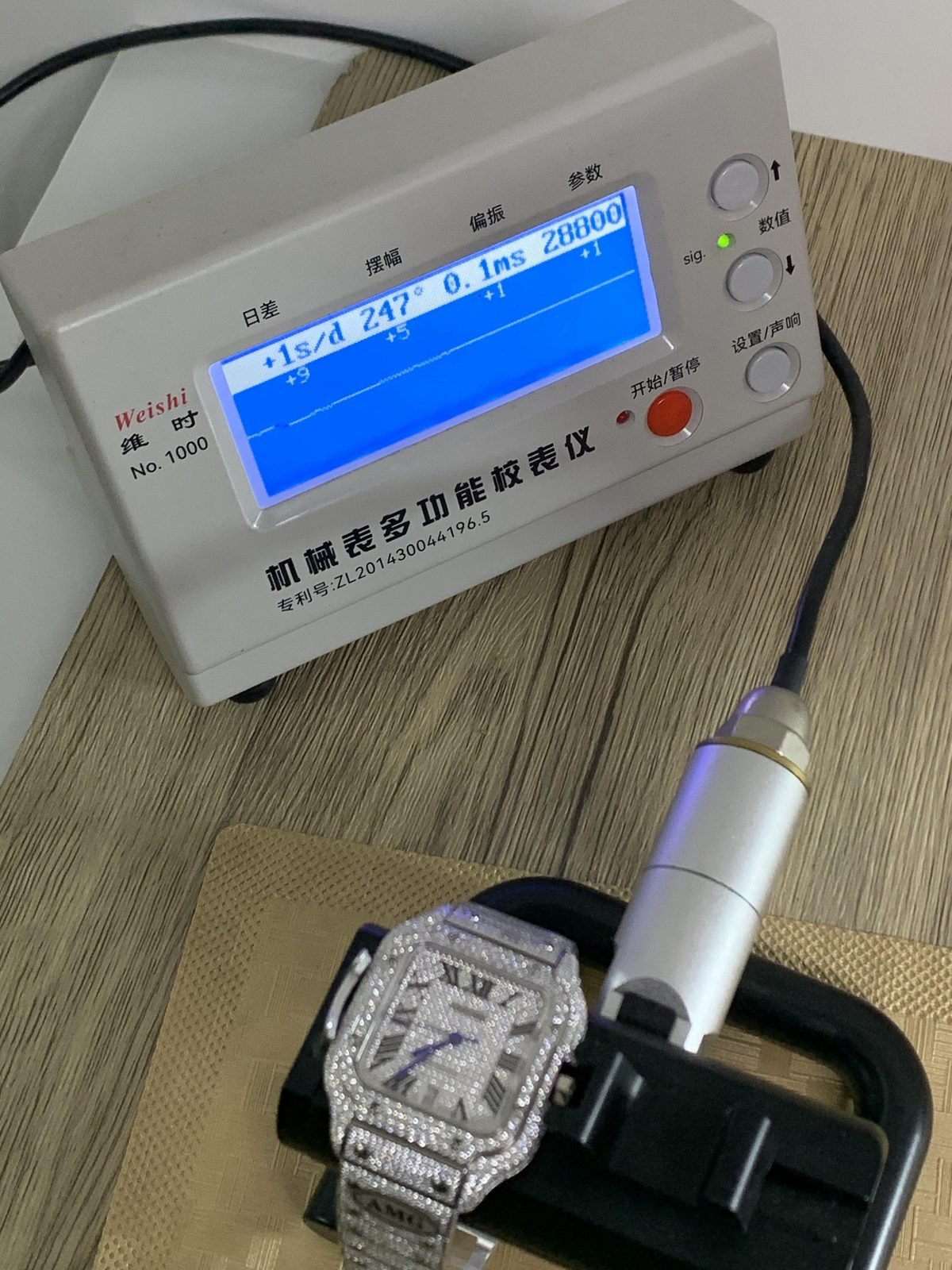
The timing QC image below shows one instrument reading from one photographed sample. Check the displayed rate, amplitude, beat error, lift angle, position, and test duration when visible. Ask whether the watch was fully wound and whether the seller checked another position.
One acceptable reading can support a narrow conclusion: the sample produced that result under those conditions. It cannot guarantee daily accuracy after shipping, movement origin, durability, or service life. A later local reading may differ because of position, power level, magnetism, temperature, shock, or regulation.
Water resistance requires a real test. ISO 22810 sets requirements and methods for watches marked water resistant. ISO 6425 covers diver's watches. IWC's service process replaces seals and then checks pressure and water resistance, which shows why a dial marking is not proof. A waterproof replica watch claim needs a recent result tied to the exact piece. If water exposure matters, request that evidence and repeat the test locally after delivery.
Power reserve should also be measured, not guessed from a movement label. Fully wind the watch, record the start time, leave it undisturbed, and note when it stops. That result belongs to the tested piece and condition.
Pass 8: Inspect the deal as carefully as the watch
The best-looking replica watches can still create a poor purchase if the seller uses stock photos, changes the sample, or has no workable return process. The FTC advises marketplace buyers to review refund rules, seller contact information, item photos, payment protections, and deadlines before purchase.
Save the listing, written configuration, original QC files, approval message, payment record, shipping information, and return terms. Confirm what happens if the delivered watch is not the approved sample, arrives damaged, or fails a demonstrated function. Ask who pays shipping and where a return is sent.
Trademark and import rules vary by country. WIPO defines counterfeit trademark goods through unauthorized use of protected signs, and customs authorities can restrict imports. Check the law where you live and where the shipment crosses a border. Do not assume personal use removes every risk.
Classify issues by decision impact
| Issue severity | Examples | Recommended action |
|---|---|---|
| Cosmetic preference | Slight tone variation visible only under one light, normal reflection difference, or a tiny feature you do not value | Ask for one neutral retake, then decide whether it matters to you |
| Correctable setup | Bracelet sizing, removable protective film, regulation, or a strap adjustment | Get the correction and a fresh result before approval |
| Sample defect | Rotated marker, trapped debris, damaged surface, loose component, rough control, or failed function | Request a replacement sample or decline |
| Specification mismatch | Wrong size, reference, dial, bracelet, movement behavior, or complication | Stop and restate the required configuration in writing |
| Evidence gap | Stock-only images, edited function clips, generic test result, or missing return terms | Do not approve until the missing evidence is supplied |
| Unsupported absolute claim | Guaranteed permanent accuracy, universal waterproofing, authentic materials, or factory identity without proof | Treat the claim as unverified and judge the sample on narrower evidence |
This table keeps decisions proportional. A reflection that changes with the camera angle should not receive the same response as a wrong movement function. A visible defect should not be excused because the seller tells a strong factory story.
A 15-minute QC routine
- Confirm the reference, size, dial, bracelet, and function list against your saved order.
- Match unique details across every photo and video so you know they show one watch.
- Check case and bracelet geometry before zooming into the dial.
- Review dial axes, marker alignment, date centering, hand clearance, dust, and damage.
- Follow reflections across brushed and polished surfaces and inspect the clasp and end links.
- Watch one continuous demonstration of the crown, date, bezel, and every complication.
- Read timing, pressure, and power-reserve evidence with the test conditions attached.
- Recheck return, defect, shipping, and payment terms before approval.
If you find a concern, send a precise request: "Please provide a straight macro photo of the 9 o'clock marker and minute track on this same sample." A precise request is easier to answer and harder to dismiss than "the watch looks off."
What a strong reproduction can and cannot prove
A strong sample can show coherent proportions, clean assembly, controlled finishes, working functions, acceptable test snapshots, and a documented transaction path. Those qualities are worth recognizing.
They do not make the watch authentic. They do not transfer the original brand's materials, certification, warranty, service network, provenance, or resale status. They also do not guarantee that another unit from the same seller will match the sample you inspected.
For that reason, approve a specific watch, keep its evidence, and inspect it again on arrival. If authorized provenance, dependable manufacturer support, and predictable resale matter most, compare the full cost with an authorized pre-owned watch, a microbrand, or an homage design before you choose.
Final checklist
You can spot the best reproductions by replacing broad impressions with repeatable checks. Lock the identity, compare geometry, read the dial as a system, follow the finishing, test every control, examine the movement within its limits, interpret instrument results narrowly, and secure the transaction record.
The goal is not to find a watch that creates the strongest illusion in one photo. It is to find the sample that survives the most honest inspection.
Looking for a Top-Tier Clone or Custom Build?
Direct access to VS, ZF, 3KF, Clean & BTF factory stock. We provide detailed multi-angle QC photo & video approval prior to final payment.