How Close to the Original Are the Best Replica Rolex Watches?
Verified Reddit Watch Specialist (RepTime / RepGuild)
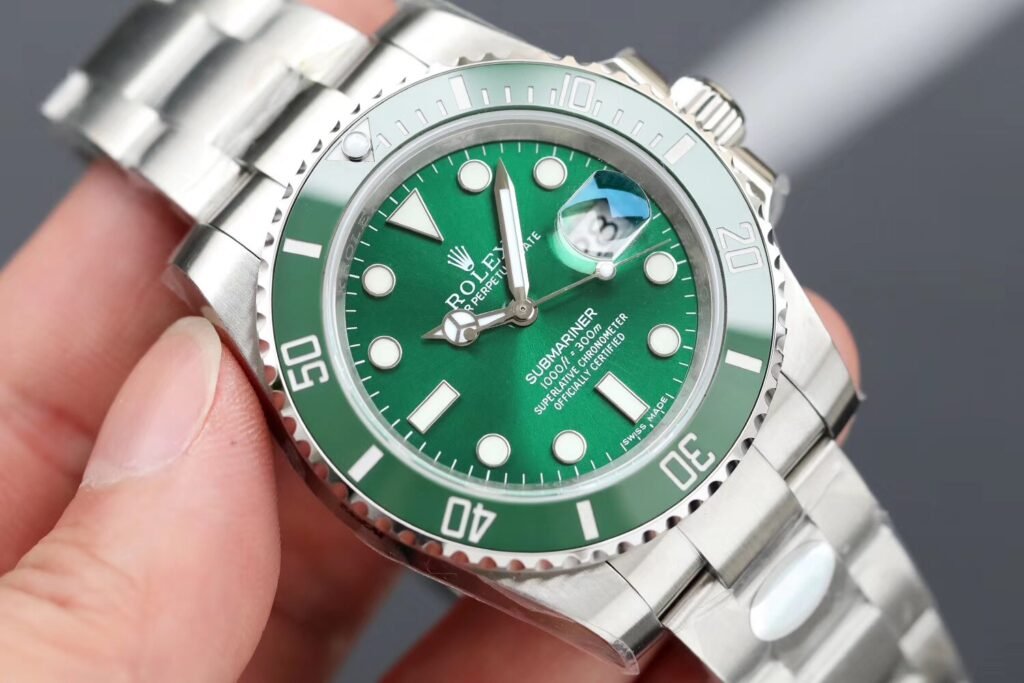
The best replica Rolex watches can look very close to an original in a normal wrist photograph or a brief face-to-face view. That does not make them identical. The distance usually grows when you check exact dimensions, case and bracelet transitions, dial construction, function behavior, movement architecture, measured performance, provenance and service support.
You cannot give every replica a reliable percentage. A result such as “95% close” hides the reference, the batch, the individual unit and the inspection method. A useful answer needs a defined Rolex reference and a layer-by-layer comparison.
Visual similarity is one layer. Original identity is a much larger system.

If you are evaluating a Rolex super clone, judge the specific watch in front of you. The seller’s best sample, another buyer’s review and a factory nickname cannot establish what your unit contains or how it performs.
Start by defining what close means
Two watches can share a recognizable outline while being far apart internally. You may care most about how the watch looks across a table. Another buyer may care about the independent GMT hour hand, chronograph reset behavior, water resistance or long-term repair options.
Use seven comparison layers:
- Reference identity: model, reference, production-era design, dial, bezel, bracelet and functions.
- Overall geometry: diameter, thickness, lug shape, bezel profile and bracelet fit.
- Visible detail: printing, markers, hands, date, magnifier, lume and finishing transitions.
- Operation: crown positions, winding feel, date change, bezel action, GMT setting or chronograph control.
- Movement: architecture, component layout, calibre identity, decoration and serviceability.
- Measured performance: rate, amplitude, beat error, power reserve and pressure-test result.
- Origin system: authentic parts, brand records, guarantee, official service and transferable provenance.
| Comparison layer | Where a strong replica may look close | What you should verify | Boundary that remains |
|---|---|---|---|
| Reference identity | Familiar model, color and bracelet combination | Exact target reference and production-era layout | A copied configuration is not brand-issued identity |
| Overall geometry | Similar silhouette and wrist presence | Diameter, thickness, lug-to-lug and side profile | Small errors combine into a different stance |
| Visible detail | Convincing dial, bezel and polished surfaces | Straight macro photos under plain light | Photos do not prove hidden construction or materials |
| Operation | Basic time, date, bezel or chronograph action | Continuous video of every crown and pusher position | Similar action does not establish the original calibre |
| Movement | Similar-looking bridges or rotor decoration | Clear movement images and declared base calibre | Engraving is not manufacturer authentication |
| Performance | Acceptable snapshot timing or function test | Stated settings, multiple positions and unit-linked results | One test cannot prove long-term output or other properties |
| Origin system | Packaging and surface markings can be copied | Official retailer, brand records and authenticated parts | Provenance, guarantee and authorized service do not transfer |
This framework lets you answer your own version of close. It also prevents a polished dial from carrying claims about the movement, waterproofness and authenticity that it cannot support.
Lock the exact original reference before comparing
“Rolex Submariner” is not a complete comparison target. References change in diameter, movement, bezel, clasp, dial details and bracelet construction. A close copy of one generation may be wrong for another.
Build a short reference passport from an official page. Record the model name, reference, case size, material, bezel type, crystal, water-resistance claim, movement, listed functions, power reserve, bracelet, clasp and dial. The official Submariner reference 124060 page, for example, lists a 41 mm Oystersteel case, unidirectional 60-minute bezel, calibre 3230, approximately 70 hours of power reserve and an Oyster bracelet with Glidelock.
For a GMT comparison, the genuine GMT-Master II reference 126710BLNR is a 40 mm watch with a bidirectional 24-hour bezel, calibre 3285 and an independently adjustable local hour hand. A copy that has a blue and black bezel but lacks that setting behavior is visually related, not functionally close.
Save the official reference page and date of access. Then write the replica’s own disclosed specification in a separate column. Never fill a missing replica specification with the original’s data.
Viewing distance changes the answer
A watch can look convincing in a wrist shot and less convincing at 10 cm. That is normal because each viewing distance reveals a different class of detail.
At arm’s length, you mainly see color, case family, dial balance and bracelet style. At reading distance, you begin to notice marker placement, hand proportions, date position and bezel alignment. A macro photograph reveals print edges, surface texture, lume fill, polishing boundaries and dust. Operation adds information that a still image cannot show.
Use the same four passes on both watches or on a replica and official reference images:
- Silhouette pass: front and side views at the same scale.
- Dial pass: straight-on image with the hands clear of the logo, date and model text.
- Surface pass: raking light across the lugs, case sides, bezel and clasp.
- Operation pass: one continuous video of the crown, bezel, date and advertised complications.
Edited catalog images tend to remove the small signals you need. Plain light and a straight camera angle are more useful than dramatic reflections.
Case shape and bracelet fit expose cumulative differences
The outer form is built from relationships. The bezel may be close by itself, and the lugs may be close by themselves, yet the watch can still sit differently because the mid-case thickness, crystal height, end-link position and bracelet taper do not agree.
Measure diameter, total thickness, lug-to-lug, end-link extension and bracelet width at the case and clasp. Compare the crown guard outline and the transition from polished case side to brushed upper surface. On a profile image, check how much of the case back sits below the mid-case and where the bezel begins.
Rolex describes its case and bracelet production as an integrated process. The brand’s Plan-les-Ouates page says cases and bracelets go through precision machining, manual finishing and visual and functional checks. That is useful context for why several small relationships matter together. It does not prove that a replica uses the same alloy, tooling, sequence or tolerances.
Bracelet feel also comes from more than weight. Check side play, link articulation, screw condition, end-link seating, clasp closure and adjustment range. The official Glidelock description explains the genuine extension system. A similar-looking clasp should be judged by its actual adjustment, security and finishing rather than its engraving.
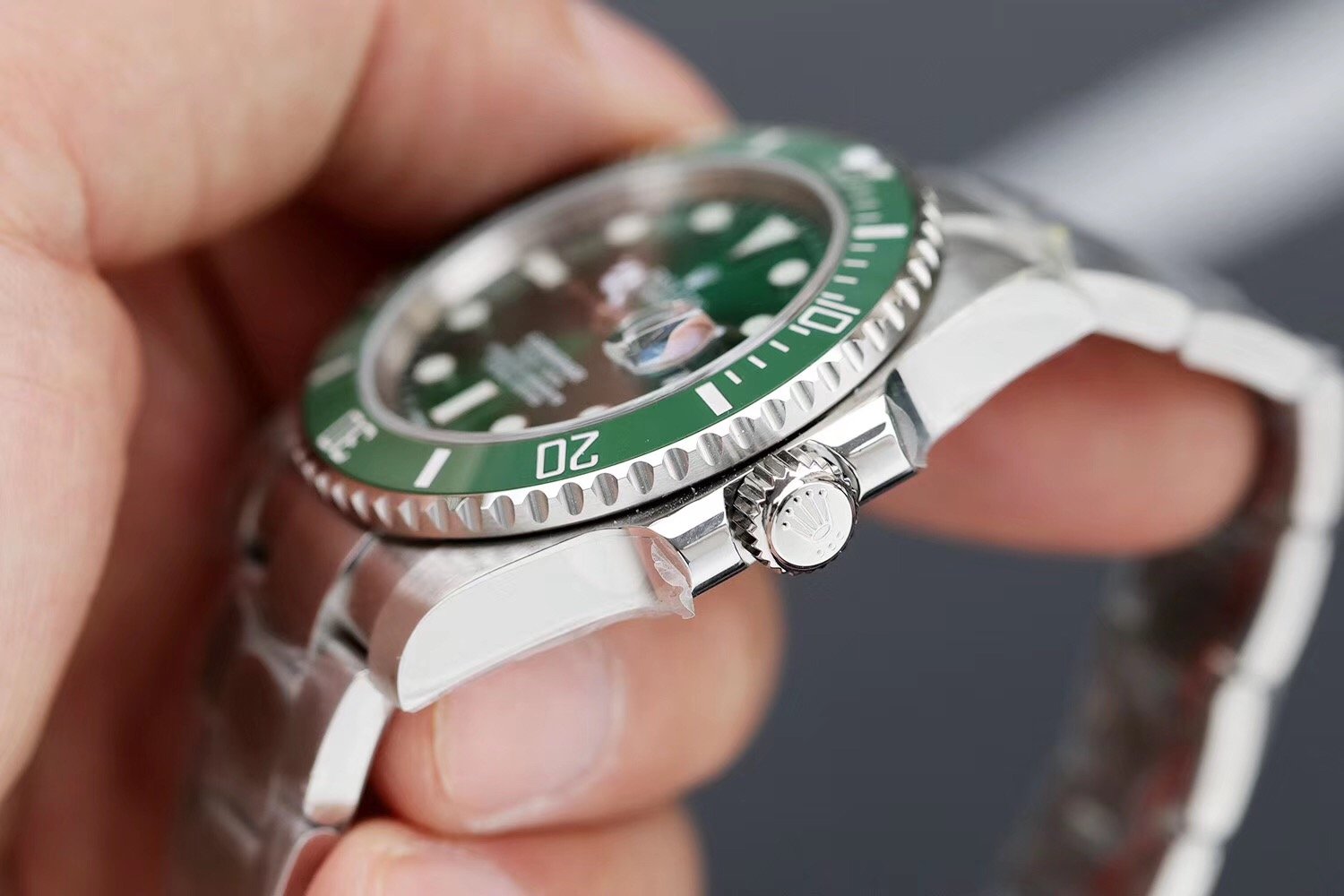
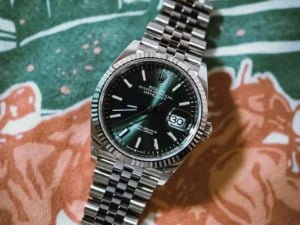
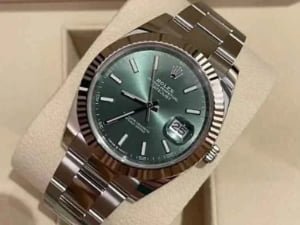
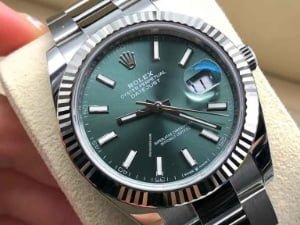
The supplied green Submariner-style images show a front view and a low side profile that can help you inspect bezel alignment, date placement, crown guards, lug shape, surface transitions and bracelet fit. They do not identify the manufacturer, reference accuracy, material, movement, water resistance, certification or authenticity.
Dial, bezel and date details create the strongest first impression
The dial carries many high-contrast relationships. Check whether the minute track is centered, markers point cleanly toward it, hand lengths match their tracks and the date sits in the window without leaning. Compare the spacing and baseline of each line of text rather than asking only whether the font looks right.
The Cyclops lens is easy to notice and easy to oversimplify. Rolex says its Cyclops lens is set over the date at 3 o’clock and uses sapphire with a double anti-reflective coating. A copy can reproduce the location and a similar visual effect, but you still need to judge centering, distortion, reflections and readability on that unit.
For a Submariner-style bezel, inspect the triangle, luminous marker, engraved numerals, fill consistency and alignment with the dial. The genuine Submariner feature page describes a unidirectional 60-minute Cerachrom bezel and Chromalight display. Do not turn that original specification into a claim about a copy’s ceramic composition or lume formula.
Low-light photographs are useful when exposure settings are disclosed. Compare initial brightness and the change over time, not a single heavily exposed image. Lume color in a phone photograph can shift with white balance.
Functions separate resemblance from engineering
Many copies display the right controls. Closeness depends on whether those controls produce the right behavior.
For a GMT-style watch, show each crown position and track which hour hand moves. The genuine GMT-Master II displays two time zones with a 24-hour hand and an independently adjustable local hour hand. A movement that moves a different hand can still show a second time zone, but its user experience is not mechanically close to the target.
For a Daytona-style watch, record start, stop and reset in one continuous clip. Watch the center seconds hand, elapsed-minute counter and elapsed-hour counter. Confirm that the reset returns each hand to zero. Rolex’s Cosmograph Daytona features describe the tachymetric scale, chronograph display and calibre 4131. A decorative subdial or a counter that measures a different interval lowers functional similarity even if the face looks convincing.
For a date watch, observe the change around midnight and test the quick-set function. Do not force the date mechanism near its changeover period unless the declared movement instructions allow it. Your goal is to document behavior without damaging the watch.
Movement appearance cannot answer movement identity by itself
A decorated rotor, bridge shape or calibre engraving can make a movement look related to an original. Authentication requires more than a visible label. You need architecture, parts, function and origin evidence.
Rolex states that its watch components and movements are developed and produced within its integrated manufacturing system. The brand’s unique approach identifies precision, waterproofness, self-winding, autonomy, magnetism resistance, reliability and durability as connected pillars. A replica movement may imitate some visual features or functions, but it does not inherit those development and production claims.
Ask for a clear movement image only after confirming that opening the case will not compromise your return rights. Record the declared movement family and compare the regulator, balance position, winding system, bridge layout and chronograph architecture. If the seller will not name the base calibre, treat the identity as unknown.
The movement should also be serviceable. Ask whether a watchmaker can obtain parts and whether the movement can be replaced without changing hand height, date position or case fit. A visually close movement that cannot be repaired may be less useful than an openly identified, less decorative movement.
Measured performance needs separate tests
Exterior similarity does not establish accuracy, power reserve or water resistance. Test each property on its own.
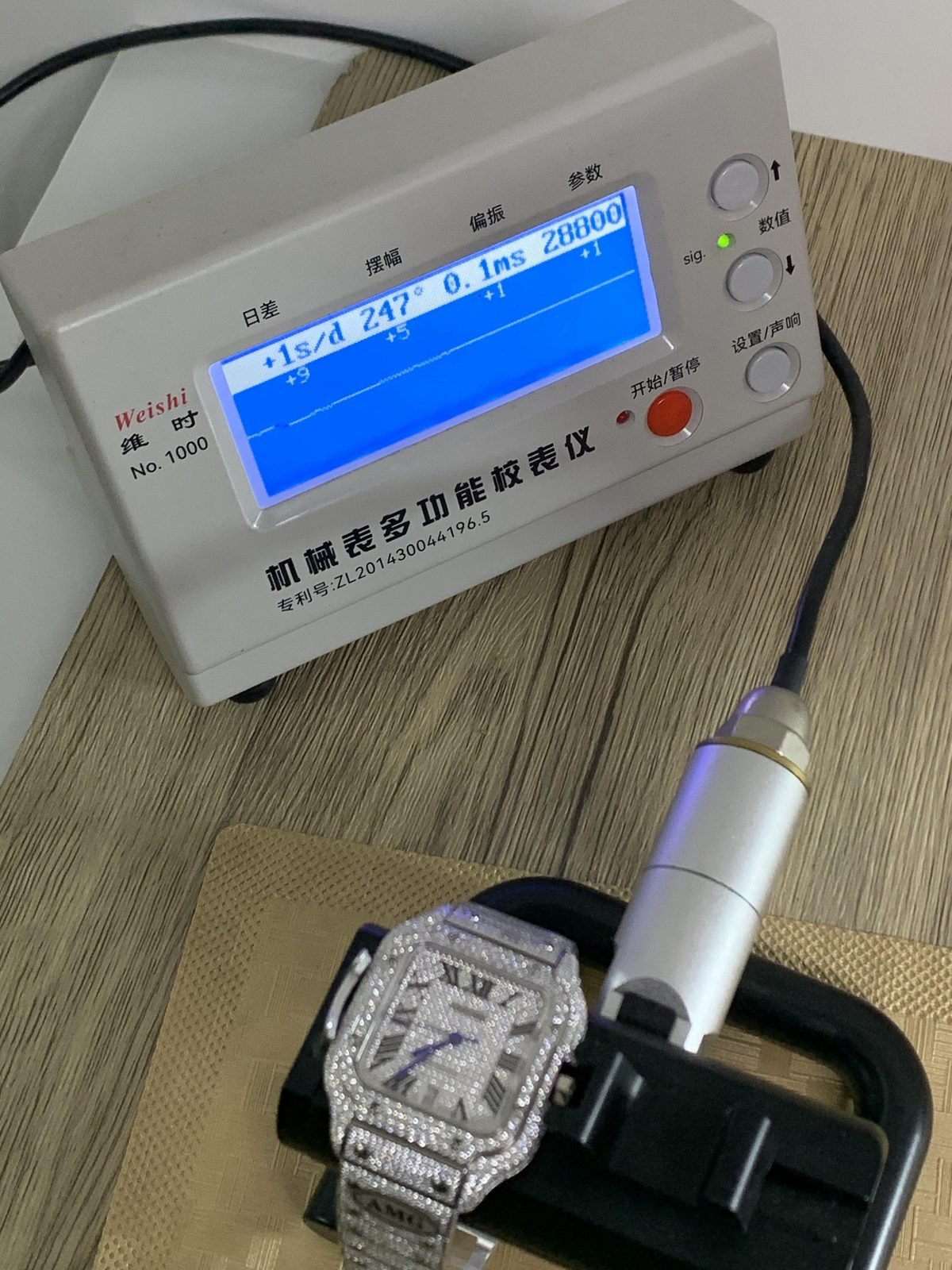
A timegrapher can show rate, amplitude and beat error for one position under particular settings. Request several positions after the movement is fully wound and allow it to stabilize. Record lift angle and beat rate if known. Treat the numbers as a snapshot, not a long-term guarantee or a movement identity test.
Rolex says its finished Superlative Chronometer watches are tested after casing to a rate deviation of minus 2 to plus 2 seconds per day. The brand explains this on its precision page. That criterion describes genuine Rolex certification. A replica that produces a similar timegrapher number in one position has shown one similar result, not the same certification protocol.
Measure power reserve by fully winding the watch, setting a start time, leaving it stationary and recording when it stops. Repeat only if you need confirmation. For water resistance, use a qualified pressure test tied to the exact unit. ISO 22810 and ISO 6425 show that water-resistant and dive-watch claims have defined scopes and test methods. A dial inscription or seller category is not a pressure result.
Provenance and service create a hard boundary
This is the layer where even a visually excellent replica cannot be close in the same sense. An original Rolex has a manufacturer, authentic parts, brand-issued records and an authorized service route. A replica copies protected identifiers but is not issued by Rolex.
Rolex’s five-year guarantee applies under stated conditions to new watches sold by Official Rolex Jewelers. The brand says watches materially modified with non-genuine parts are excluded. Its service procedure includes component assessment, genuine replacement parts, refinishing, precision checks and pressure testing.
Rolex Certified Pre-Owned is also different from a high quality replica watch. The RCPO program verifies eligible second-hand watches through participating official jewelers, services them and provides a two-year international guarantee. Packaging, a serial-style engraving or a seller card cannot create that status.
If provenance is part of your definition of close, the replica reaches a firm limit no matter how well the case or dial is reproduced.
Use evidence that matches the claim
| Seller or reviewer claim | Evidence that can help | What the evidence supports | What still needs a separate check |
|---|---|---|---|
| “Looks identical” | Same-scale front and side images under plain light | Visible similarity from those angles | Dimensions, underside, operation and internals |
| “Same material” | Independent material analysis or traceable specification | Tested composition of the sampled part | Every component and batch consistency |
| “Clone movement” | Clear movement images, declared base calibre and function video | Visible architecture and demonstrated functions | Origin, hidden parts, durability and serviceability |
| “Keeps Rolex-level time” | Multi-position timing and longer wrist record | Rate behavior during the recorded period | Rolex certification, shock, magnetism and future stability |
| “Waterproof” | Dated pressure test linked to the exact unit | Result under the stated test conditions | Future seal condition and use outside that scope |
| “Perfect QC” | Fresh unit-specific photos and continuous video | Visible condition and demonstrated actions | Hidden defects, long-term reliability and other units |
The wording matters. Say “the marker appears centered in this image” instead of “the dial is perfect.” Say “the chronograph started, stopped and reset in this video” instead of “the movement is identical.”
A practical 15-minute closeness check
- Confirm the target reference. Keep the official specification beside the replica’s written specification.
- Match the configuration. Dial, bezel, bracelet, clasp and function set should belong together for that reference.
- Check front geometry. Compare marker positions, hand lengths, date placement, bezel alignment and dial spacing.
- Check side geometry. Compare thickness, crystal height, bezel profile, lugs, crown guards and end-link fit.
- Inspect finish transitions. Look where polished and brushed surfaces meet and where edges should remain defined.
- Operate every control. Wind, set time and date, rotate the bezel and use each advertised complication.
- Review movement evidence. Record the declared family and compare architecture without treating engraving as proof.
- Separate performance tests. Timing, power reserve and pressure resistance need their own unit-linked records.
- Check the ownership layer. Decide whether lack of brand provenance, guarantee and authorized service fits your goal.
If a seller will not provide evidence for a layer, mark it unknown. Unknown is more accurate than assuming the best.
How close are the best replica Rolex watches in practice?
The strongest examples can be visually convincing at normal viewing distance, especially when the target reference, overall proportions, dial layout, bezel and bracelet are handled carefully. Macro inspection, operation, movement examination and measured testing usually reveal more separation. Provenance and Rolex’s manufacturing, certification, guarantee and service systems remain fundamentally different.
So the useful answer is not a universal percentage. It is a comparison record for one exact unit. Define the original reference, inspect the watch at several distances, operate its functions, test each performance claim separately and keep identity apart from appearance. That tells you how close the watch is in the ways that matter to you without pretending that visual similarity turns it into an original.
Looking for a Top-Tier Clone or Custom Build?
Direct access to VS, ZF, 3KF, Clean & BTF factory stock. We provide detailed multi-angle QC photo & video approval prior to final payment.