Everything You Should Know About High-End Super Clone Watches
Verified Reddit Watch Specialist (RepTime / RepGuild)
High-end super clone watches are usually presented as the upper tier of the replica-watch market. The phrase sounds precise, but it is not an independent grade, a protected definition, or a certification. One seller may use it for cleaner finishing, another for a decorated movement, and another for the most expensive version in a catalog. You need evidence for the exact watch instead of trusting the label.
That does not mean every sample is identical. Exterior finishing, bracelet fit, function execution, movement choice, regulation, and quality control can vary. The useful question is not whether a watch has been called high-end. It is which parts of the proposed unit you can inspect, measure, test, service, and document before you buy.
Treat high-end as a claim that starts your inspection, not a conclusion that ends it.
Read quality as several separate layers
| Quality layer | What you can inspect | Evidence to request | What remains unproven |
|---|---|---|---|
| Reference accuracy | Dial layout, hand shape, case profile, bezel, crown, bracelet, clasp, and visible functions | Original-brand reference page plus current sample photos | Authenticity, original parts, and brand approval |
| Exterior execution | Printing, alignment, transitions, polishing, brushing, gaps, dust, and surface damage | Sharp images under soft and side light from several angles | Exact alloy, coating thickness, hidden surfaces, and long-term wear |
| Function execution | Winding, setting, date, GMT, chronograph, bezel, crown, pushers, and clasp | One continuous video tied to the reserved sample | Future reliability and internal condition |
| Movement evidence | Visible architecture, setting sequence, rate, amplitude, and beat error | Movement view, base-caliber explanation, and a current timegrapher video | Proprietary identity, service history, parts quality, and lifespan |
| Performance claims | Timing, power reserve, water resistance, magnetic resistance, and shock resistance | A separate named test for each property | Results outside the stated conditions or after later damage |
| Fit and handling | Measured dimensions, first-link spread, bracelet range, weight, crown access, and clasp feel | Measurements and an uncut handling video | Comfort on your wrist over a full day |
| Ownership support | Return process, parts route, local service, written defect standard, and transaction record | Policy, invoice, service discussion, and payment protection | Authorized warranty, official provenance, and predictable resale |
High-end is a seller category, not a universal standard
Watch standards define particular terms and tests. ISO 6426-2 covers horological vocabulary, while ISO publishes separate standards for properties such as water resistance and magnetic resistance. None creates a worldwide grading ladder for super clone watches.
Ask what the seller means by high-end in practical terms. Does it identify a particular case construction, a base caliber, a movement decoration package, a later production revision, or only a higher price? Request a written specification for the configuration and the sample identifier. If the answer stays at phrases such as best quality, 1:1, or same as original, you still do not have a usable definition.
A factory nickname does not solve this problem. Names can be copied, reused, translated differently, or attached to mixed inventory. Treat the label as a search clue. The reserved unit, current evidence, and written terms are what you are deciding whether to accept.
Build a reference map before you inspect the replica
Start with the exact original reference rather than the model family alone. Dial color, bezel, bracelet, clasp, case size, and movement can change within one collection. A clean comparison depends on matching the right configuration.
Use official pages to understand the original design and operating logic. A Rolex Datejust reference page, for example, describes one original configuration. A Cartier Santos skeleton page describes another. These pages are reference maps. Their materials, caliber, certification, guarantee, and service coverage do not transfer to a replica that resembles the design.
Create a short feature list: visible dial details, hand stack, crown and pusher behavior, bezel direction, date or GMT operation, bracelet type, clasp, and measured dimensions. This keeps you focused on the features you will actually use. It also helps you catch a seller who combines photographs or specifications from different versions.
Exterior quality needs more than one flattering photograph
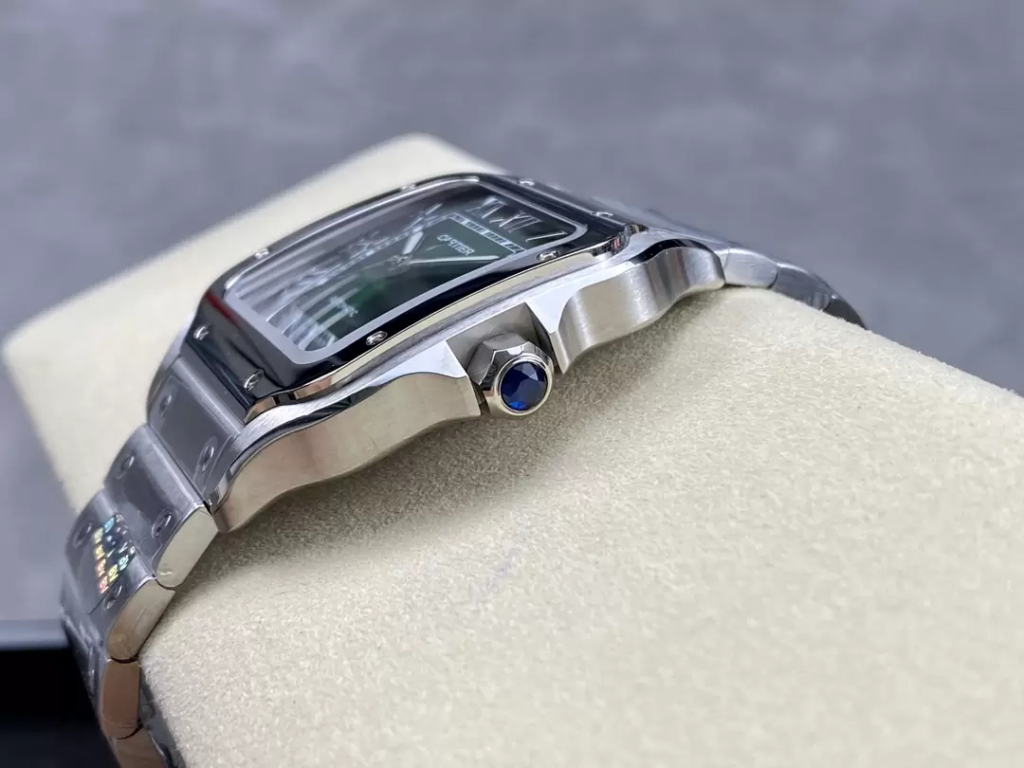
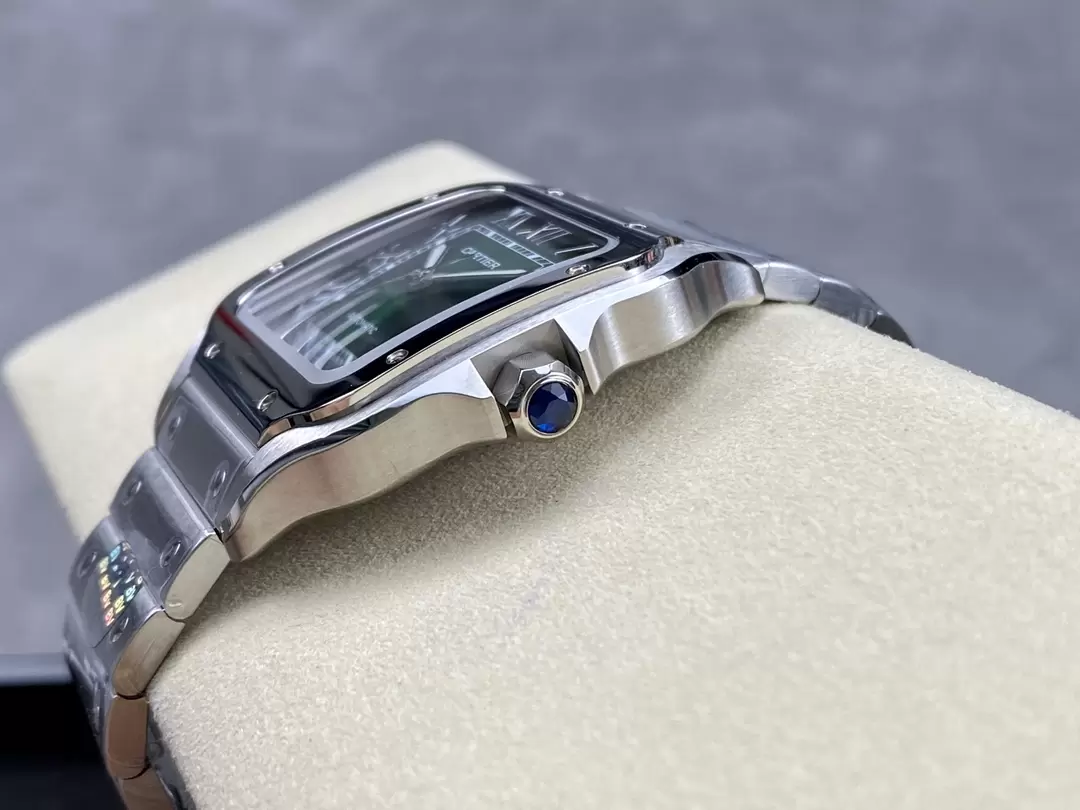
The supplied side-profile image above is useful for studying case geometry. You can look at the crystal edge, bezel height, brushed and polished transitions, crown position, screws, end-link fit, and how the first bracelet links leave the case. The image does not prove authenticity, exact material, internal movement, pressure resistance, or durability.
Request a straight front view, both sides, case back, crown, clasp, end links, and close views of the dial and hands. Soft light shows overall appearance; stronger side light can reveal scratches, dents, residue, uneven brushing, and wavy polishing. Ask for one frame containing a current order code or another harmless sample identifier so you can connect the files to the reserved unit.
Look for consistency rather than microscopic perfection. Check whether hour markers point toward the minute track, printing stays sharp at the edges, hands clear one another, the date sits inside its window, bezel marks align at their intended positions, and gaps appear even. On a watch with exposed screws, compare their seating and surrounding finish. A single angle can hide a tilted marker, high crystal, loose end link, or rough case transition.
Movement appearance, identity, and behavior are different questions
A movement can resemble the layout of an original caliber without being that caliber. Bridges, rotors, plates, engravings, and decorative parts can change the view while the working mechanism is based on a different architecture. Ask for the known base caliber, winding direction, setting sequence, beat rate, parts route, and service options. If a seller cannot explain those items, treat the movement identity as unknown.
Published specifications for a known base movement can help you ask better questions. The MIYOTA 8215 page lists the manufacturer's specifications for that caliber. It cannot identify a movement from a distant photograph, and its stated performance does not automatically apply to a modified, decorated, or differently named mechanism.
Use a continuous function video. Ask the seller to show winding, time setting, quick-set features, hand alignment, crown closure, and each complication from a known starting position. A chronograph should start, stop, and reset visibly. A GMT watch should show which hand adjusts and how the date responds. The video proves the demonstrated behavior on that sample at that time; it does not predict years of use.
Make sample-level QC more important than catalog reputation
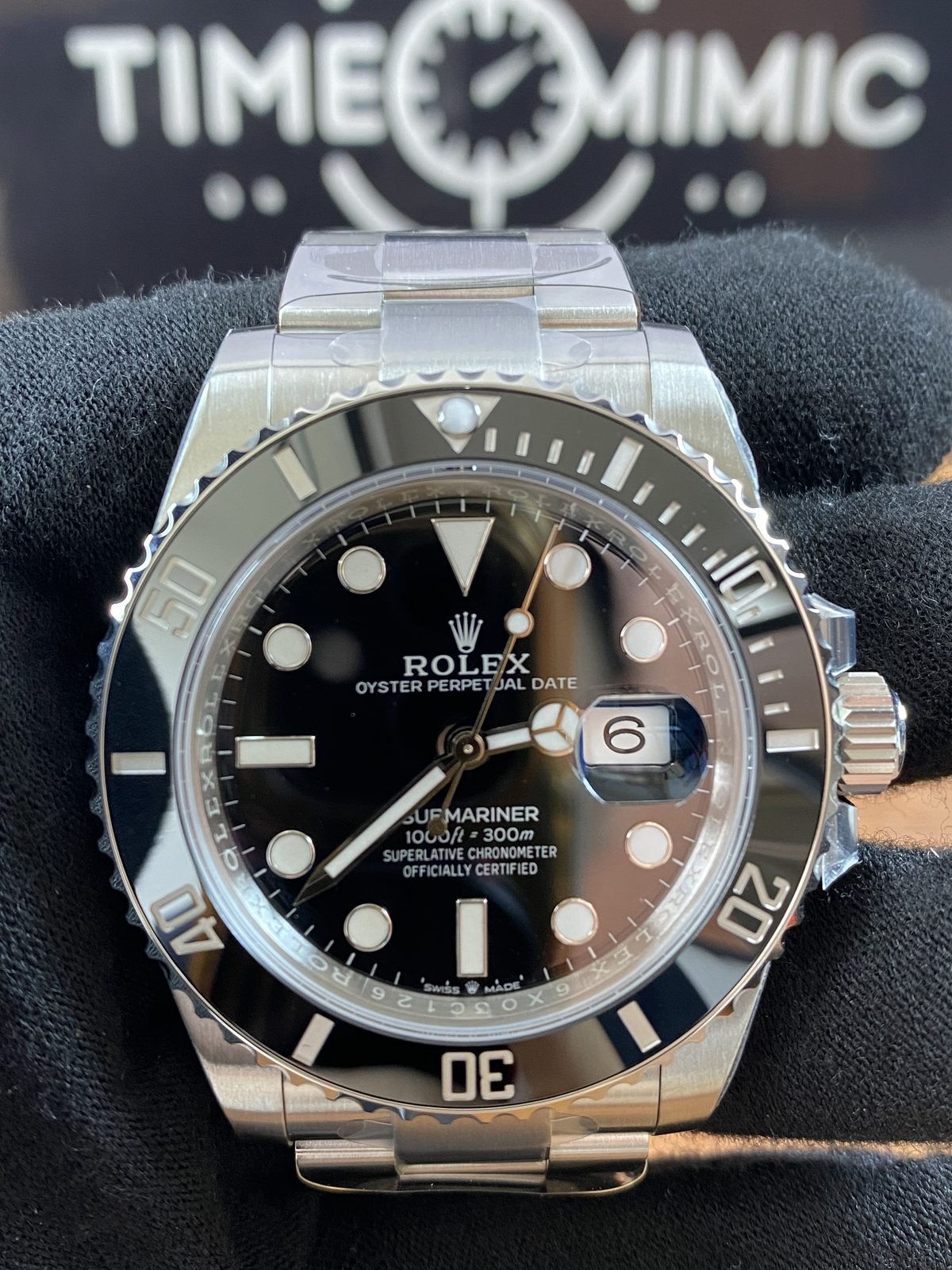
The close-up QC image below is an example of evidence you can inspect. It can reveal visible alignment, surface condition, hand position, bezel relationship, and bracelet integration on one photographed watch. It cannot establish the sample's origin, exact materials, movement identity, sealing, or future reliability.
A useful watch QC guide should produce a set that is current, clear, and complete enough to reject the unit. Ask for original-resolution files where possible. Compare identifying marks, reflections, hand positions, protective films, and backgrounds across the set so that one watch is not being represented by several unrelated images.
Write your approval criteria before the files arrive. Separate visible defects you will reject from small variations you can accept. If the seller replaces the unit, configuration, dial, bracelet, or movement claim, begin the review again. Approval of one sample should not be treated as approval of the next.
Performance claims need their own tests
Timing, power reserve, water resistance, magnetic resistance, and shock resistance describe different properties. One result cannot prove all of them. METAS Master Chronometer certification is a controlled program with defined examinations. A seller's use of similar vocabulary or one instrument photograph is not equivalent to that certification.
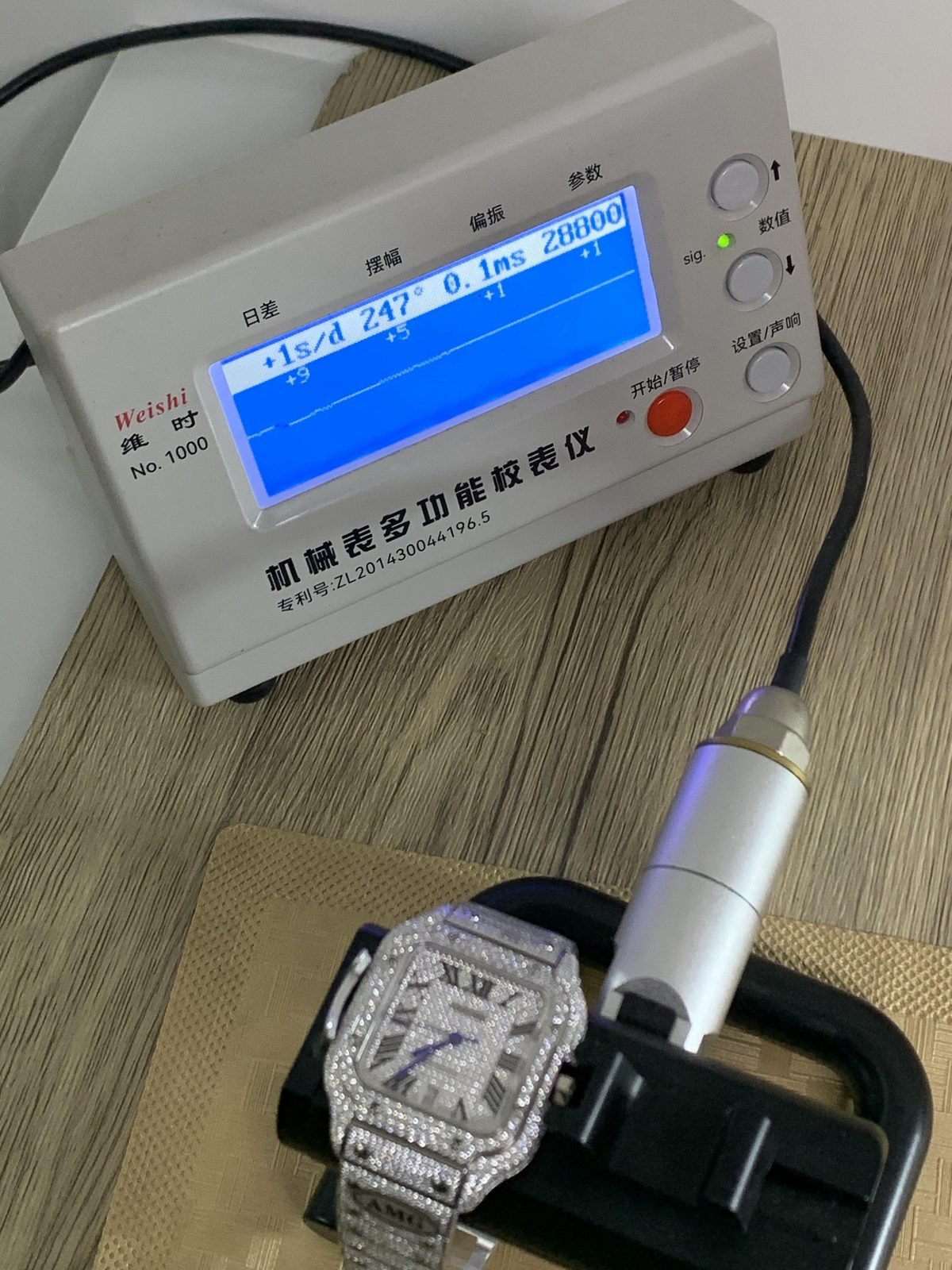
The timegrapher image below shows one visible measurement setup from one photographed sample. A timegrapher can display rate, amplitude, and beat error for the stated position and conditions. Ask for the lift angle used, state of wind, position, duration, and a continuous view linking the screen to the watch. The reading does not prove power reserve, water resistance, caliber identity, shock history, or performance in other positions.
Water resistance requires a separate method. ISO 22810 specifies requirements and test methods for water-resistant watches. If a seller claims a unit was tested, ask for the tester, method, pressure, date, sample identifier, and result. A screw-down crown, gasket, or printed depth rating is not a pressure-test record. If water exposure matters to you, arrange a local independent test after delivery and after any case opening.
Magnetic resistance is also separate. ISO 764 addresses magnetic-resistant watches. Keep the watch away from strong magnets unless its performance is known, and have unusual timing changes checked rather than assuming the sample has the protection of the original design.
Fit, bracelet construction, and handling shape perceived quality
A watch can look convincing in a photograph and still feel wrong on your wrist. Measure a watch you already wear comfortably. Record case diameter, thickness, lug-to-lug span, first-link spread, bracelet range, clasp length, and approximate weight. Ask for the same measurements on the proposed configuration instead of relying on catalog dimensions.
Pay attention to articulation. Fixed or wide first links can make a bracelet wear larger than the case number suggests. Check how the end links move, whether links bind, how the clasp closes, whether the crown is easy to use, and whether sharp edges touch the wrist. Request a slow handling video with sound if clasp and bezel feel matter to you.
Weight is not a quality score by itself. More weight can come from dimensions, solid components, or material choices, but it does not identify an alloy or prove accuracy. Balance, fit, finishing, and comfortable operation tell you more about daily use.
Serviceability can matter more than the first impression
Before buying, ask a local watchmaker whether they will inspect or service replica watches. Describe the claimed base movement without presenting the claim as established fact. Ask whether common wear parts are available, whether regulation and pressure testing are possible, and what happens if decorative components obstruct service.
Original-brand ownership includes a separate system. Rolex explains that its servicing procedure is performed within its authorized framework, and its Certified Pre-Owned process ties authenticity and provenance to official controls. Those systems do not follow a replica. Price your purchase with that difference in mind.
Include inspection, sizing, a possible early repair, return shipping, and eventual movement replacement in your budget. A lower purchase price can still create a high total ownership cost when parts and local support are uncertain. That ownership calculation matters more than the luxury replica watch label. If you cannot identify a realistic service path, assume the watch may become uneconomical to repair.
Keep transaction and legal boundaries visible
Save the final specification, seller identity, website domain, payment recipient, invoice, QC files, approval message, shipping terms, return address, defect definition, and tracking. The FTC's marketplace guidance recommends checking the seller, item information, return terms, and payment protections. Confirm that the actual transaction type is covered by any protection you expect to use.
Counterfeit and trademark rules vary by location and shipment route. The OECD's 2025 report on counterfeiting and the Swiss economy describes the enforcement problem around counterfeit Swiss products, including watches. WIPO provides a broader intellectual-property enforcement overview. Check official local guidance for possession, import, travel, customs, and resale rather than accepting a seller's general assurance.
Never offer a replica as genuine. A high quality replica watch may provide a visual or mechanical experience you value, but it does not acquire the original brand's identity, provenance, authorized warranty, certification, or resale status.
Match every claim to minimum useful proof
| Claim | Minimum useful proof | Weak evidence |
|---|---|---|
| The finishing is high-end | Current multi-angle photos under different light, tied to one sample | One retouched catalog image |
| The movement is a named caliber | Clear movement view, setting behavior, base-caliber explanation, and independent inspection where practical | Rotor engraving or a factory nickname |
| The timing is good | Continuous timegrapher video with position, state of wind, settings, and sample identity | A cropped screen with no watch visible |
| The power reserve meets a number | Fully wind the sample, record the start, leave it undisturbed, and record the stop time | A movement specification copied from a different caliber |
| The watch is water resistant | Documented pressure test tied to the sample, plus local retest after delivery | A screw-down crown or printed depth rating |
| The material is a stated alloy | Reliable documentation or appropriate independent material analysis | Color, weight, magnet response, or seller wording alone |
| The watch can be serviced | A local watchmaker's willingness, known base movement, and plausible parts route | A broad promise of lifetime support |
Your practical high-end checklist
- The exact original reference and replica configuration are written down.
- The seller explains what high-end means for this version without relying only on a nickname.
- Current QC files show the front, back, sides, crown, clasp, end links, dial, hands, and all visible functions.
- One continuous video demonstrates winding, setting, date or complication behavior, and clasp operation.
- Movement identity, timing, power reserve, pressure, and material claims each have their own evidence.
- Measured dimensions and bracelet range fit your wrist and intended use.
- You know who can inspect or service the watch and what an early repair could cost.
- Payment, shipping, return, defect, customs, and sample-substitution terms are saved in writing.
- Official local rules have been checked for your purchase and delivery route.
- You are comfortable declining the watch if one important claim remains unsupported.
Final answer
The best way to understand high-end super clone watches is to stop treating high-end as one overall grade. Break the watch into reference accuracy, exterior execution, movement evidence, function behavior, measured performance, fit, serviceability, transaction terms, and legal risk. Then connect each claim to the exact sample and the right form of proof.
You may find a carefully finished watch with functions and fit that suit you. You may also find that the evidence stops at a polished catalog description. The difference becomes clearer when you inspect one unit at a time, keep performance claims separate, budget for ownership after delivery, and remember which benefits belong only to an authenticated original.
Looking for a Top-Tier Clone or Custom Build?
Direct access to VS, ZF, 3KF, Clean & BTF factory stock. We provide detailed multi-angle QC photo & video approval prior to final payment.