Exploring the Technology Behind Super Clone Watches
Verified Reddit Watch Specialist (RepTime / RepGuild)
The technology behind super clone watches is a chain of ordinary engineering disciplines used toward a difficult imitation task. It starts with measuring a reference design, continues through machining, forming, coating, printing, movement selection, assembly, and regulation, and ends with inspection. No single machine turns a copy into a convincing watch. The result depends on how well every small decision fits the next one.
That answer also needs a boundary. Replica factories rarely publish audited process sheets, tolerance records, material certificates, or full test plans. You can study what a photographed watch reveals, compare dimensions and functions, and request sample-level tests. You cannot safely infer a hidden factory process from a polished listing or a grade name.
Use technology to turn claims into checks. Ask what was measured, what movement is inside, what was tested on your sample, and what evidence you can keep after payment.
A watch is a system, not a collection of buzzwords
A mechanical watch joins dozens of interfaces in a very small space. The crystal must fit the case and gasket. The dial feet must locate the dial over the movement. The hands need enough vertical clearance to pass each other and the crystal. The crown, stem, tube, and keyless works must transmit several different motions. The bracelet and clasp must fit the case while moving freely.
Genuine manufacturers publish useful examples of this systems approach. Rolex says its development and assembly, movement production, case and bracelet production, and dial and ceramic production are divided across specialized sites in its watchmaking overview. Grand Seiko describes one studio that covers movement development, cases, dials, hands, indexes, assembly, and adjustment in its Shinshu Watch Studio profile. Those pages describe the original makers. They help you understand the number of disciplines involved; they do not prove that a replica uses the same processes.
This is why one impressive feature cannot settle quality. A clean dial cannot rescue poor hand clearance. A familiar movement cannot correct a misaligned bezel. A bright polish cannot prove the steel grade. A timegrapher photo cannot establish water resistance.
The technology stack at a glance
| Technology layer | What it controls | What you can inspect | What remains unknown without records |
|---|---|---|---|
| Reference capture | Shape, spacing, proportions and surface geometry | Measured dimensions and comparison photos | Instruments, model files and target tolerances |
| Machining and forming | Case, bezel, crown, links, clasp and movement holder | Symmetry, fit, articulation and measured size | Alloy identity, tool control and process capability |
| Surface finishing | Brushing, polishing, edges, color and coatings | Reflection, grain direction and transition lines | Coating chemistry, thickness and wear life |
| Dial and hand production | Printing, markers, lume, date window and hand shape | Macro alignment, print edges and hand clearance | Ink, lume compound, attachment strength and aging |
| Movement engineering | Functions, dimensions, winding, frequency and service path | Crown sequence, timing, power reserve and open-case view | True caliber, modifications, lubrication and parts supply |
| Assembly and testing | Cleanliness, sealing, regulation and final function | Dust, alignment, pressure result and continuous videos | Batch consistency and long-term reliability |
Reference capture and digital comparison
The first technical problem is geometry. A maker needs the case diameter, thickness, lug or bracelet interface, bezel profile, crown position, dial opening, marker locations, hand stack, date position, and movement envelope to agree with one another. Digital calipers, optical measurement, profile projectors, photography, and CAD can all support that work. Yet you should treat any claim about a particular scanner or software package as unverified unless the seller supplies credible records from the actual manufacturer.
You can judge the result without knowing the machine. Request the diameter, total thickness, lug-to-lug or effective wrist span, bracelet taper, clasp length, and weight of the exact configuration. Compare straight-on and side photographs with the correct original reference. Do not compare one generation with another just because the brand name is the same.
Reference capture is also where small errors spread. If the dial opening is wrong, the minute track may look crowded. If the movement sits too low, the stem can meet the crown at an angle. If the hand-stack height is wrong, the seconds hand may touch the minute hand or crystal. These are tolerance-chain problems, not cosmetic trivia.
Machining, forming, and tolerance control
Cases and bracelet parts may be cut, drilled, turned, milled, stamped, forged, sintered, or cast before finishing. The visible shape does not tell you which route was used. It also does not prove the exact alloy. When a listing says 904L, titanium, ceramic, or precious metal, ask for supplier documentation or an independent material test if the distinction affects your decision.
The best public manufacturing references show why the unfinished geometry matters. Grand Seiko says its mechanical-watch cases are first formed by a 300-ton cold-forging press in an official case-making account. That is an original-brand example, not a replica-factory claim. The lesson for you is that final appearance starts before polishing. A rounded edge or wavy plane may come from the underlying part, and extra polishing can remove more definition instead of restoring it.
Check the places where parts meet. Look for even gaps around the bezel, crystal, end links, clasp, crown guards, and case back. Operate every bracelet link and clasp component. A high quality replica watch should be judged by repeatable fit and function, not by a front photograph that hides the interfaces.
Surface finishing is controlled geometry
Polishing and brushing change how a case reads under light. A mirror plane should reflect without obvious waves. A brushed plane should have a consistent grain. The boundary between them should follow the intended ridge instead of bleeding across it.
Grand Seiko explains that Zaratsu polishing aims for a smooth, distortion-free surface while preserving sharp ridge lines in its official finishing article. Patek Philippe describes separate hand-finishing operations on movement components in its craft account. These examples show that finish is an operation with geometry and sequence behind it. They do not mean that similar-looking copies receive the same work.
Use moving light rather than one studio image. Ask for a slow video that rolls the case and bracelet under a single light source. Watch whether straight edges stay straight, whether the brushing direction changes unexpectedly, and whether polished recesses contain compound or scratches. On an integrated bracelet, look across several links because a local finish difference becomes obvious as the reflections move.
Color coatings need separate scrutiny. ISO 16253 covers general requirements and test methods for vapor-deposited coatings on watch cases and accessories. A seller saying PVD or DLC does not prove compliance with that standard. Ask what the base metal is, whether the color is a solid alloy or a surface layer, and how exposed edges are expected to wear.
Crystal and anti-reflective treatment
Sapphire is a material claim, while clarity is a system result. Crystal shape, thickness, inner or outer anti-reflective treatment, gasket geometry, cyclops placement, and dial spacing all affect what you see.
ISO 14368-4 defines terminology, test methods, and result evaluation for anti-reflective treatment on sapphire watch glasses, with possible use as a reference for mineral glass. It gives you a better way to think than asking whether a watch has blue coating. Color alone does not establish the treatment, its location, adhesion, or durability.
Ask for a video under indoor light and daylight. Look for double reflections, haze, distortion at the edge, scratches, chips, dust below the crystal, and correct magnifier position where applicable. An outer coating can improve clarity but may show wear more readily. You need the seller’s actual specification and the sample’s visible condition.
Dial, printing, markers, and hands
The dial compresses many processes into a few square centimeters. A base plate may be stamped or machined, textured, plated, painted, lacquered, printed, drilled, and fitted with applied markers. Patek Philippe describes the dial as a sequence of specialized operations in its official dial overview. Its guillochage page also explains a specific decorative method used on genuine pieces.
For a replica, do not use those original methods as assumptions. Inspect the output. A sharp macro photograph should show whether letters have clean edges, minute marks share a common radius, markers sit squarely, lume stays within its intended boundaries, and the date window is cut cleanly. Ask for several date numbers because a single centered numeral says little about the whole disc.
Hand production has the same issue. Correct shape is only the beginning. Check hand length, center-hole finish, paint or plating, lume fill, horizontal level, and vertical clearance. Request a continuous video through a full hand overlap if you suspect contact. A brief clip with the hands parked apart can hide the fault.
Movement technology: identify the architecture first
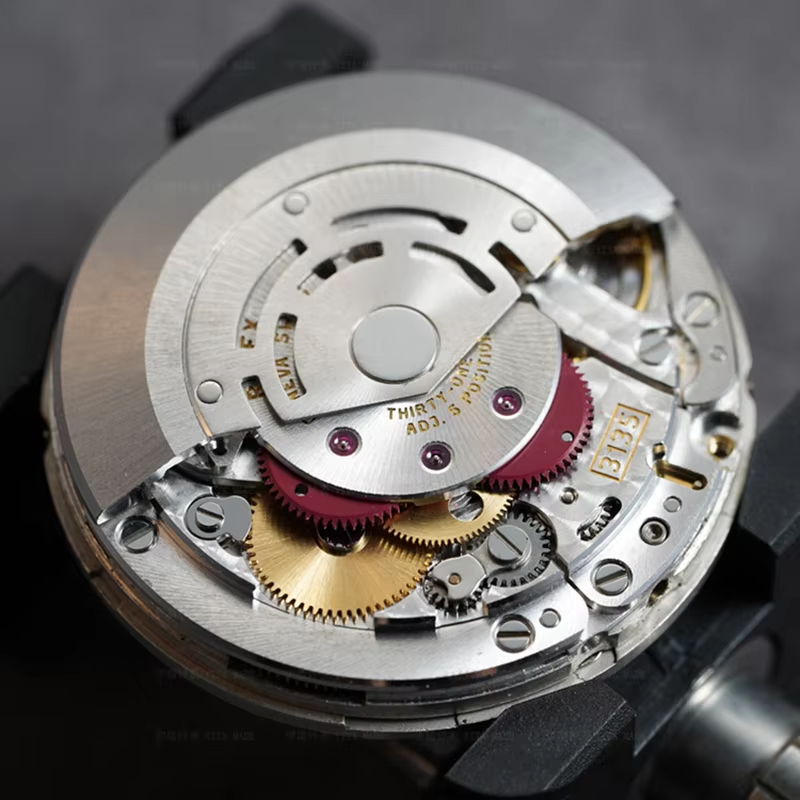
Movement labels create more confusion than any other part of replica watches. You may encounter a standard commercial caliber, a decorated commercial caliber, a modified movement that relocates a display, or a mechanism intended to resemble the original layout. Each approach creates a different balance among appearance, function, thickness, parts access, and repair difficulty.
Start with verifiable dimensions and functions. Miyota lists its 9015 as a 3.90 mm high automatic caliber with hand winding, stop seconds, quick date correction, 28,800 vibrations per hour, and a stated running time of more than 42 hours in the official product catalog. Its 9015 specification sheet also documents hand and movement clearances. Time Module lists the NH35 as a 5.32 mm high, 21,600-vibration, 24-jewel automatic caliber with stop seconds in its NH product line. The NH35 technical guide provides functional, timing, winding, and parts information.
Those documents are useful only when the movement identity is real. Rotor engraving can be added, bridges can be reshaped, and photographs can come from a different watch. Ask for the exact caliber in writing, an open-case-back image of your sample, the crown-setting sequence, beat frequency, date-change behavior, and the repair plan. If possible, have a watchmaker compare the visible architecture with the claimed movement.
An automatic replica watch with a documented standard movement may offer a clearer parts path than a closer-looking mechanism with uncertain components. That does not make every standard movement installation good. Spacers, stem alignment, hand height, date alignment, and casing still matter.
Search labels such as Swiss super clone watches or exact replica watches are not movement specifications. A country adjective does not identify the caliber, origin of each component, assembly location, regulation standard, or warranty route. Replace the label with a caliber number and evidence.
Assembly: where good parts can still fail
Assembly joins the technology stack. Dust control, correct tools, lubrication amount, screw torque, gasket condition, hand pressing, dial seating, and regulation affect the finished watch. Rolex’s service procedure describes disassembly, cleaning, lubrication, reassembly, precision checks, casing, waterproofness testing, and final control for genuine Rolex service. It is a useful model of separate control steps, not evidence that an unrelated copy received them.
Look at what assembly leaves behind. Macro photographs can reveal dial dust, fibers, fingerprints, damaged screws, uneven hand levels, marks on the rehaut, or a pinched gasket. A crown that feels gritty, a rotor that scrapes, a clasp that releases under light pressure, or a date that hangs between positions points to a functional issue even when every part looks correct in a still image.
You should also ask who will repair the watch. Some watchmakers decline counterfeit-branded items. Others may accept a standard movement but not an unfamiliar clone-style caliber. Get that answer before you buy rather than treating future service as an automatic option.
Regulation and timegrapher data
A timing machine listens to the movement and estimates rate, amplitude, and beat error from the escapement signal. The reading is useful, but it is conditional. Position, state of wind, lift-angle setting, test duration, temperature, magnetism, and movement condition all affect interpretation.
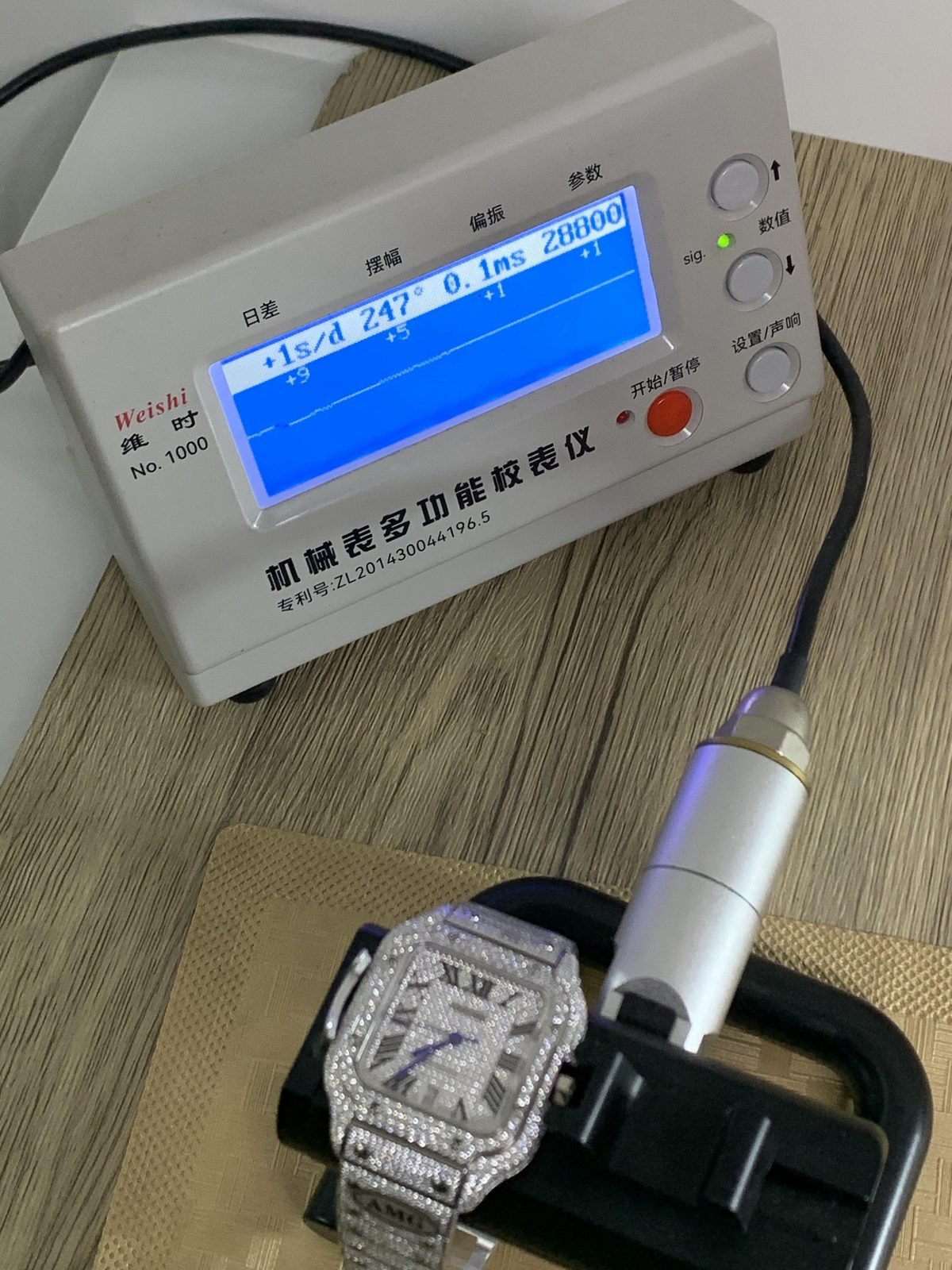
The supplied QC image used here shows one visible timing-machine screen for one sample. It is evidence of that test moment only. Ask for the watch identifier in the same uncut video, a full wind, the machine settings, and readings in several positions. Then compare the result with real wear over several days.
ISO 3159 defines the term chronometer and its test program for wrist chronometers with spring-balance oscillators. METAS Master Chronometer certification addresses complete-watch performance areas including water resistance, chronometric performance, magnetic resistance, and power reserve under a controlled program. Copied dial text does not transfer either certification to a replica.
Water resistance requires a test of the finished sample
Water resistance comes from the assembled system: crystal fit, crown and tube, case back, pushers where present, gaskets, contact surfaces, and final tightening. A design copied from a dive watch does not carry the original rating with it.
ISO 22810 sets requirements and test methods for water-resistant watches. ISO 1413 separately addresses shock resistance. These standards show why a printed depth and a pressure result are different things.
If you intend to expose the watch to water, request a recent pressure test tied to the exact finished sample. Ask whether it was dry or wet, the pressure used, the test duration, and the pass criteria. Retest after the case is opened. Treat a waterproof replica watch search phrase as a question to verify, never as a permission slip to swim.
Wear, coatings, and hard exterior parts
Durability cannot be read from a launch photo. ISO 23160 describes tests for resistance of cases and bracelets to wear, scratching, and impacts. ISO 18684 covers performance and test methods for certain hard-material watch exterior parts. These standards do not certify a sample unless the relevant testing and conformity are documented.
For your decision, focus on likely contact points. Examine clasp edges, bracelet center links, bezel corners, crown guards, screw heads, and coating transitions. Ask how the seller handles early coating failure, loose screws, broken spring bars, or a ceramic insert that cracks in shipping. Technology has value when it comes with a test or remedy.
Remote QC turns a distant watch into inspectable evidence
Remote QC uses familiar tools: high-resolution photography, controlled lighting, macro lenses, measurement tools, video, timegraphers, and pressure testers. The technology is simple compared with manufacturing, but it can sharply improve your decision when the files belong to the actual watch.
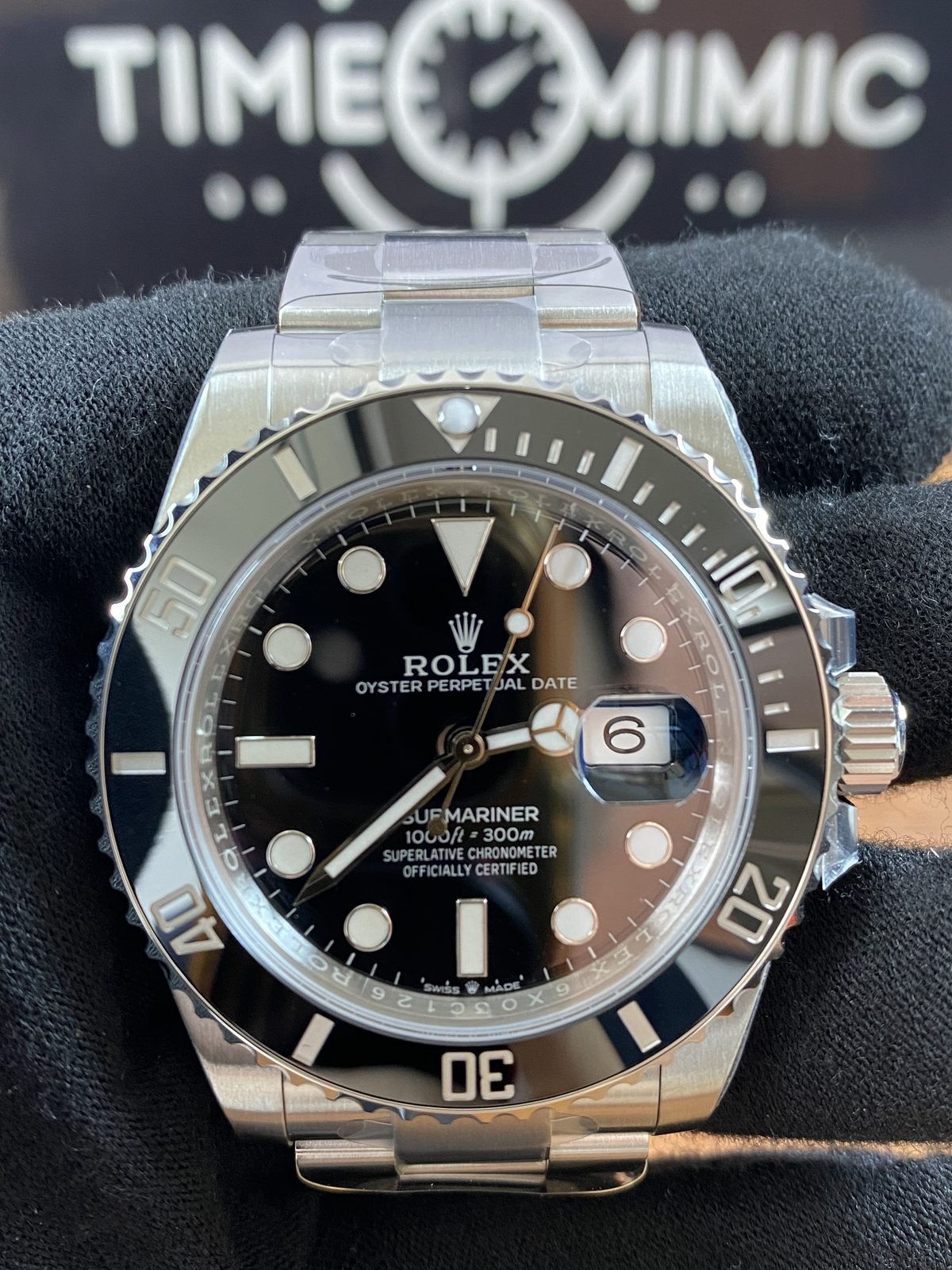
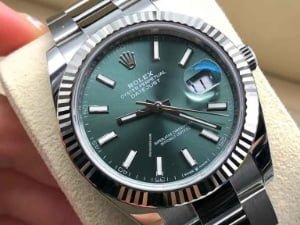
The front-view QC image used here is helpful for visible alignment and condition. It does not establish the movement, exact material, pressure resistance, or long-term reliability. Build your own inspection packet instead of relying on a seller’s best image.
| Evidence request | What it can answer | What it cannot answer by itself | Better version to request |
|---|---|---|---|
| Straight-on macro | Dial, date, marker and bezel alignment | Case profile, movement and hidden dust | Original file plus oblique light views |
| Side-profile video | Thickness, crown, crystal and case shape | Material identity and internal fit | Include caliper readings in one take |
| Open-case photo | Visible movement architecture and condition | Hidden parts, lubrication and service life | Add caliber statement and watchmaker review |
| Timegrapher video | One or more timing observations | Certification and future wrist accuracy | Several positions, settings visible, sample ID shown |
| Pressure-test record | Result under one stated setup | Permanent water resistance | Exact sample, method, pressure, date and retest policy |
| Function video | Crown, date, GMT or chronograph behavior | Long-term wear | One uncut sequence through every function |
A practical technology audit before you buy
Work from the outside toward the movement, then return to the transaction.
- Write down the exact original reference and the replica configuration being offered.
- Record the seller’s material, crystal, coating, movement, water-resistance, and warranty claims in plain language.
- Replace grade terms with measurements, macro photos, continuous videos, or written test results.
- Check case geometry, finishing transitions, dial layout, hand clearance, bracelet fit, clasp function, and crown operation.
- Verify the movement architecture and functions rather than accepting rotor decoration or a copied caliber name.
- Request timing and pressure evidence only from the exact finished sample, with conditions shown.
- Confirm return terms, shipping responsibility, payment protection, and a realistic service route.
Keywords such as replica watches, luxury replica watch, and super clone watches can help you find listings. They do not form a shared technical standard. The phrase high quality replica watch has value only after the seller defines quality in evidence you can check and a remedy you can use.
What the technology really tells you
The technology behind super clone watches is less mysterious than the marketing around it. Measurement establishes geometry. Manufacturing creates parts. Finishing controls the surfaces you see. Movement design controls dimensions and functions. Assembly joins the interfaces. Testing measures a specific result under stated conditions.
Your safest approach is to keep those layers separate. Official manufacturing sources show what mature watchmaking can involve, but they do not document an unknown replica factory. A sample can look accurate and still have uncertain material, assembly, sealing, or serviceability. A familiar movement can be a practical choice and still be installed poorly.
You do not need access to a factory to make a better decision. You need an exact reference, an exact sample, a clear evidence packet, and transaction terms that survive a problem. That is where watch technology becomes useful to you.
Looking for a Top-Tier Clone or Custom Build?
Direct access to VS, ZF, 3KF, Clean & BTF factory stock. We provide detailed multi-angle QC photo & video approval prior to final payment.