The Evolution of Super Clone Watches: From Concept to Reality
Verified Reddit Watch Specialist (RepTime / RepGuild)
The idea behind a replica watch is old: reproduce the visible identity of a desirable design at a lower price. What has changed is the number of tools available to study, manufacture, market, and inspect the result.
Today, a seller can show high-resolution case details, name a movement architecture, send a current sample video, and provide a timing-machine screen before shipping. That makes the modern buying experience look far removed from the simple imitation many people picture. It does not mean every claim is true or every sample is consistent.
There is no transparent production archive covering every workshop, batch, or factory name used in the replica market. A responsible history should not invent one. This guide follows the verifiable changes that helped super clone watches move from a broad concept toward a product category buyers can examine in more detail.
The real evolution is not a straight line from bad to perfect. It is a shift from surface resemblance alone toward more layers of design data, component choice, sample evidence, and buyer verification.
Stage 1: The concept began with recognizable appearance
The earliest goal is also the easiest to understand. A watch looks familiar because of its dial layout, bezel, case shape, bracelet, color, and marks. A copy can reproduce some of those cues without reproducing the engineering, materials, testing, or service system behind the original.
That distinction still matters. The genuine Patek Philippe Nautilus 5811/1G-001 combines a named movement, documented white-gold construction, case dimensions, water-resistance statement, and brand support. A visually similar watch may copy the outline while using a different metal, movement, clasp structure, crystal, and gasket system.
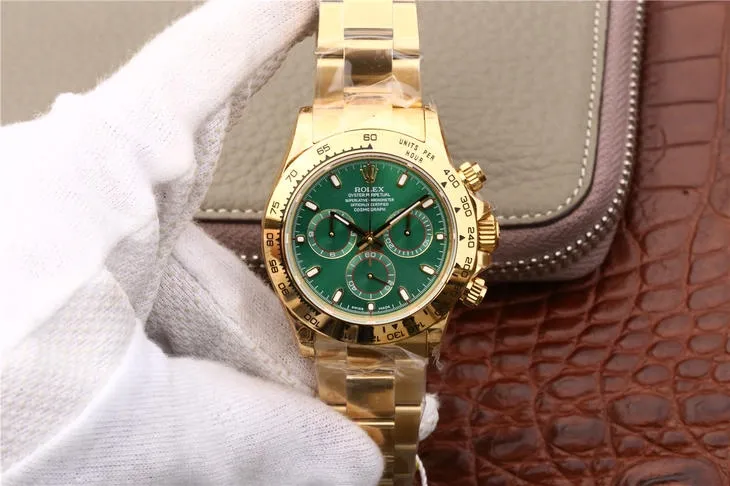
The supplied image below shows why appearance became such a strong starting point. A colored dial, precious-metal look, polished center links, engraved bezel, and chronograph layout create immediate recognition. Treat it as an editorial illustration. It does not prove the identity, material, movement, function, or condition of a sample offered for sale.
At this stage, quality was mostly discussed as resemblance. The problem is that resemblance answers only one question: does the watch create a familiar visual impression? It cannot answer whether the controls work correctly, whether the movement can be serviced, or whether the watch will survive ordinary use.
Stage 2: Timekeeping technology became easier to source at scale
The broader watch industry changed the parts available to watch makers. Quartz technology greatly reduced the cost of accurate timekeeping. Seiko’s documented heritage records the 1969 Quartz Astron and the later spread of quartz systems. Its quartz technology explanation describes how oscillator, integrated-circuit, and step-motor development made a wrist-sized system practical.
Mechanical supply also became more accessible. Miyota’s history of the Caliber 82 Series describes decades of mass production and an accessible architecture. Its mechanical-movement overview shows how standard, open-heart, GMT, and slimmer automatic options give legitimate watch makers several starting points.
That component access created more possible realities behind a replica dial. A watch could contain an inexpensive quartz unit, a documented third-party automatic movement, a modified architecture, or a movement decorated to resemble something else. The outside no longer tells you enough.
For an automatic replica watch, the useful question changed from does it tick to what architecture is inside, which functions are real, and who can service it? Official pages for the Miyota 8215 and Miyota 9015 publish different heights, frequencies, jewel counts, functions, and accuracy ranges. A seller’s movement name becomes meaningful only when the exact sample matches the architecture.
Stage 3: Digital design and manufacturing improved repeatability
Modern manufacturing can move from a digital model to a physical part with more control than hand copying alone. Computer-based measurement, machining, scanning, and process monitoring make it easier to repeat shapes and compare results.
That does not produce automatic quality. The NIST measurement program for additive manufacturing explains that digital design-to-product workflows still face variability, part accuracy, surface quality, material consistency, and qualification problems. This is a broader manufacturing lesson, not proof that a specific replica watch was made by additive manufacturing.
The genuine industry shows the gap between having equipment and controlling a complete process. Rolex describes an integrated manufacturing system across movements, cases, bracelets, dials, assembly, and testing. Its Chene-Bourg production page discusses dial operations, pad printing, applique fitting, ceramic work, and inspection.
A replica workshop may borrow the visual result without sharing that system. Better machining can narrow a case gap or improve a bezel profile, but it does not establish alloy composition, coating durability, gasket performance, or process consistency. One polished sample also cannot represent every batch.
Stage 4: Online reference material made comparison much easier
High-resolution official catalogs, review photography, forums, and video changed what both makers and buyers could see. Small differences in dial printing, hand shape, date position, bracelet taper, and movement layout became easier to study.
The official Rolex collection now gives buyers a direct reference for current configurations. Historical pages such as Rolex’s 2013 to 2022 timeline document when genuine material and design changes appeared. These sources help you check whether a listing combines features that never belonged together.
The same digital access also helps sellers reuse or steal images. A WIPO domain dispute involving counterfeit watch offers describes a site using protected marks and copied digital product images. This is why a beautiful photograph is no longer enough. You need evidence that belongs to the exact watch being offered.
Digital distribution widened the market as well. WIPO’s paper on counterfeits in online marketplaces discusses how the digital economy expanded access to worldwide buyers. The later WIPO material on technology and sophisticated counterfeiting notes that visual inspection alone has become harder as techniques improve.
Stage 5: Remote QC moved the conversation to the exact sample
One of the most useful changes is procedural rather than mechanical. Buyers can ask for front, side, clasp, case-back, movement, function, and timing views before shipping. That can turn a vague product grade into a specific sample file.
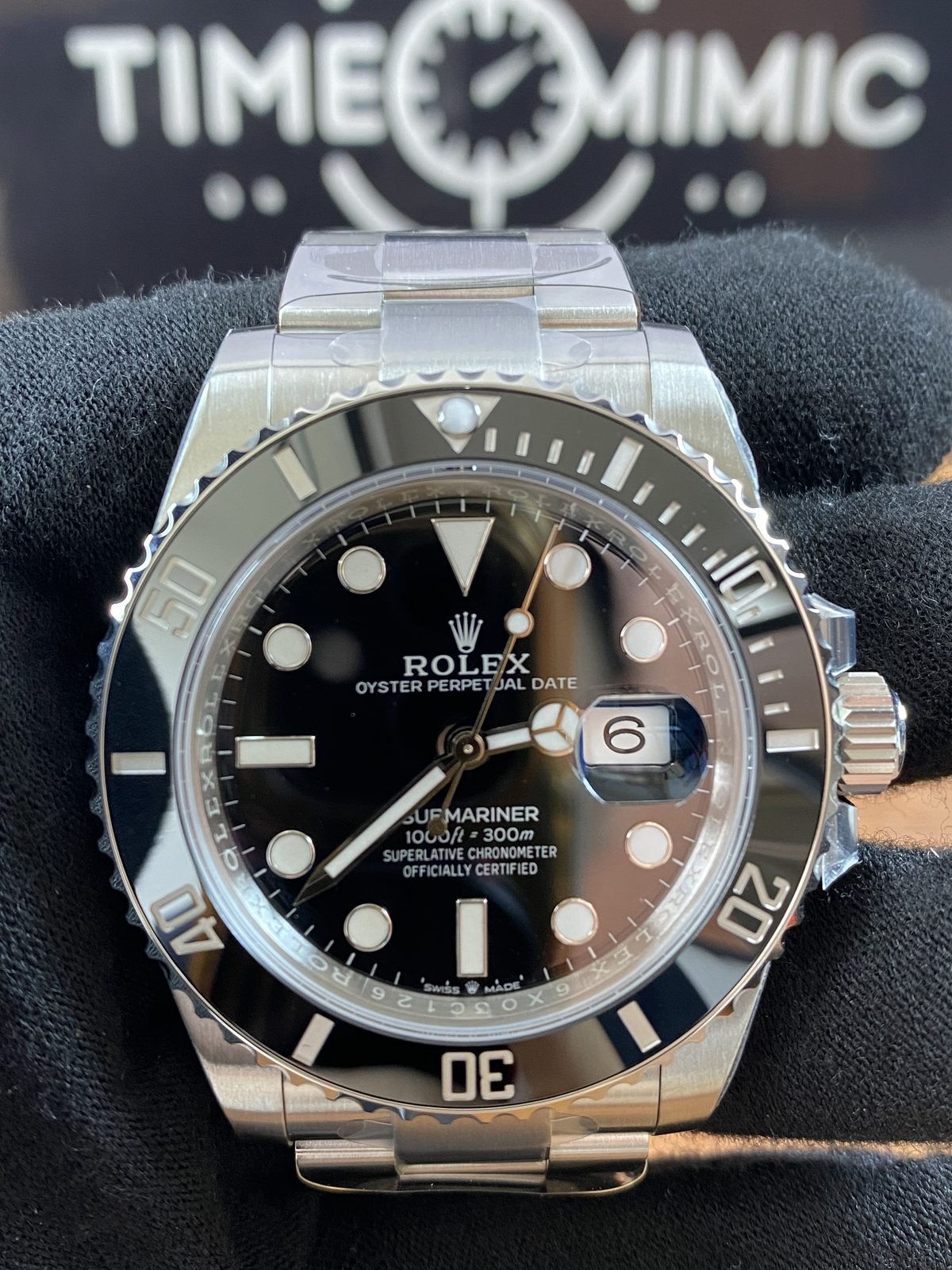
The front-view QC example below shows the limit clearly. You can inspect visible alignment, date position, printing, bezel relationship, hand clearance, and exterior condition. You cannot confirm the alloy, crystal composition, movement origin, gasket condition, water resistance, or long-term durability from the photo.
Good remote QC includes a handwritten order code, the complete watch in one continuous function video, and consistent details across every view. It reduces substitution risk. It does not eliminate it, and it cannot replace an independent inspection after delivery.
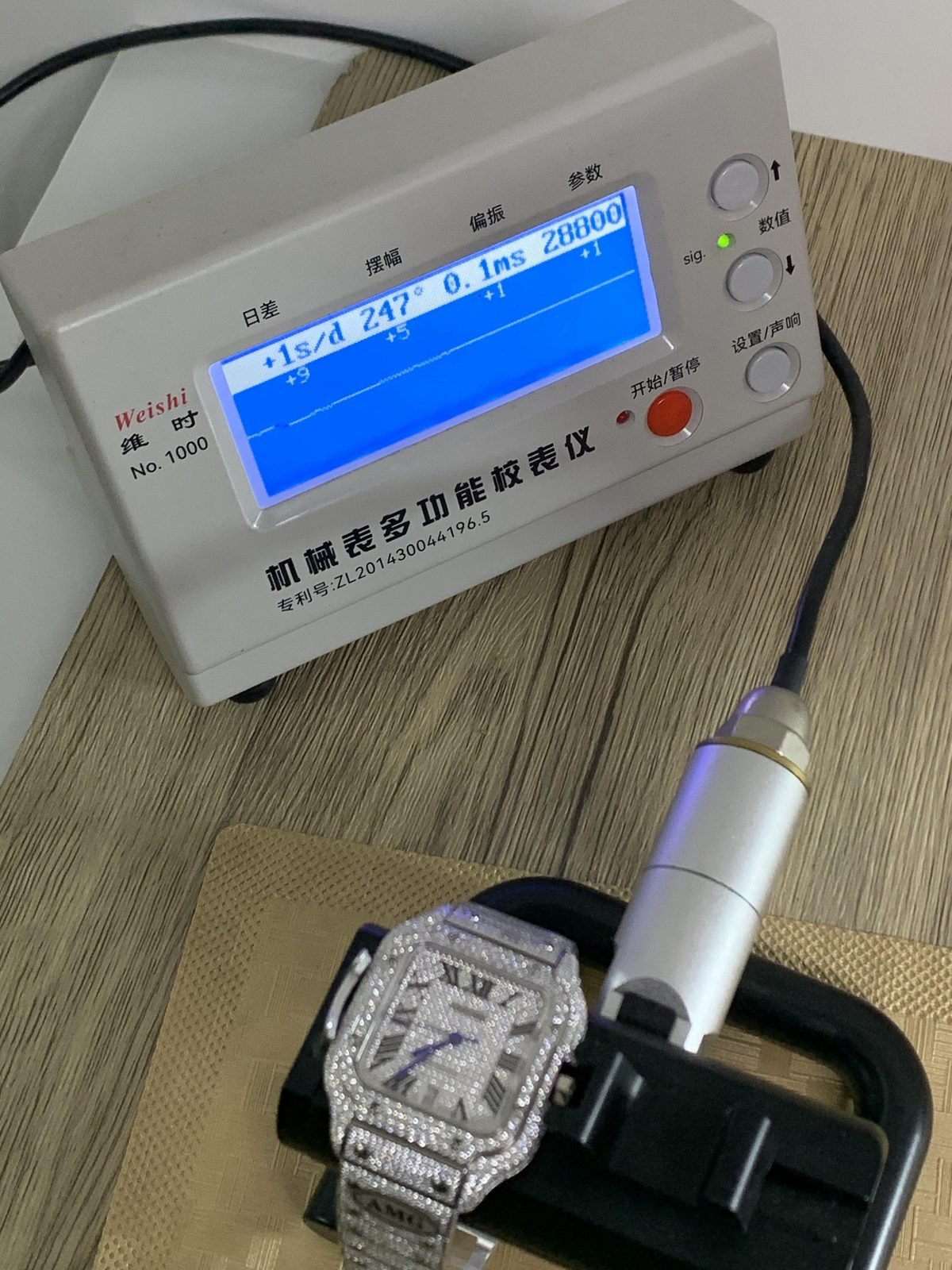
A timing machine provides one narrow layer of evidence. The display can record rate, amplitude, and beat error for one position and one winding state. Seiko’s explanation of mechanical accuracy shows why temperature, position, winding, magnetism, and use all affect performance.
The modern improvement is that you can request the reading. The remaining limit is interpretation. A single attractive number does not identify the movement, prove regulation in several positions, verify power reserve, or predict future service needs.
Stage 6: Buyers learned to separate a claim from a test
Terms such as super clone, 1:1, Swiss, waterproof, and top grade sound precise but do not describe a shared standard. The more useful modern approach is to ask what was measured, on which watch, with which method, and when.
International standards show why this matters. The ISO list of watch standards separates magnetic resistance, shock resistance, water resistance, chronometer performance, coatings, and watch-glass criteria. ISO 22810 defines water-resistance requirements and test methods, while ISO 764 covers magnetic-resistant watches.
A waterproof replica watch claim does not show that your assembled sample passed a defined test. A seller saying high quality replica watch does not show shock, magnetic, or wear performance. Each performance area needs its own evidence.
The genuine industry has also moved toward testing complete watches. OMEGA’s account of Master Chronometer certification describes tests for precision, magnetic resistance, power reserve, temperature, and water resistance. Those tests apply to certified genuine watches. They are useful as an example of layered evidence, not a badge that visual similarity transfers to a luxury replica watch.
The evolution in one evidence map
| Stage | What changed | What you can verify more easily | What still needs caution |
|---|---|---|---|
| Visual copying | Recognizable external cues were reproduced | Layout, color, case family, bracelet style | Hidden construction and durability |
| Component access | Quartz and mass-produced mechanical options expanded | Basic function and a named architecture | Substitution, decoration, modified functions |
| Digital manufacturing | Measurement and repeatable processes improved | Dimensions and visible consistency on a sample | Material qualification and batch variation |
| Online reference | Official images and specifications became easier to compare | Configuration, proportions, known genuine functions | Stolen images and mixed-reference listings |
| Remote QC | Buyers could review current sample media | Visible condition, operation, one timing setup | Shipping substitution and hidden defects |
| Test literacy | Claims could be divided into separate measurements | Pressure, rate, power reserve, function, dimensions | No single test proves total quality |
This map explains why the phrase exact replica watches became more persuasive without becoming a scientific category. More details can be copied and more evidence can be requested, but no single label closes every gap.
What has genuinely improved for you as a buyer
You can now ask better questions before money changes hands. You can compare the listing with an official reference, request current sample media, identify a documented movement, and separate a timegrapher reading from a pressure test.
You also have better transaction guidance. The FTC online marketplace guide recommends checking seller identity, return terms, actual-item photos, and safer payment methods. Those steps do not make the goods legal or authentic, but they help you understand the transaction.
Counterfeit enforcement has not disappeared as products became more detailed. The OECD 2025 mapping of trade in fakes uses customs data to show the continuing scale of counterfeit trade. The CBP intellectual-property fact sheet lists watches and jewelry as a major seizure category by value. Modern presentation does not remove import risk.
What has not changed
The dial still cannot prove the movement. A movement photo still cannot prove the steel grade. A pressure-test screen still cannot prove long-term gasket life. One QC set still cannot represent every batch. A seller’s factory story still cannot replace traceable documents.
Official brand systems remain different in kind, not just degree. Patek Philippe describes its own manufacturing and quality framework. Rolex documents an official service process tied to genuine components and brand standards. A replica can become visually closer without acquiring those systems.
| Modern claim | Evidence worth requesting | What the evidence can support | What it cannot support |
|---|---|---|---|
| Closer case and dial | Measurements and sharp current photos | Visible geometry and alignment | Alloy, coating life, factory identity |
| Upgraded movement | Clear movement view and full function video | Architecture clues and operating functions | Origin without marks and expert inspection |
| Better accuracy | Multi-position readings after a full wind | Short test behavior | Long-term stability or service interval |
| Waterproof | Dated pressure result for the exact watch | Result under the stated test | Every depth, activity, or future condition |
| Premium batch | Consistent sample file and written terms | The sample you reviewed | Every watch using the same sales label |
The current reality
Super clone watches have evolved into a market where some sellers provide more detailed samples, more complex functions, and more pre-shipment evidence than buyers once expected. The strongest progress is not the sales label. It is your ability to break the watch into claims and ask for proof of each one.
The current reality is still uneven. One sample may show careful alignment and a serviceable movement. Another using the same name may not. Some improvements are visible. Others are decoration. Some QC files belong to the offered watch. Others may be stock media.
Use the evolution to your advantage. Compare the correct reference, identify the movement architecture, request current sample evidence, test water resistance separately, use protected payment where available, and keep the complete cost within an amount you can lose. That is how the concept becomes a decision you can evaluate instead of a story you have to trust.
Looking for a Top-Tier Clone or Custom Build?
Direct access to VS, ZF, 3KF, Clean & BTF factory stock. We provide detailed multi-angle QC photo & video approval prior to final payment.