7 Key Features of the Best Super Clone Watches
Verified Reddit Watch Specialist (RepTime / RepGuild)
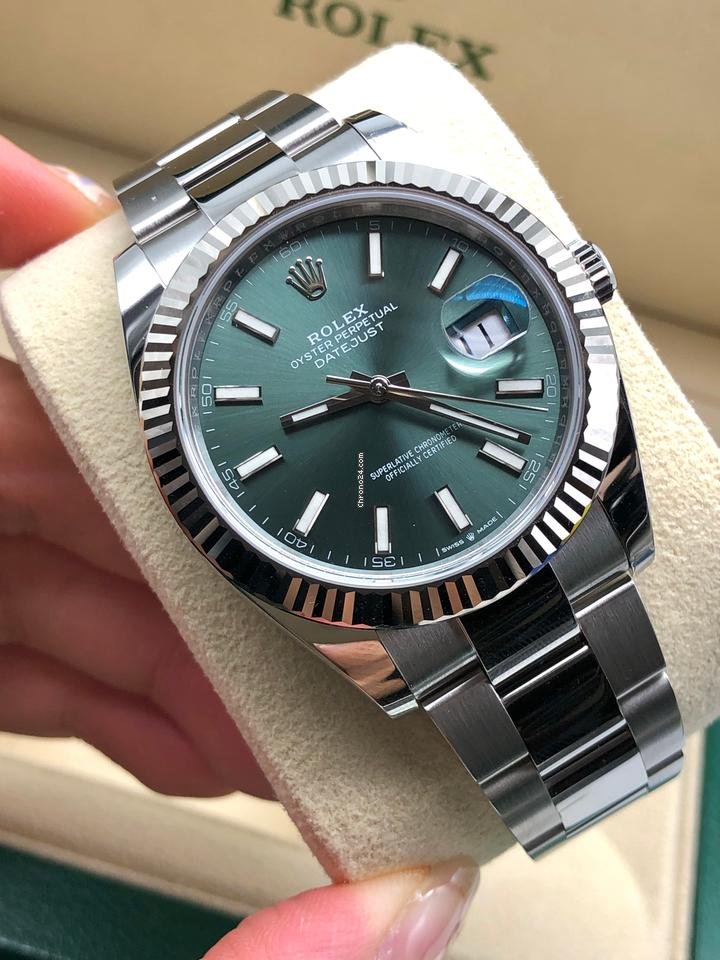
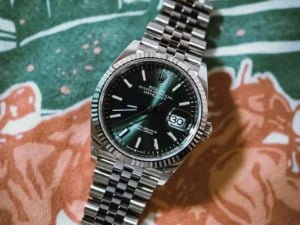
The best super clone watches are not defined by a factory nickname, a price tier, or a seller calling them “1:1.” You make a safer comparison by looking for seven practical features that can be checked on the exact watch: sensible proportions, clean visible alignment, consistent exterior finishing, demonstrated functions, test-backed water resistance, sample-specific QC, and a realistic service path.
This guide gives you a way to judge those features without needing to become a watchmaker. It also shows where the evidence stops. A replica can look convincing in photos and still offer no brand authenticity, official warranty, dependable parts supply, or collector value.
The strongest candidate is the watch that fits your wrist and use, matches the seller’s written description, and comes with evidence you can review before payment. A quality label without sample-specific proof should not decide the purchase.
The seven features at a glance
| Feature | Evidence you can request | A warning sign |
|---|---|---|
| 1. Proportions and fit | Diameter, thickness, lug-to-lug length, and wrist photos | Only a close-up photo with no measurements |
| 2. Dial and exterior alignment | Straight-on, well-lit photos of dial, hands, date, and bezel | Angled or blurred images that hide alignment |
| 3. Consistent case and bracelet finishing | Side, case-back, bracelet, clasp, and link close-ups | Mixed stock photos or missing clasp views |
| 4. Demonstrated functions | Short videos of crown, date change, bezel, clasp, and complications | A function is claimed but never operated |
| 5. Test-backed water resistance | A current pressure-test result for the exact watch | “Waterproof” stated in a message with no test |
| 6. Sample-specific QC | One coherent photo set tied to your order | QC from a different color, model, or reference |
| 7. Serviceable ownership | Written return terms, repair route, parts plan, and full cost | No answer about defects, returns, or repairs |
1. Proportions that make sense on your wrist
A well-proportioned watch looks convincing because the case, bezel, dial, lugs, crown, and bracelet share the same visual scale. You do not need calipers to notice a crown that appears too large or a bezel that makes the dial look crowded, but measurements help you move beyond first impressions.
Start with four numbers: case diameter, thickness, lug-to-lug length, and bracelet width. Diameter gives you a starting point. Lug-to-lug length tells you how far the watch actually reaches across your wrist. Thickness affects whether it sits comfortably, slides under a cuff, or feels top-heavy. Bracelet taper changes both comfort and visual balance.
Chrono24’s current sizing guide recommends judging diameter, lug-to-lug distance, wrist shape, thickness, bezel, and strap together. Its guide on why diameter alone is not enough makes the same point in practical terms.
Compare the seller’s numbers with a watch you already wear comfortably. Then compare them with the official reference only to understand the intended proportions. For example, Rolex lists the current Submariner Date 126610LN as 41 mm, Patek Philippe lists the Nautilus 5811/1G-001 as 41 mm by 8.2 mm, and Audemars Piguet lists the Royal Oak 15510ST as 41 mm by 10.5 mm. Those official pages are reference points, not proof that a replica matches the published dimensions or construction.
If the seller cannot provide basic measurements, do not guess from a magnified product image. A watch can photograph beautifully and still feel wrong after one hour on your wrist.
2. Clean alignment and readable details
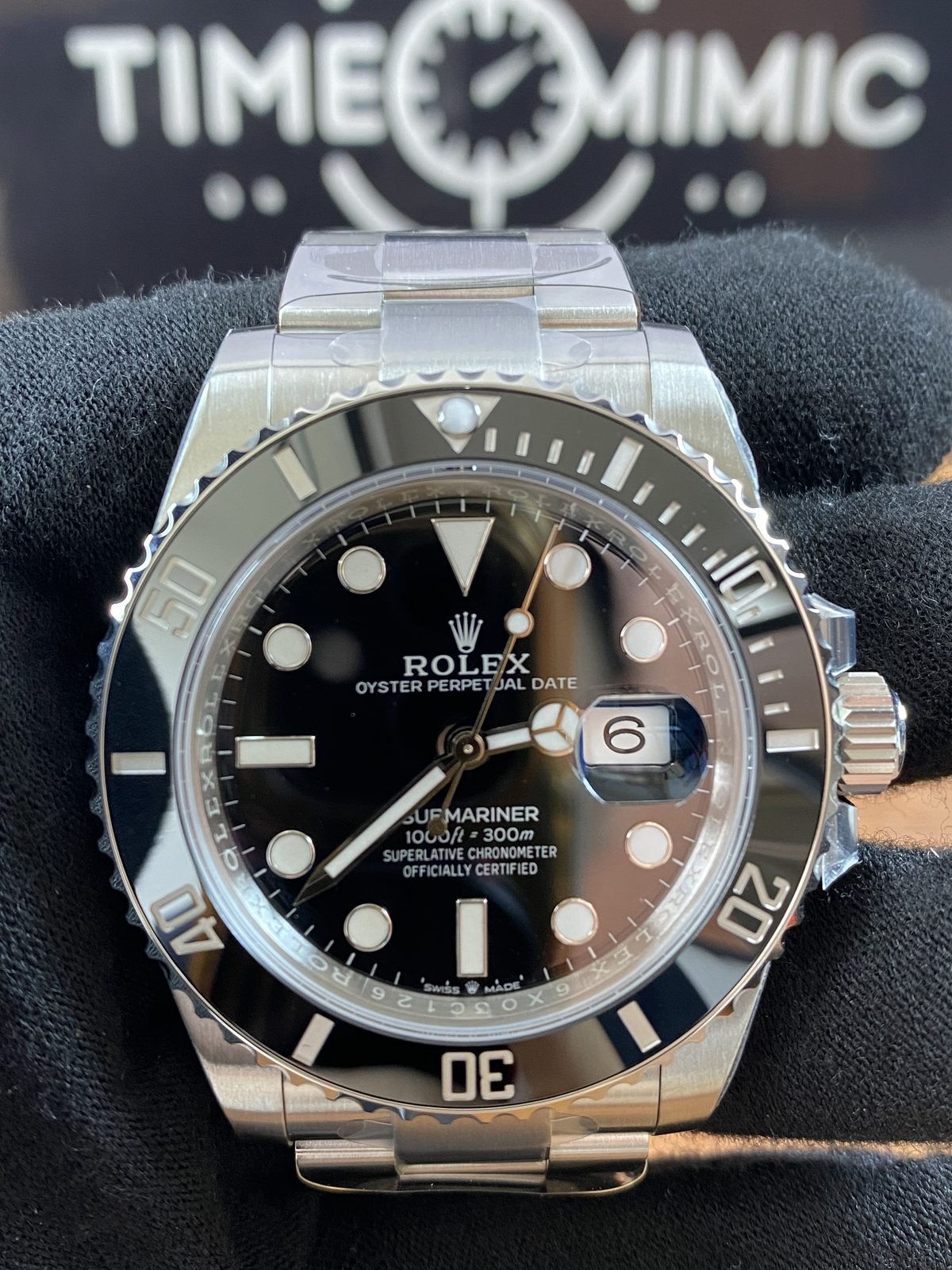
The second feature is visible order. Your eye notices small relationships before it notices individual parts: hour markers should follow the minute track, the date should sit naturally in its window, the hands should clear one another, and a rotating bezel should line up with the dial at its neutral position.
Ask for a straight-on photo taken at enough resolution to inspect these points:
- Twelve o’clock marker, logo, and six o’clock text on one vertical line
- Equal-looking spacing around applied hour markers
- Hands that do not visibly touch each other or the dial
- A date that is centered rather than pressed against one side of the window
- Bezel zero marker aligned with the twelve o’clock index
- Printing without obvious smears, missing characters, or dust beneath the crystal
Legibility matters as much as resemblance. Rolex’s official Submariner page describes broad hands and simple marker shapes as functional reading aids. That does not make a replica a dive watch, but it gives you a useful design principle: the time should be easy to read at a glance. If decorative details make the hands disappear into the dial, the watch may look impressive in a close-up and remain frustrating in normal use.
Remember that one minor alignment issue may matter less than a watch that is comfortable and reliable for your use. Decide your tolerance before you examine the photos. Otherwise, zooming in can turn every tiny variation into a reason to worry.
3. Consistent case, bracelet, and clasp finishing
Finishing should look deliberate from one surface to the next. Brushed areas should run in a consistent direction. Polished edges should not appear wavy. The transition between polished and brushed surfaces should look controlled rather than fuzzy. On a bracelet, the links should articulate without obvious gaps, sharp burrs, or a clasp that sits crooked when closed.
Request more than the front view. A useful QC set includes both case sides, the crown, case back, end links, bracelet, open clasp, closed clasp, and any adjustment system. These images help you check whether the watch shown from the front is the same sample shown from the side.
Comfort is part of quality. Ask yourself:
- Do the end links extend beyond your wrist?
- Does the clasp have enough adjustment for changes in temperature?
- Are screw heads or link pins visibly damaged?
- Does the crown appear easy to grip without pressing into your hand?
- Are there exposed sharp edges where the bracelet touches skin?
Do not use color alone to identify a material. Steel grade, gold content, plating method, crystal composition, and ceramic formulation cannot be confirmed from a photograph. Treat claims about “904L steel,” sapphire, solid gold, or a particular coating as unverified unless the seller provides relevant, sample-specific evidence.
4. Functions that are demonstrated, not merely listed
A good-looking watch can still disappoint if the crown feels wrong, the date does not change properly, a chronograph is decorative, or the bezel moves unevenly. The fourth feature is simple: every function you are paying for should be demonstrated on the exact sample.
Ask for a short, continuous video when a function matters. You may want to see:
- The crown released, wound, and returned to its normal position.
- The hands set through a full cycle without jumping or binding.
- The date advanced through the crown and, where relevant, across midnight.
- The bezel rotated and returned to its alignment point.
- The clasp opened, closed, and adjusted.
- A chronograph started, stopped, and reset to zero.
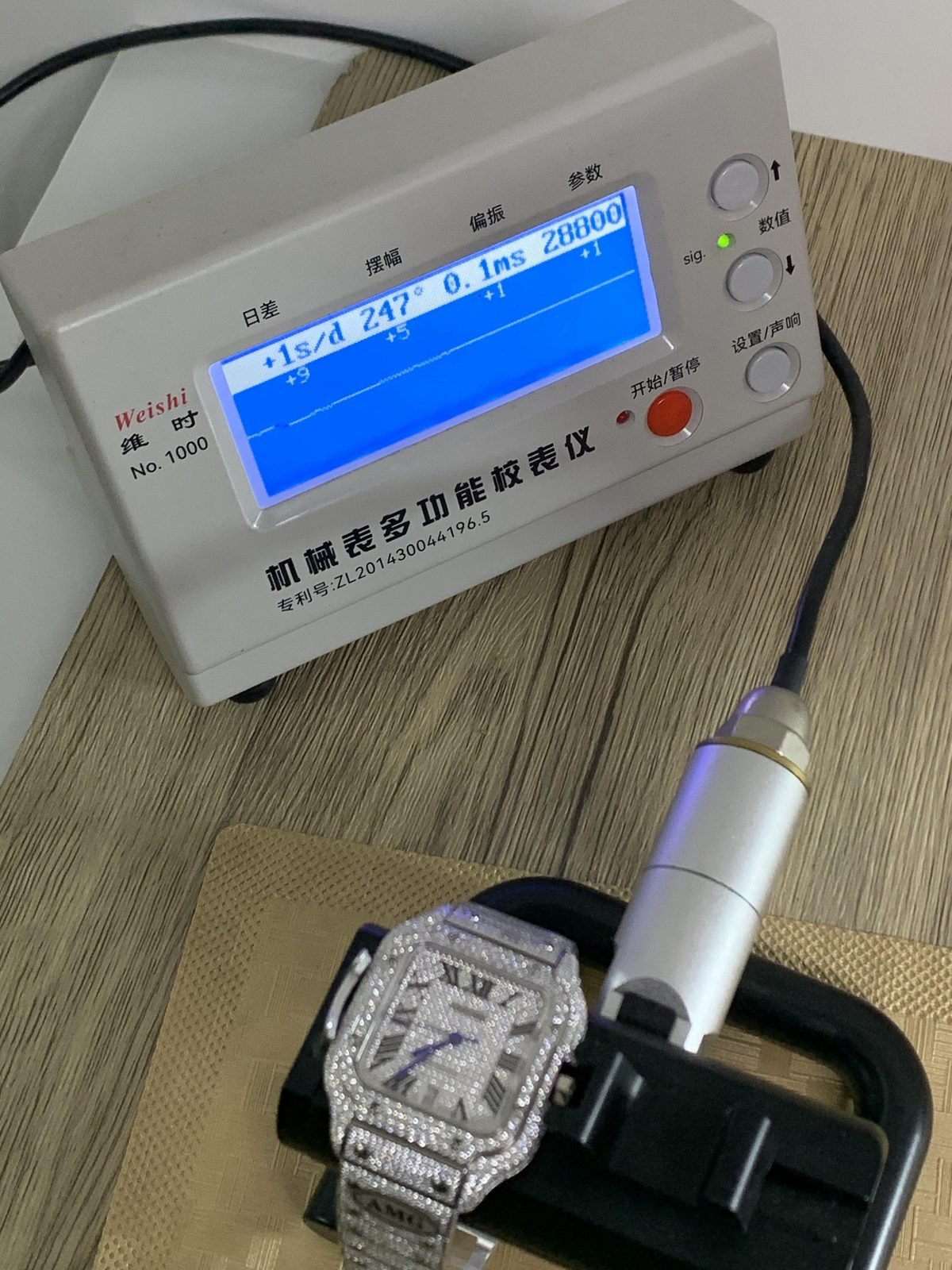
A timegrapher image can add useful information for a mechanical watch, but it needs context. Ask which position was tested and whether the watch was fully wound. The screen records one rate, amplitude, and beat-error reading under one setup. It does not prove future accuracy, shock resistance, power reserve, service life, or movement origin.
Independent certification shows how much broader real testing can be. METAS explains that Master Chronometer certification covers the complete watch and includes water resistance, chronometric performance, magnetic resistance, and power reserve. A seller screenshot is not equivalent to that program. Use it only for the narrow information it actually shows.
5. Water resistance supported by a relevant test
Water resistance is one of the easiest features to overstate. A screw-down crown, a thick case, or a seller message saying “waterproof replica watch” cannot tell you whether the assembled watch will resist water.
ISO 22810 defines requirements and test methods for watches marketed as water-resistant. Seiko also notes that water resistance can decline as gaskets age or parts are affected by shock. These sources give you the practical rule: water resistance is a tested condition, not a permanent visual feature.
If you plan to expose the watch to water, request a current pressure test tied to the exact sample. Ask what test was performed, the result, and when it was done. Even a successful test describes the condition at that time. Opening the case, damaging the crown, or ageing a gasket can change it later.
If there is no relevant test, keep the watch dry. That answer is less exciting than a depth rating, but it protects both the watch and your expectations.
6. Sample-specific QC you can trace to the order
The best super clone watch QC is a coherent evidence set, not the largest number of photos. Each image should show the same reference, color, dial, bracelet, and visible marks. If one picture shows a different date, bezel, sticker, or background, ask the seller to explain the difference.
The FTC’s online-marketplace guidance recommends looking for photos of the actual item and checking the seller, return rules, total cost, and payment protection. It warns that stock photos cannot show condition or even prove that the seller has the item.
Use this ten-minute QC sequence:
| Step | What to check | What it cannot prove |
|---|---|---|
| Identity | Reference, color, bracelet, date, and repeated sample marks | Brand authenticity |
| Front view | Marker, hand, date, bezel, and printing alignment | Hidden construction |
| Side and back | Thickness, gaps, crown position, exterior finish | Gasket condition or water resistance |
| Bracelet and clasp | Scratches, link fit, screws or pins, closure | Long-term durability or exact alloy |
| Function proof | Crown, date, bezel, clasp, and complication operation | Future reliability |
| Test evidence | Readable screen, sample identity, position, and date | Lifetime accuracy or movement origin |
Save the listing, QC set, written promises, payment receipt, and return terms together. If the delivered watch differs materially from the evidence, those records show what was agreed.
7. A realistic service, return, and total-cost plan
The final feature is not visible in a glamour photo. When you compare replica watches, ownership support matters because a watch is easier to live with when you know what happens after delivery.
Ask the seller four direct questions before payment:
- What is the inspection and return window after delivery?
- Who pays return shipping if the watch differs from the QC evidence?
- What happens if a demonstrated function does not work?
- Can the movement be repaired locally, or is replacement the likely solution?
Official brands publish systems that show what structured ownership support looks like. Rolex describes authorized service, genuine parts, and warranty conditions. Seiko states its warranty coverage and exclusions. Citizen, Tissot, and Cartier also publish service or warranty routes. A replica does not inherit any of that support because it resembles the product.
Set a repair reserve and assume no dependable resale value. Include shipping, payment fees, bracelet sizing, a replacement strap, and one possible repair in the total. A high quality replica watch is not a bargain if one failure turns it into an unusable object.
What these features still cannot prove
Even a strong QC set cannot prove authenticity, exact metal composition, licensed production, factory identity, long-term accuracy, future parts availability, or safe use in water. It also cannot remove customs or trademark risk.
The European Commission explains customs enforcement for IPR-infringing goods. U.S. Customs and Border Protection describes only a narrow traveler personal-use exemption. The OECD’s 2025 watch-sector analysis notes that online buyers can bear the financial loss when a counterfeit watch is seized after payment.
Check the current rules for your location and travel plans. Do not assume that personal wear, online availability, or a seller’s shipping promise makes import or resale lawful everywhere.
Your pre-purchase scorecard
Give one point for every “yes” answer:
- Do you have the diameter, thickness, lug-to-lug length, and bracelet width?
- Do the measurements fit a watch you already wear comfortably?
- Is there a straight-on, sample-specific dial photo?
- Are the case sides, back, bracelet, and clasp visible?
- Are the functions you care about demonstrated?
- Is every water-use claim supported by a relevant test?
- Does one coherent QC set match the exact order?
- Are the return window and defect process written down?
- Do you have a realistic local service or replacement plan?
- Can you afford the full cost while assuming no resale return?
Eight to ten points means you have enough information to make a considered personal-use decision. Five to seven means important gaps remain. Below five, the seller is asking you to buy the promise rather than the watch.
Frequently asked questions
What is the most important feature of a super clone watch?
The most important feature is evidence tied to the exact sample. Proportions, alignment, functions, and test results are useful only when the watch shown is the watch you will receive.
Does a higher price mean better quality?
No. Price can reflect seller margin, marketing, scarcity, or included service. Compare sample-specific evidence, written policies, and total ownership cost instead of using price as a quality grade.
Can QC photos confirm a Swiss movement?
No. A case-back photo may show visible components or markings, but it does not establish movement origin, hidden parts, service history, or performance. Treat the claim as unverified unless independent evidence supports it.
Is a timegrapher result enough to judge the movement?
It is one useful data point. It records the tested watch in one position at one moment. It does not replace observation over time, a power-reserve check, function testing, or a service inspection.
Should I swim with a super clone watch after it passes a pressure test?
A current pressure test is more relevant than a seller claim, but it still describes the watch at that time. If water use matters, ask the tester what the result supports, inspect the crown and gaskets periodically, and understand that later impact or opening can change the seal.
Final answer
The seven key features of the best super clone watches are sensible proportions, clean alignment, consistent exterior finishing, demonstrated functions, test-backed water resistance, traceable sample-specific QC, and a realistic ownership plan.
Use those features as a checklist, not as a promise of authenticity. The goal is to reduce uncertainty about the exact watch you are considering. If the evidence is incomplete, the seller refuses direct questions, or the full cost would create pressure, the better feature is the ability to walk away.
Looking for a Top-Tier Clone or Custom Build?
Direct access to VS, ZF, 3KF, Clean & BTF factory stock. We provide detailed multi-angle QC photo & video approval prior to final payment.