Behind the Craftsmanship of Super Clone Watches
Verified Reddit Watch Specialist (RepTime / RepGuild)

The craftsmanship behind super clone watches is easiest to understand when you stop treating the label as a grade. A label can be copied as easily as a logo. The work you can actually examine is more specific: case geometry, surface transitions, dial printing, hand alignment, movement behavior, assembly cleanliness, and the evidence produced for one finished watch.
That distinction matters because replica watches are not made under one public standard. Two pieces sold with the same description can come from different batches, contain different movements, or receive different levels of finishing. You therefore need a way to judge the watch in front of you without relying on a factory nickname or a seller’s adjectives.
Search phrases such as luxury replica watch, exact replica watches, and Swiss super clone watches are commercial descriptions, not recognized quality certificates. They can help you find a style, but they do not tell you where a watch was made or how it was tested. Treat every production and origin claim as unverified until the seller provides evidence that can be checked.
Good watchmaking reveals itself through controlled geometry, consistent finishing, correct function, clean assembly, and repeatable tests. For a replica, you need sample-level proof for each of those points.

Start with the reference, then separate resemblance from provenance
A detailed replica begins with reference study. Makers may examine dimensions, photographs, dial layouts, case profiles, bracelet construction, and the sequence in which functions operate. Digital images and precise measuring tools make close visual comparison possible, but resemblance does not transfer the original maker’s materials, patents, certification, service network, or history.
Rolex describes a vertically integrated process in which cases, bracelets, dials, movements, assembly, and testing are handled across dedicated Swiss sites. Its overview of watchmaking lists precision, waterproofness, winding, power reserve, magnetic resistance, reliability, and durability as connected performance goals. Patek Philippe’s own quality criteria extend from movement construction to exterior geometry and long-term service.
Those systems explain why copying a visible shape is only the first layer. An exact replica watch claim may refer to appearance while leaving movement architecture, alloy, tolerances, testing, and support unspecified. When you compare a sample, use the genuine reference for design details and use separate evidence for the replica’s construction.
Case work begins with geometry
The case is where machining and finishing meet. Its middle case, bezel, case back, crystal seat, crown tube, lugs, and bracelet interfaces must fit together. Small errors can affect more than appearance. An uneven gasket seat, damaged crown tube, or poorly cut case-back thread can compromise sealing and later service.
Rolex says its cases and bracelets can require hundreds of operations, followed by manual polishing, satin finishing, visual checks, and functional checks at its Plan-les-Ouates facility. That is a brand-specific process, not evidence about a replica. It still gives you a useful inspection vocabulary.
Look for these transitions on the exact watch:
- straight and symmetrical lugs;
- even gaps where the bracelet meets the case;
- crisp borders between brushed and polished surfaces;
- a bezel that sits level and rotates or remains fixed as intended;
- a crown that starts its thread smoothly without wobble;
- a case back with no tool damage or trapped debris.
The supplied editorial photograph below shows polished and brushed surfaces meeting around a watch case and bracelet. It is useful for studying reflections and edge definition. It does not establish that a current replica sample uses the same material, construction, dimensions, movement, or finishing process.
Heavy polishing can create shine while softening corners and changing the original profile. A high quality replica watch should therefore be judged by the control of the surface, not by brightness alone. Rotate the watch under one continuous light source. The reflection line should travel smoothly across a polished plane, and the brushed grain should remain consistent in direction and density.
Dial making is a stack of small tolerances
The dial is not one printed disc. It may combine a base, color or coating, printed tracks, applied markers, lume, a date window, hands, and a surrounding chapter ring or rehaut. Each element has its own position, height, and finish. A small error becomes obvious because your eye compares it with twelve repeating hour positions.
Rolex says its dial facility uses about 60 operations for some dials, including coloring, printing, fitting appliques, and applying luminous material. Patek Philippe describes dial making as a distinct craft that combines modern production with techniques such as engraving, enameling, guilloche, and manual finishing. Its separate guillochage guide explains how human-controlled machines cut regular patterns. Breguet explains that traditional guilloche can support legibility as well as decoration. Vacheron Constantin’s Metiers d’Art overview shows how engraving, enameling, gem setting, and watchmaking require different specialist skills.
On a replica watch, a stamped or printed pattern can imitate the look of an artisanal technique without being made the same way. That difference is acceptable only when the description remains honest. Magnification can help you inspect alignment and cleanliness, but it cannot prove the claimed method by itself.
Check the dial in a straight-on photograph before you approve it. Compare the 12, 3, 6, and 9 o’clock positions first. Then inspect the remaining markers, printed minute track, date window, logo, text spacing, and lume borders. Ask for an angled view to reveal marker height and a short video to confirm that the hands clear one another through a full rotation.
Hands and controls reveal assembly quality
Hand installation looks simple until you consider the clearances. The hour, minute, seconds, and complication hands must remain parallel, sit at the correct heights, align with their scales, and avoid contact with the dial, crystal, or one another. Grand Seiko’s description of hand assembly in its 9F movement notes that multiple hands occupy only a small vertical space and require careful adjustment.
You can test a replica without disassembling it:
- Move the minute hand slowly through 12 o’clock and check whether the hour hand reaches the marker.
- Turn the hands through 24 hours and watch the date transition.
- Operate every advertised pusher and return the hands to zero several times.
- Wind, set, and screw down the crown while feeling for grinding, skipping, or cross-threading.
- Confirm that the bezel action, clasp, and quick-adjust mechanism behave consistently.
Do not force a crown or pusher that binds. A function that looks correct in one still image may fail under repeated operation. Continuous video is more useful than a collection of edited clips because it links the visible sample to the complete test.
The movement is more than a decorated rotor
An automatic replica watch may use a standard movement, a modified movement, or a layout designed to resemble the original caliber. A decorated bridge or rotor can change appearance without changing the underlying mechanism. Ask for the exact caliber designation, frequency, expected power reserve, parts availability, and evidence that the displayed functions are mechanically connected.
The movement’s real work includes storing energy, transmitting it through the gear train, controlling its release through the escapement, and regulating the rate. Rolex’s Bienne movement facility describes component manufacture, controlled environments, assembly, and rate testing as separate stages. Grand Seiko’s Micro Artist Studio discusses how design, surface preparation, assembly, and energy efficiency interact.
Fine decoration can be functional in places. Patek Philippe explains that hand finishing can remove burrs, refine edges, and protect surfaces as well as improve appearance. Audemars Piguet notes that movement decoration and jewelling precede careful assembly. These descriptions should not be used to imply that a replica receives equivalent work. They show why a photograph of stripes or polished screws is incomplete evidence.
For a serviceable replica, a familiar movement with available parts may be more practical than an elaborate copy with an uncertain supply chain. Ask an independent watchmaker whether they will accept the watch before you buy it. A movement that no one will open can turn a small fault into a complete replacement. Patek Philippe’s watchmaker training program and Audemars Piguet’s restoration workflow illustrate how much specialist knowledge sits behind genuine after-sales work. Rolex’s service description similarly separates movement, case, bracelet, cleaning, lubrication, adjustment, sealing, and final control. A replica does not gain access to those brand systems merely because its exterior is similar.
Assembly cleanliness is part of craftsmanship
Dust, fibers, fingerprints, excess lubricant, loose screws, and metal debris can enter during assembly. Some contamination is visible through the crystal or display back. Some appears only when a watchmaker opens the case.
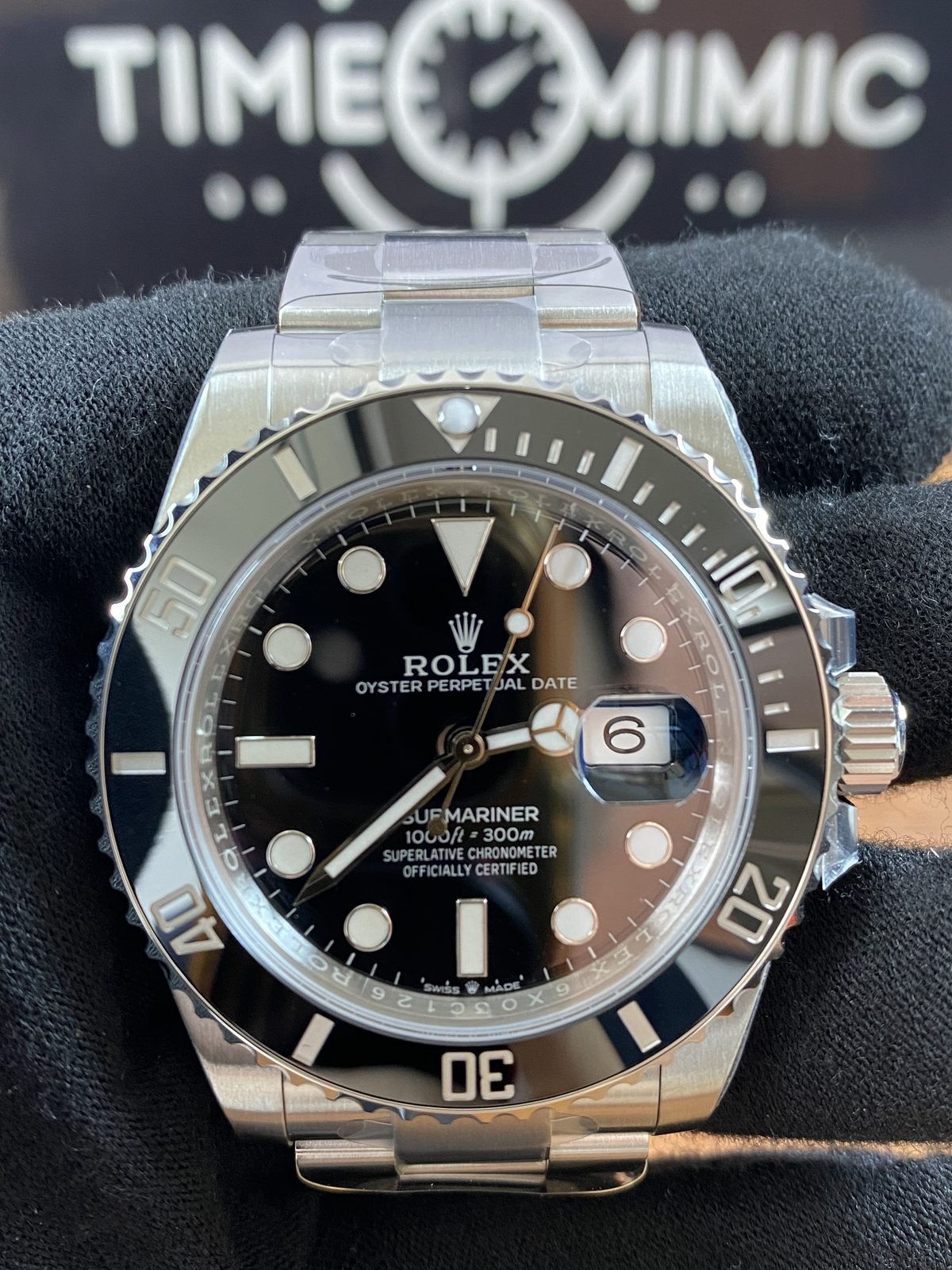
The front-view QC image below is one sample-level example. You can inspect marker position, hand clearance, printing, date placement, bezel relationship, scratches, and bracelet condition. The image cannot prove the alloy, crystal specification, movement origin, lubrication, sealing, or long-term reliability.
Use high-resolution images taken before protective film hides edges or creates false lines. Ask for the same order code beside the watch in front, side, back, clasp, and timing views. If a visible scratch, tilted marker, or date-window problem appears, pause before approval. Craftsmanship is easier to judge before shipping than after a disputed delivery.
The FTC’s marketplace guidance also recommends checking actual-item photographs, seller information, return terms, platform protection, and safer payment options. Those transaction records do not prove quality, but they help link your approval to the sample and remedy you were offered.
Testing turns claims into evidence
The finished watch should be tested after assembly because casing can change rate, function, and sealing. Independent standards show what meaningful evidence looks like. METAS watch certification covers complete-watch accuracy under defined conditions, power reserve, magnetic resistance, and water resistance. ISO 22810 specifies requirements and test methods for water-resistant watches.
A replica is not entitled to those certifications unless it actually went through the applicable authorized process. You can still ask for narrower tests on your exact sample. Keep the claims proportional to the evidence.
| Craft area | Evidence you can request | What it helps you judge | What it does not prove |
|---|---|---|---|
| Exterior geometry | Straight-on and side macro photos with order code | Alignment, gaps, edge shape, visible surface consistency | Alloy, hardness, internal tolerances, original tooling |
| Functions | One continuous video of setting, date change, pushers, bezel and clasp | Whether the photographed sample performs the shown actions | Long-term wear, shock resistance, future parts supply |
| Rate | Timegrapher readings in stated positions after adequate winding | Rate, amplitude and beat error under that setup | Movement identity, service life, all-wrist accuracy |
| Power reserve | Dated start and stop record after a stated winding method | Approximate running duration for that sample | Future consistency or efficiency under all conditions |
| Water resistance | Dated result from a competent tester with pressure and method | Whether the assembled sample passed that test at that time | Permanent protection after impact, aging, heat or opening |
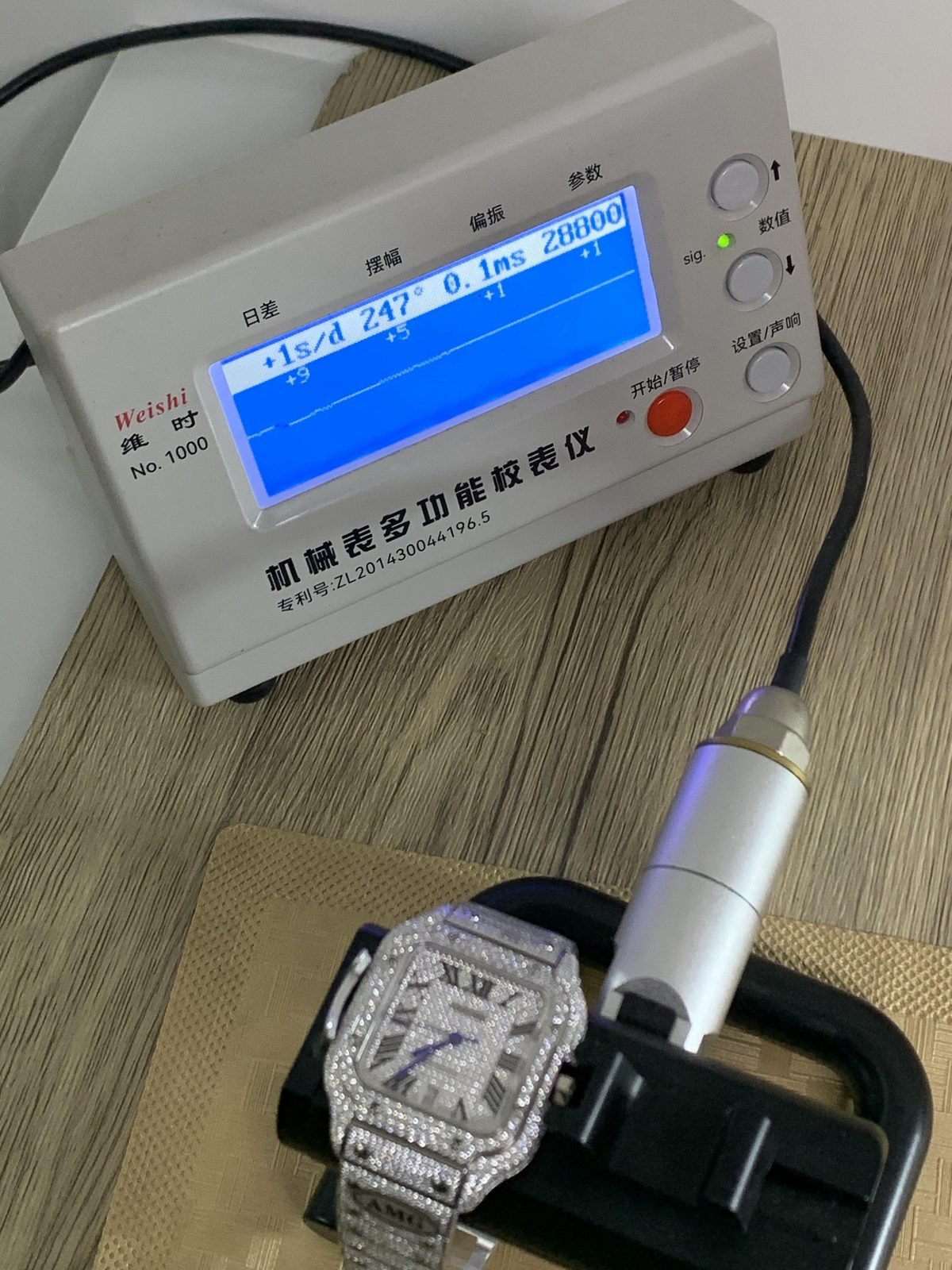
The supplied timing-machine image records one watch in one test setup. It is a visible QC example, not a universal performance claim. A timegrapher result depends on position, winding state, lift-angle setting, temperature, and test duration. Ask for several positions when accuracy matters, then compare those readings with real wear during the return period.
A waterproof replica watch description deserves special caution. A dial depth rating, screw-down crown, or gasket photograph is not a pressure test. Even a passed test is dated evidence. Gaskets age, crowns can be left open, and later service can change the seal. Keep the watch away from water unless you have reliable sample-specific results and understand the tester’s limits.
Handwork and automation both need control
Craftsmanship does not mean that every part was made by hand. Modern watch production can combine computer-controlled machining, automated inspection, manual finishing, human assembly, and final testing. The useful question is whether each process is controlled and whether defects are detected before shipment.
Rolex describes automated logistics and laboratory measurement alongside hand assembly and finishing. A Swissinfo interview about Swatch’s automated Sistem51 production explains that automated assembly still depends on trained people, image inspection, process monitoring, and tool control.
The same principle helps you evaluate super clone watches. A machine-polished case can be well executed, and a hand-finished case can be inconsistent. You need clean surfaces, stable dimensions, correct assembly, and a test record. Romantic factory stories are not a substitute for those results.
Use a sample-level craftsmanship scorecard
You do not need a microscope laboratory to organize a sensible review. Use the first table to request evidence, then score only what you can verify. Leave unknown items blank instead of giving the seller the benefit of the doubt.
| Inspection stage | Pass when | Pause when | Your next action |
|---|---|---|---|
| Reference match | The exact model, size, color, dial and bracelet are confirmed | Listing, invoice and QC show different configurations | Ask for one written configuration and a new coded QC set |
| Exterior finish | Edges, brushing, polish, gaps, printing and marker alignment are consistent | Soft case lines, uneven grain, dust, scratches or tilted parts appear | Request macro views or reject that sample |
| Functions | Crown, date, hands, bezel, clasp and complications work repeatedly | A control binds, slips, resets incorrectly or is not demonstrated | Stop approval until a continuous test is supplied |
| Movement evidence | Caliber claim, timing, power reserve and service route are documented | Only a rotor photo or unsupported Swiss claim is offered | Treat movement identity and support as unknown |
| Final risk check | Written return terms, payment protection and legal route are acceptable | Seller changes the sample, terms, parcel description or remedy | Do not pay or ship until the discrepancy is resolved |
Save the original files rather than screenshots compressed by chat apps. Keep the listing, payment record, seller terms, QC approval, tracking, and an unbroken unboxing video. The FTC’s online shopping guidance recommends checking descriptions, delivery promises, return terms, and payment protections before purchase.
Keep craftsmanship separate from brand authorization
A carefully finished replica remains a replica. Copied trademarks, serial-style markings, packaging, or paperwork do not create authorized origin. WIPO explains the legal framework around intellectual property enforcement, while customs treatment and personal possession rules vary by country.
Do not ask a seller to misdescribe the parcel, and do not present the watch as genuine when you give, insure, service, or resell it. If authentic provenance, official warranty, or future resale is central to your decision, use an authorized dealer or a reputable pre-owned route with verifiable records.
This boundary also protects your evaluation. You can appreciate case finishing, dial execution, or mechanical behavior without turning visible quality into an unsupported claim about origin. The watch earns credit only for the work and evidence you can verify.
The practical answer
The craftsmanship behind super clone watches is a chain of separate tasks: reference study, machining, surface finishing, dial and hand assembly, movement installation, casing, adjustment, and testing. The quality of that chain can vary from one piece to the next.
You can judge it without memorizing factory names. Inspect geometry before shine. Check the dial straight on. Test every control in one continuous video. Ask what movement is inside and who can service it. Treat timing, power reserve, and pressure results as dated evidence for one sample. Keep brand provenance and certification separate from visual resemblance.
When a seller can support those points, you have useful evidence for a buying decision. When the answer is only a label, a staged photograph, or a story about secret craftsmanship, you still have unanswered questions.
Looking for a Top-Tier Clone or Custom Build?
Direct access to VS, ZF, 3KF, Clean & BTF factory stock. We provide detailed multi-angle QC photo & video approval prior to final payment.