Everything You Should Know Before Buying Super Clone Watches
Verified Reddit Watch Specialist (RepTime / RepGuild)

Buying a watch from photos is easy. Buying the exact watch you think you are buying is harder. The useful question is not whether a seller calls a model "1:1," "top grade," or "best factory." It is whether you can define the configuration, inspect the actual sample, understand what has and has not been tested, and still have a workable remedy if the order goes wrong.
Quick answer: Before you approve any super clone watches, build a small evidence file for that exact sample. It should identify the model and size, show current QC, explain the movement and functions, state the tests actually performed, and record payment, return, shipping, and service terms. If the seller changes the sample or configuration, your approval should reset.

This guide gives you a practical pre-purchase process. It does not treat seller language as proof, and it does not assume that one good photograph can establish authenticity, materials, movement origin, water resistance, or long-term reliability.
Start with a dossier, not a sales description
A product page is an invitation to ask questions. Your evidence dossier is the record that lets you decide whether the answers are good enough. Save the listing, messages, photos, videos, invoice, payment receipt, and shipping terms before you pay. The FTC's guidance for online marketplaces likewise recommends checking the seller, the product description, the total cost, the return policy, and the payment method.
| Dossier section | Evidence to save | What it can prove | Stop condition |
|---|---|---|---|
| Exact configuration | Reference, size, color, bracelet, clasp, functions, and agreed substitutions | What you ordered | Any material detail remains "similar" or unspecified |
| Current sample | Date-linked photos, continuous video, and a seller identifier | Which visible watch you approved | QC is recycled, cropped, or replaced without a new approval |
| Movement and tests | Movement label, function demonstration, timing photo, and named test method | What the seller represents and what was observed once | Claims are broader than the evidence |
| Transaction terms | Seller identity, total price, payment route, return window, shipping, duties, and remedy | What happens if delivery or condition fails | The remedy depends only on trust or private promises |
The file does not make a replica watch risk-free. It simply turns a vague purchase into a series of claims you can inspect. That matters whether you are considering an automatic replica watch, a high quality replica watch advertised for daily use, or a specific Rolex super clone configuration.
1. Freeze the exact configuration before QC
Write one specification message that a seller can answer line by line. Include the model or design family, case diameter, dial color, bracelet or strap, clasp type, date or chronograph functions, and any change from the advertised configuration. A photo alone is not enough when two versions look similar but differ in thickness, bracelet fit, dial printing, or movement layout.
Ask the seller to repeat the final configuration on the invoice or order record. If a substitution is necessary, treat it as a new offer. You can accept it, decline it, or ask for new QC, but do not let the words "same quality" replace a description of what changed.
For movement claims, request a clear movement designation and a complete function map. An official maker page can show what a named caliber is designed to do. For example, Citizen Miyota publishes a 9015 product page, technical sheets, and parts information. Those documents can help you understand a claimed base caliber. They cannot prove that the movement inside your sample is genuine, unmodified, correctly assembled, or in good condition.
2. Check whether the watch will fit your wrist and routine
Case diameter is only one fit number. Ask for thickness, lug-to-lug length, bracelet or strap range, clasp length, and the approximate weight of the configured watch. Then compare those dimensions with a watch you already wear comfortably. A 40 mm case can feel very different depending on the lugs, bezel, caseback, and bracelet.
Think about your routine as well. A prominent clasp may bother you at a desk. A thick chronograph may catch a shirt cuff. A polished bracelet will show handling marks sooner than a brushed surface. These are not defects, but they affect whether the watch will earn wrist time. If a seller cannot provide dimensions, ask for photos beside a ruler or caliper and treat the numbers as seller-supplied, not independently certified.
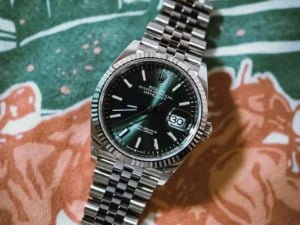
The supplied reference image below is useful for considering case shape, bezel profile, bracelet taper, and presentation. It is not current QC for a reserved sample.
3. Ask for QC tied to your exact sample
Your QC set should make it difficult to substitute a different watch. Ask for a handwritten order code, current date, or another identifier in the frame. Request front, back, both sides, crown, clasp, bracelet or strap, and close views of the dial, bezel, date window, and any visible serial or model markings. A short continuous video should show the same watch and demonstrate the functions you plan to use.
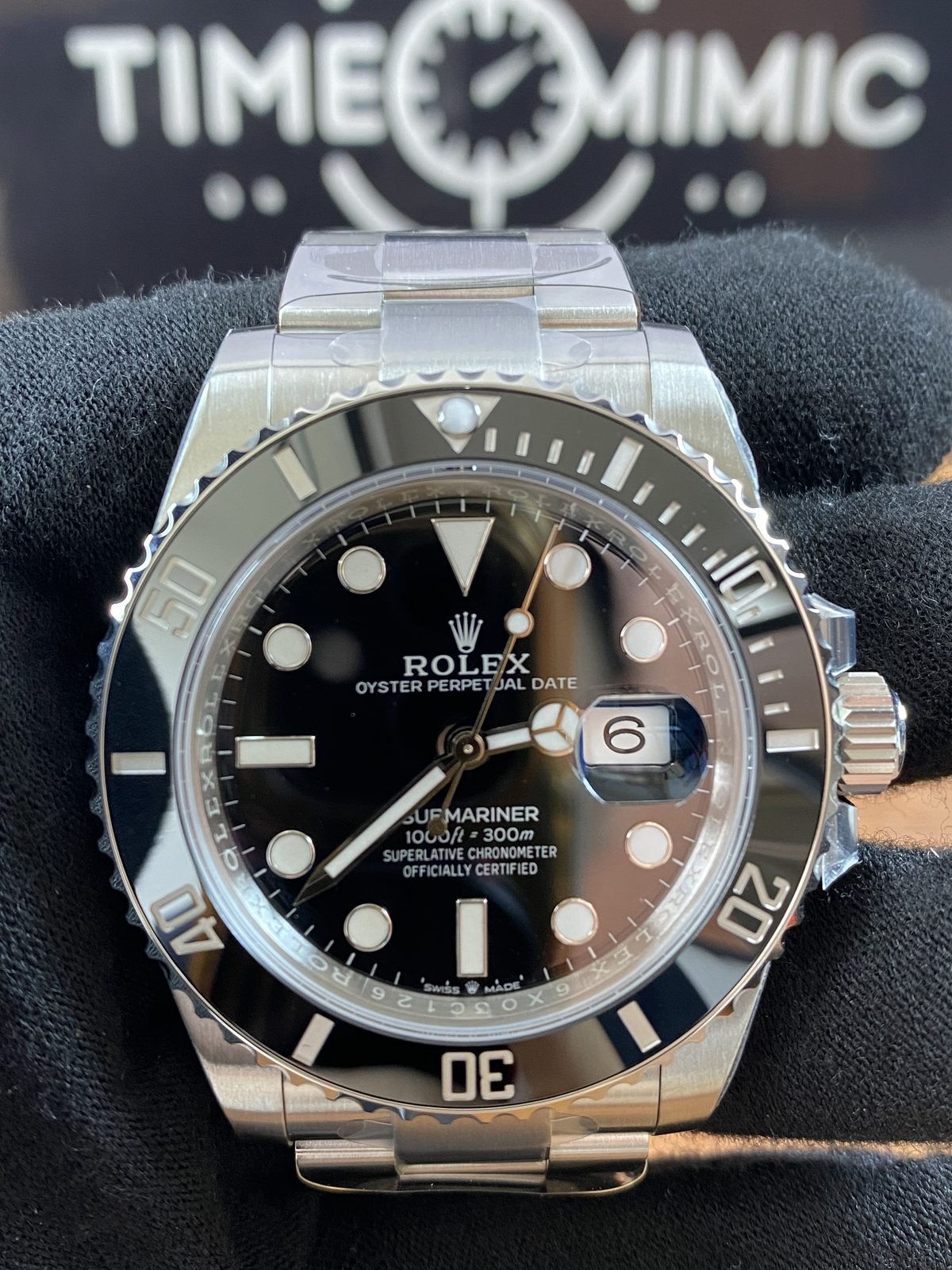
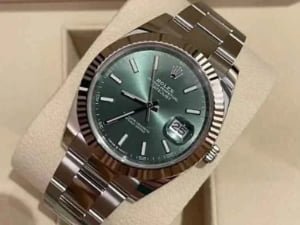
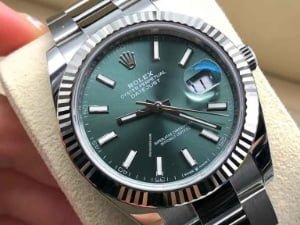
The QC image below is a visible example from one photographed sample. You can use this kind of view to inspect alignment, print placement, bezel position, hand condition, dust, scratches, and obvious handling marks. You cannot use it to prove steel grade, crystal composition, movement identity, pressure resistance, internal cleanliness, factory source, or future reliability.
Zoom in, but keep perspective in mind. A tilted camera can make markers look misaligned. Reflections can hide scratches or make dial color appear different. If one area is unclear, ask for a straight-on replacement photograph rather than trying to infer the answer.
Use a simple approval rule: approve only the pictured sample. If the seller says that sample is unavailable, your approval ends and the next sample needs its own QC. This one rule prevents a large share of avoidable disputes.
4. Separate function checks from movement identity
A working seconds hand does not identify a movement. A timegrapher screen does not identify it either. Ask the seller to demonstrate winding, time setting, date setting, hacking if claimed, chronograph start-stop-reset if present, and any GMT or calendar functions. The demonstration should match the crown and pusher sequence described for the offered watch.
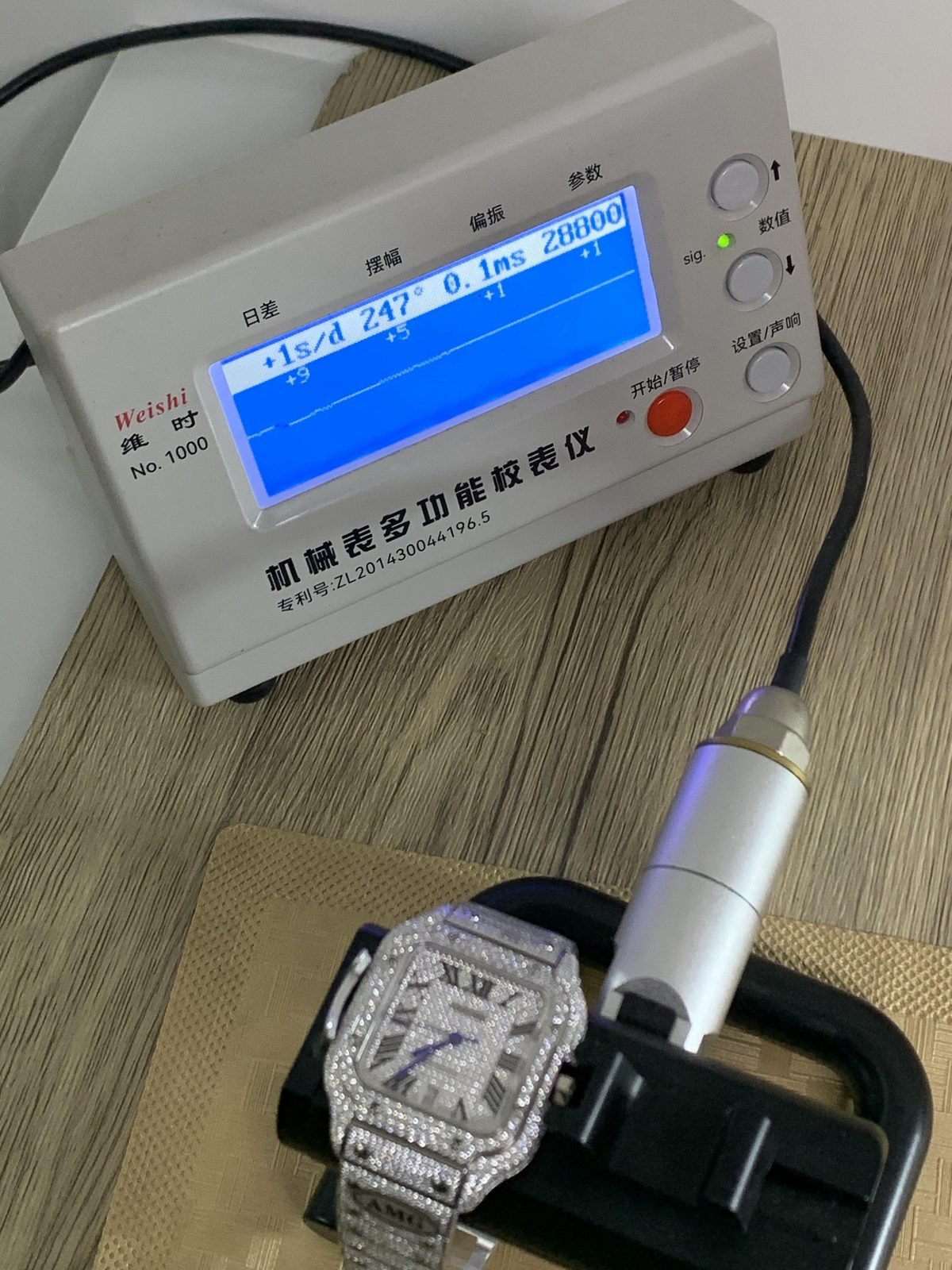
The timegrapher image below records one reading under one setup. Rate, amplitude, and beat error may help you discuss the condition of a running mechanical movement at that moment. The numbers can change with position, winding level, lift-angle setting, temperature, shock, and later regulation. They do not guarantee long-term accuracy or show who made every component.
If serviceability matters, ask what a local watchmaker is likely to encounter: a known base movement, a modified layout, or a movement with uncertain parts support. Miyota's own material on mechanical movements and the caliber 90 series is a useful reference for the official product family, but your sample still needs its own evidence.
5. Treat every test claim as a narrow statement
Words such as waterproof, antimagnetic, and chronometer are easy to overread. Ask what was tested, on which sample, with which equipment, at what setting, and when. A pressure test on your finished sample is more useful than a generic water-resistance promise. Even then, it records one test at one time.
ISO 22810 covers water-resistant watches, while ISO 6425 concerns divers' watches. A seller's informal claim is not the same as testing or certification to either standard. METAS also publishes a watch certification service and technical requirements for its own programs. Those documents show how controlled certification differs from an isolated seller photo.
Unless you have reliable sample-specific test evidence, keep the watch away from water. Have seals and pressure resistance checked by a competent watchmaker before swimming, and repeat the check after case opening or service.
6. Plan service before you need it
Ask who can service the movement, whether routine parts are available, whether the case can be opened without special tooling, and what the seller will do if the watch arrives non-running. Get the answer in writing. A promise of "free service" has limited value if you must pay risky international shipping twice or if the seller excludes the exact fault you experience.
A practical service plan may be modest: a local watchmaker willing to inspect the watch, a known movement family with documented parts, and a budget for regulation or basic repair. If no one near you will work on replica watches, factor that into the purchase before payment. The purchase price is not your full ownership cost.
7. Verify the seller and payment route
Search the seller's name, domain, email, payment account, and phone number with terms such as complaint, refund, scam, and review. Read recent reviews across independent sources and look for repeated details rather than a perfect average score. The FTC explains how to evaluate online reviews, including signs of suspicious patterns and incentives.
Confirm the seller's identity and contact route. In the United States, the INFORM Consumers Act imposes disclosure and verification duties on certain high-volume third-party sellers, but a disclosure badge still does not guarantee product quality.
Choose a payment method with a documented dispute process. The Consumer Financial Protection Bureau explains how to dispute a credit-card charge and when a refund dispute may apply. Protections depend on the payment type, issuer, location, timing, and facts. Do not assume a bank transfer, cryptocurrency payment, or friends-and-family transfer has the same remedy.
8. Read the return, shipping, customs, and legal terms
Get the full delivered price, dispatch window, carrier, tracking method, insurance terms, customs responsibility, and return address before paying. Ask what happens if the parcel never arrives, arrives damaged, differs from the approved sample, or is held by customs. The FTC has separate guidance for orders that never arrive and billing for items you did not receive.
Replica watches can raise trademark, import, and seizure issues. Rules and enforcement vary by country and route. The European Commission's customs guidance describes EU controls involving counterfeit and pirated goods. The OECD's work on counterfeiting and the Swiss economy documents broader economic and enforcement concerns, and WIPO maintains information on intellectual-property enforcement. Check the law that applies to you. A seller's promise of "safe customs" is not legal advice or a guarantee.
| Before approval | After arrival | If evidence fails |
|---|---|---|
| Save the listing, final specification, QC set, invoice, and written remedy | Film the sealed parcel, label, opening, and first function check in one continuous sequence | Stop using the watch, preserve packaging, photograph the fault, and contact the seller promptly |
| Confirm total cost, payment protection, dispatch window, tracking, duties, and return address | Compare the serial or sample identifier, configuration, visible condition, and functions with approved QC | Follow the written dispute timeline and payment-provider procedure |
| Record what tests were actually performed on the exact sample | Arrange independent inspection or pressure testing before relying on risky claims | Do not open, alter, or repair the watch before documenting the issue unless safety requires it |
A one-message purchase specification you can use
Send a compact request before payment. It should be specific enough to produce a yes, no, or corrected offer:
- Confirm the exact design, size, dial, bracelet or strap, clasp, and functions.
- State the movement designation and show how every claimed function operates.
- Provide current QC of the exact sample with my order code visible, including a continuous function video.
- List each test performed on this sample and the result. Do not replace a test result with a general claim.
- State the total delivered price, dispatch time, carrier, tracking, duties, and customs responsibility.
- State the return window, return address, who pays shipping, and the remedy for non-delivery, damage, wrong configuration, or a non-running watch.
- Confirm that any sample or configuration change requires my approval again.
If the seller refuses to answer material questions, that is useful information. You do not need to solve every uncertainty by taking more risk.
Final answer
The best preparation before buying super clone watches is not memorizing factory rankings. It is controlling the evidence for one exact sample and one transaction. Define the configuration, measure the fit, verify visible QC, separate function checks from movement identity, narrow every testing claim, plan service, and document the remedy before payment.
You may still decide that the design, price, and expected use make sense for you. If so, your approval should say exactly what you accept and what you do not know. That approach gives you a clearer decision than labels such as luxury replica watch or best replica watches, and it leaves you with a usable record if the delivery does not match the agreement.
Looking for a Top-Tier Clone or Custom Build?
Direct access to VS, ZF, 3KF, Clean & BTF factory stock. We provide detailed multi-angle QC photo & video approval prior to final payment.